



When sourcing PE protective film in bulk, most procurement managers encounter two pricing structures: price per kilogram (kg) and price per square meter (m²). On the surface, kilogram pricing feels familiar—a single number that’s easy to compare across competing suppliers. But that simplicity is deceptive. Kilogram pricing hides critical variables: material density, film thickness, thickness tolerance, and the presence of UV stabilizers or fillers that shift density without improving performance. The result? You may receive far fewer usable square meters per dollar than you expected. This article explains how to convert between both pricing models, identifies the traps in kg-based quotes, and gives procurement professionals a practical checklist to evaluate offers fairly. Whether you’re sourcing ACP protective film or profile protective film, understanding the underlying math is your first line of defense against overpaying.
Why Kilogram Pricing Feels Simple—But Isn’t
Kilogram pricing is intuitive. You receive a roll, weigh it, and multiply by the per-kg rate. No geometry, no film width calculations, no thickness gauges required. This is why bulk commodity buyers often default to it.
The problem is that weight alone tells you nothing about how much surface area that film will actually cover. A heavy roll could simply mean the film is thicker than specified, uses a denser filler material, or has been blended with non-PE additives—none of which benefit the end user.
Two rolls can weigh exactly the same yet deliver 20–30% different amounts of usable protective area due to differences in density and true thickness.
The Hidden Traps in Kg-Based Quotes
Trap 1: Material Blending and Density Shifts
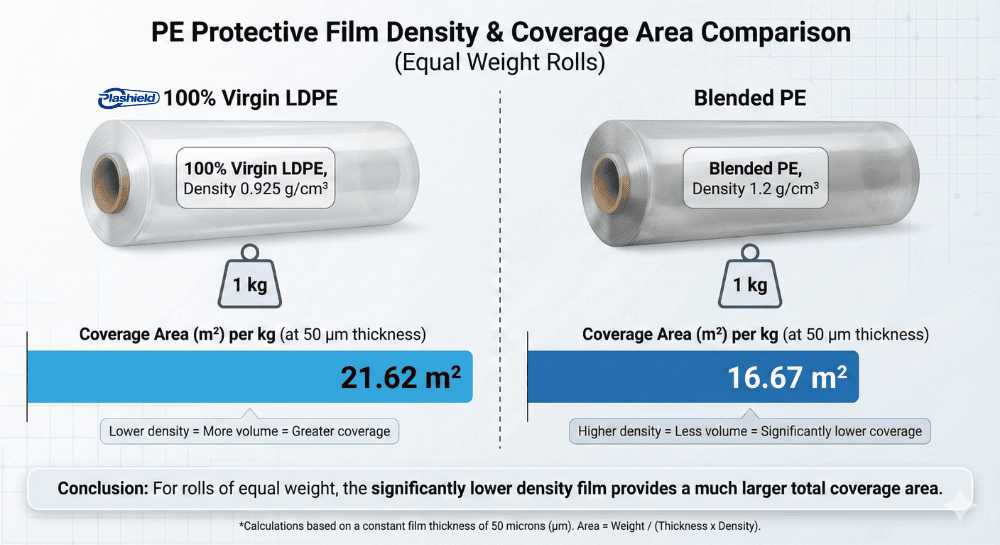
Not all “PE film” is 100% virgin polyethylene. Lower-grade suppliers blend recycled content, calcium carbonate fillers, or cheaper polymers into their film compound. These additives increase density—sometimes from the standard ~0.920–0.925 g/cm³ for LDPE up to 1.2 g/cm³ or higher.[epstec]
When you pay per kilogram, a denser film delivers fewer square meters per kilogram than you would expect. The quoted price looks competitive, but you’re getting less coverage for the same weight. The difference is invisible without a COA (Certificate of Analysis) confirming material composition.
Trap 2: Negative Thickness Tolerance
“Negative thickness tolerance” refers to how much thinner than nominal a film is allowed to be at the time of shipment. A film labeled as 60 µm with a −10% tolerance can legally ship at just 54 µm.[epstec]
A thinner film means less mass per unit area—which, when buying by weight, means you appear to receive more square meters per kilogram. This makes low-cost film look area-efficient on paper. But in practice, a thinner film offers less scratch resistance, lower adhesive consistency, and weaker UV protection—all problems that surface downstream.
For protective films used on architectural aluminum or ACP façades, even a 6 µm underrun can lead to surface damage claims during transportation or installation.
Trap 3: Downgraded UV Performance
UV-stabilizer packages add raw material cost. Suppliers cutting margins often reduce UV additive loading invisibly—the film weighs the same, but degrades far faster under sunlight.[plashield]
For any outdoor or construction application, UV resistance is non-negotiable. Inadequate UV stabilization causes the adhesive to degrade, the film to embrittle, and removal to become difficult—leaving residue on expensive coated surfaces. This risk is entirely hidden in a kilogram price with no supporting UV aging report.
The Only Fair Comparison: The Four-Variable Framework
Regardless of whether a quote is per kg or per m², a fair comparison must lock down all four variables:
- Material type – 100% virgin LDPE/LLDPE vs. blended or recycled content
- Density – The actual g/cm³ of the film compound (must appear in the COA)
- Nominal thickness – In microns (µm) or millimeters (mm)
- Thickness tolerance – Expressed as ±X µm or ±X%
Without all four confirmed in writing, no kg-based quote is meaningfully comparable to any other.
The Conversion Formula: Mass, Density, and Area
The core relationship between mass, density, and area is straightforward.[epstec]
Formula: Mass per unit area (g/m²) = Density (g/cm³) × Thickness (µm) × 0.0001 × 10,000
Simplified:
Mass per m² (g/m²) = Density (g/cm³) × Thickness (µm) × 0.1
Coverage (m²/kg) = 1,000 ÷ [Density (g/cm³) × Thickness (µm) × 0.1]
Here are three worked examples using standard LDPE at a certified density of 0.925 g/cm³:
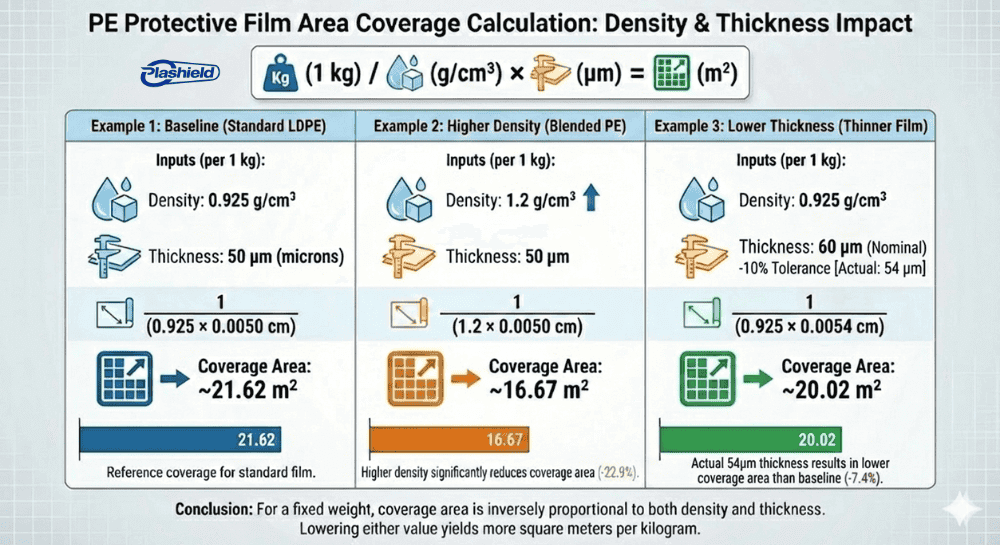
Example 1 — 50 µm virgin LDPE film (standard ACP or window application)
Mass per m² = 0.925 × 50 × 0.1 = 4.625 g/m² → × 10 = 46.25 g/m²
Coverage per kg = 1,000 ÷ 46.25 = ≈ 21.6 m²/kg
→ At $2.00/kg, true cost = ≈ $0.093/m²
Example 2 — 60 µm film with −10% negative tolerance (ships at 54 µm)
Mass per m² = 0.925 × 54 × 0.1 = 49.95 g/m²
Coverage per kg = 1,000 ÷ 49.95 = ≈ 20.02 m²/kg
→ You receive 7.3% fewer m² than nominal 60 µm would imply at the same kg price
Example 3 — Blended PE film at density 1.2g/cm³, same 50 µm nominal
Example 3 — Blended PE at density 1.2 g/cm³, 50 µm nominal
Mass per m² = 1.2 × 50 × 0.1 = 60 g/m²
Coverage per kg = 1,000 ÷ 60 = ≈ 16.67 m²/kg
→ Compared to Example 1 (21.6 m²/kg), you receive 22.8% fewer m² per kilogram—completely invisible from the price alone.
Summary Table
| Example 1 | Example 2 | Example 3 | |
|---|---|---|---|
| Density | 0.925 g/cm³ | 0.925 g/cm³ | 1.2 g/cm³ |
| Thickness | 50 µm | 54 µm (nominal 60 µm, −10%) | 50 µm |
| g/m² | 46.25 g/m² | 49.95 g/m² | 60 g/m² |
| m²/kg | ≈ 21.6 m²/kg | ≈ 20.02 m²/kg | ≈ 16.67 m²/kg |
| vs. Example 1 | Baseline | −7.3% | −22.8% |
*When density increases from 0.925 g/cm³ to 1.2 g/cm³—a rise of approximately 29.7%—coverage per kilogram drops from 21.6 m²/kg to just 16.67 m²/kg, representing a loss of more than ONE-FIFTH of usable area. This clearly demonstrates the enormous hidden cost of density variation when purchasing by kilogram.
Kg vs. m² Pricing: When Each Is Fair
| Pricing Basis | Fair When… | Watch Out For… |
|---|---|---|
| Per kg | Density and thickness are certified in writing via COA + gauge report | Density variation from fillers; recycled content blends |
| Per m² | Thickness tolerance is explicitly stated (e.g., ±3 µm or ±5%) | Vague “nominal” claims with no stated tolerance band |
| Per kg | Buying commodity film with no surface-critical end-use spec | Comparing rolls from suppliers using different base resins |
| Per m² | Surface-specific film (ACP, profiles, glass, painted metals) | No data on adhesive coat weight disclosed alongside coverage |
| Either basis | Supplier provides full COA, UV aging test result, and batch report | Either basis accepted without any supporting documentation |
What to Look for in a Reliable Manufacturer
When evaluating a PE protective film manufacturer, the difference between a trustworthy long-term partner and a cost-cutting supplier comes down to documentation and process discipline.
Plashield, established in 2004, manufactures 100% virgin PE protective film and serves over 60 countries across more than 20 years of continuous operation. Their strict thickness control program and UV resistance testing reflect exactly the kind of process rigor that makes square-meter pricing reliable—because certified specifications mean you know precisely what your roll delivers per kilogram paid.
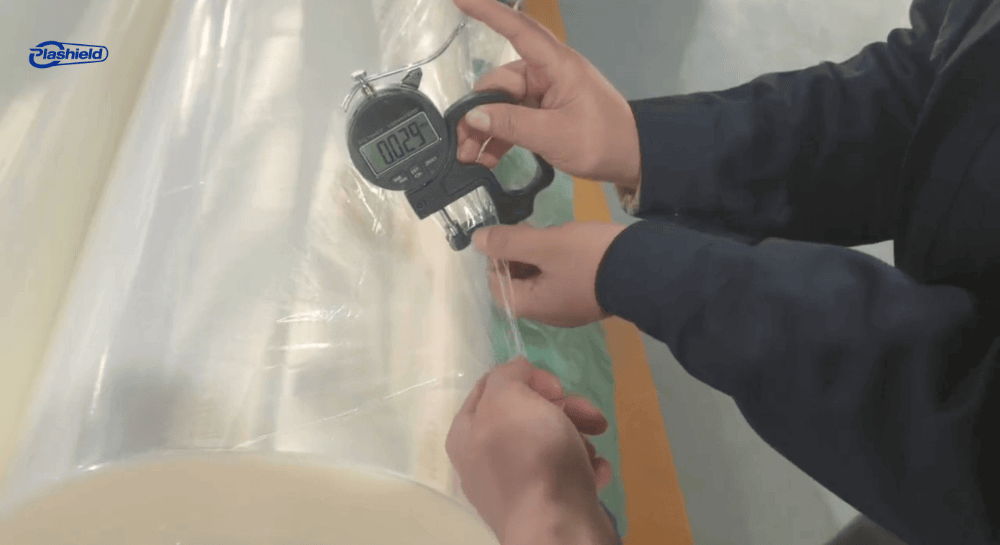
Key attributes to demand from any supplier before placing an order:
- 100% virgin PE resin — No recycled blends or calcium carbonate filler additions that shift density
- Certified density value — Specified in g/cm³ in the COA for every production batch
- Thickness tolerance within ±5% — Confirmed by a third-party or in-house gauge measurement report
- UV aging specification — Minimum 200–500 hours per ASTM D4329 or equivalent, with documented adhesive retention
- Roll geometry disclosure — Width, core diameter, and meters per roll stated explicitly so m² can be verified independently
- Traceability — Batch number and production date printed or labeled on every roll
Suppliers who resist providing any of these documents are likely unable to guarantee consistent output—meaning your kg-based price is being built on unverified variables.
Procurement Checklist: Avoid Being Tricked
Use this checklist before accepting any PE protective film quote, regardless of whether it is priced per kg or per m²:
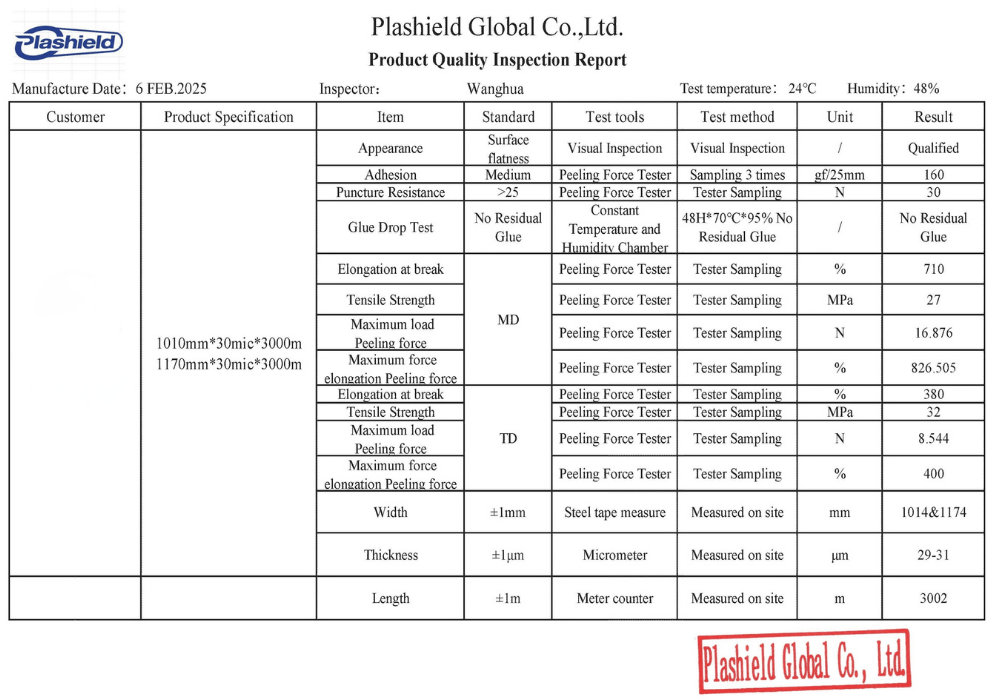
- COA (Certificate of Analysis) — Confirms resin type, density (g/cm³), and additive content by batch
- Thickness Report — States nominal thickness AND documented tolerance (±µm or ±%)
- UV Aging Test Report — Shows hours of UV exposure and adhesive/tensile retention result
- Density Confirmation — Exact g/cm³ value explicitly written, not implied or estimated
- Roll Geometry Specs — Width, core ID, and length per roll (enables independent m² calculation)
- Adhesive Coat Weight — Especially critical for ACP protective film and profile protective film where clean, residue-free removal is required
Practical Recommendation
For commodity applications with no strict surface-protection spec, kilogram pricing is acceptable—provided density and thickness are confirmed in writing before order placement. For any surface-critical application—architectural aluminum, ACP façades, painted profiles, glass—always request m² pricing or convert the kg price yourself using the formula above before signing a purchase order.
If you’re unsure which specification applies to your surface, request a sample with a full technical datasheet and run a simple area yield test: weigh the sample, measure its area, and calculate coverage per gram. Any credible manufacturer will support and encourage this process.
Get a Transparent Quote for Your Application
Tell us your surface type (ACP, aluminum extrusion, glass, stainless steel, or painted metal), the required film thickness range, and your project’s square meter volume. We’ll provide a density-verified, tolerance-confirmed quote—with full COA and UV aging documentation your engineering and procurement teams can rely on.
Contact Plashield today at plashield.com and send your specs for a fair, fully documented PE protective film quote.
❓ FAQs
Q1: What is the standard density of PE protective film, and why does it matter?
Standard LDPE protective film has a density of approximately 0.920–0.925 g/cm³. LLDPE ranges from 0.915 to 0.940 g/cm³, while blended or filled films can exceed 0.950 g/cm³. Density directly determines how many square meters of PE protective film you receive per kilogram purchased—making it the single most important variable to verify in any supplier COA.[epstec]
Q2: How do I convert PE protective film pricing from per kg to per square meter?
Use the formula: Coverage (m²/kg) = 1,000 ÷ (Density g/cm³ × Thickness µm × 0.1). For example, 50 µm virgin LDPE at 0.925 g/cm³ yields approximately 21.6 m²/kg. Multiply your kg rate by grams per m² to find your true cost per square meter—critical for accurate comparison across PE protective film suppliers.[epstec]
Q3: What does “negative thickness tolerance” mean in PE film specifications?
Negative thickness tolerance means a film can be manufactured thinner than its stated specification without being considered non-conforming. A 60 µm PE film with −10% tolerance can ship at 54 µm. This reduces protective performance and adhesive consistency while inflating apparent area yield per kilogram, making inferior protective film appear deceptively cost-efficient to buyers pricing by weight.
Q4: Is 100% virgin PE film significantly better than recycled PE for surface protection?
Yes, for any surface-critical application. Virgin PE provides consistent density, predictable UV aging behavior, and clean adhesive performance. Recycled or blended PE film introduces variable density, potential contaminants, and inconsistent tack—raising the risk of surface damage, adhesive residue, or premature film failure on ACP panels, coated aluminum profiles, and high-gloss surfaces.plashield+1
Q5: What UV resistance standard should I require for outdoor PE protective film?
For construction or outdoor applications, request a UV aging test report showing at least 200–500 hours of exposure per ASTM D4329 or an equivalent standard, with documented retention of adhesive tack and tensile strength post-exposure. Reputable PE protective film manufacturers including Plashield provide these reports as part of standard product qualification documentation.plashield+1
Q6: When is square meter pricing always preferable to kilogram pricing?
Always request m² pricing for surface-specific applications: ACP protective film, window film, painted profile film, and glass protective film. Per-square-meter pricing obligates the supplier to commit to a defined, verifiable coverage area—eliminating density variation and tolerance manipulation from the equation and making the true cost per protected surface directly and honestly comparable across bidders.plashield+1