



Adhesive ghosting on a No. 4 brushed stainless steel panel after six months of outdoor storage is not a film failure — it is a specification failure. Choosing the wrong tack level or leaving PVC film on a surface beyond its removal window causes adhesive transfer that grinding cannot fully reverse. This guide helps stainless steel sheet manufacturers, metal fabrication procurement managers, and architectural panel distributors select the correct PE protective film grade by process type, surface finish, and exposure duration. Plashield has manufactured PE protective film since 2004 and supplies to 60+ countries.
Why Film Material Is Only Half the Decision
Most buyers frame the selection question as PE or PVC. That framing misses two variables that determine whether a film protects cleanly or creates a rework problem.
The three variables that actually control performance are: base film material, adhesive type, and tack level. A PE film with the wrong tack level on a mirror-polished No. 8 surface will leave residue just as reliably as a PVC film. Conversely, a correctly specified low-tack PE film on a 2B finish stainless sheet will peel cleanly after six months of transit and outdoor storage without any adhesive transfer.
The difference in adhesive types has a greater impact: PVC films typically use solvent-based adhesives containing plasticizers, which can migrate to the stainless steel surface when exposed to heat or UV light; PE films use water-based acrylic adhesives, which completely prevent plasticizer migration.
The correct selection sequence is therefore: confirm surface finish type → select tack level → confirm processing method → confirm outdoor exposure duration → select thickness and weather resistance grade.
PE vs. PVC for Stainless Steel — The Real Differences
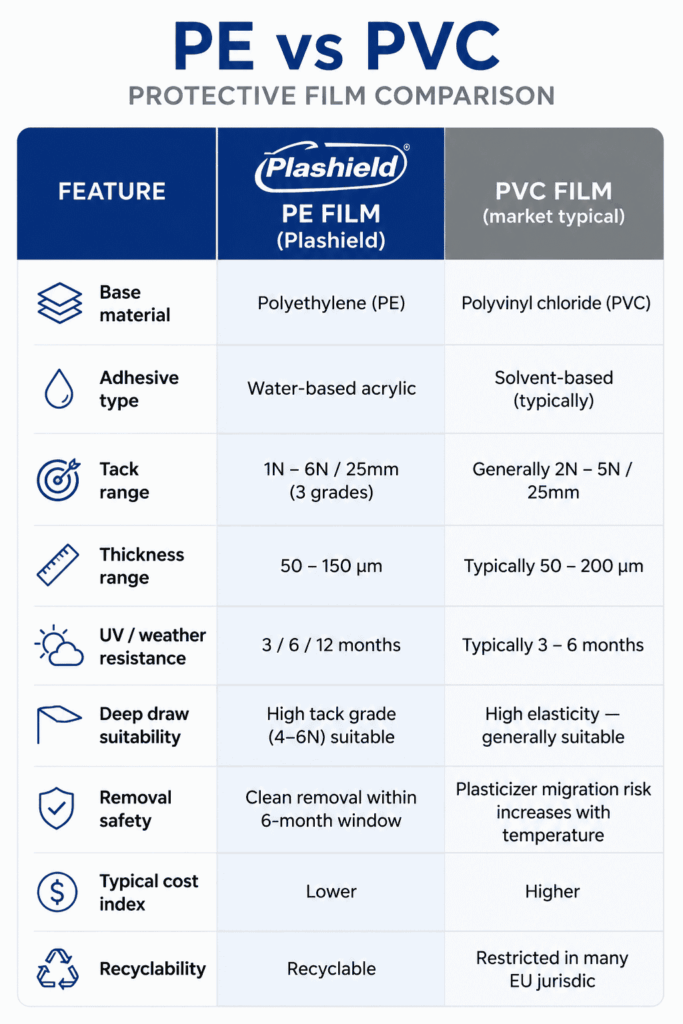
The comparison below uses confirmed production data for Plashield PE film. PVC data reflects general market specifications; Plashield produces PE film only.
| Feature | PE Film (Plashield) | PVC Film (market typical) |
| Base material | Polyethylene (PE) | Polyvinyl chloride (PVC) |
| Adhesive type | Water-based acrylic | Solvent-based (typically) |
| Tack range | 1N – 6N / 25mm (3 grades) | Generally 2N – 5N / 25mm |
| Thickness range | 50 – 150 μm | Typically 50 – 200 μm |
| UV / weather resistance | 3 / 6 / 12 months | Typically 3 – 6 months |
| Deep draw suitability | High tack grade (4–6N) suitable | High elasticity — generally suitable |
| Removal safety | Clean removal within 6-month window | Plasticizer migration risk increases with temperature |
| Typical cost index | Lower | Higher |
| Recyclability | Recyclable | Restricted in many EU jurisdictions |
PVC protective films rely on phthalate plasticizers to achieve flexibility; common examples include DEHP, DBP, BBP, and DIBP.
The actual risk lies in the fact that under high-temperature conditions (such as inside shipping containers during summer, where temperatures often exceed 60°C), phthalate plasticizers in the PVC film can migrate from the adhesive layer to the stainless steel surface, causing contamination that requires chemical cleaning to remove.
Water-based acrylic adhesive PE protective films contain no plasticizers, and the adhesive system remains chemically stable within the typical temperature range of ocean shipping. Unlike solvent-based PVC adhesives, their clean peel performance is not affected by temperature, allowing for easy removal upon arrival at the destination.
Matching Tack Level to Your Stainless Steel Process
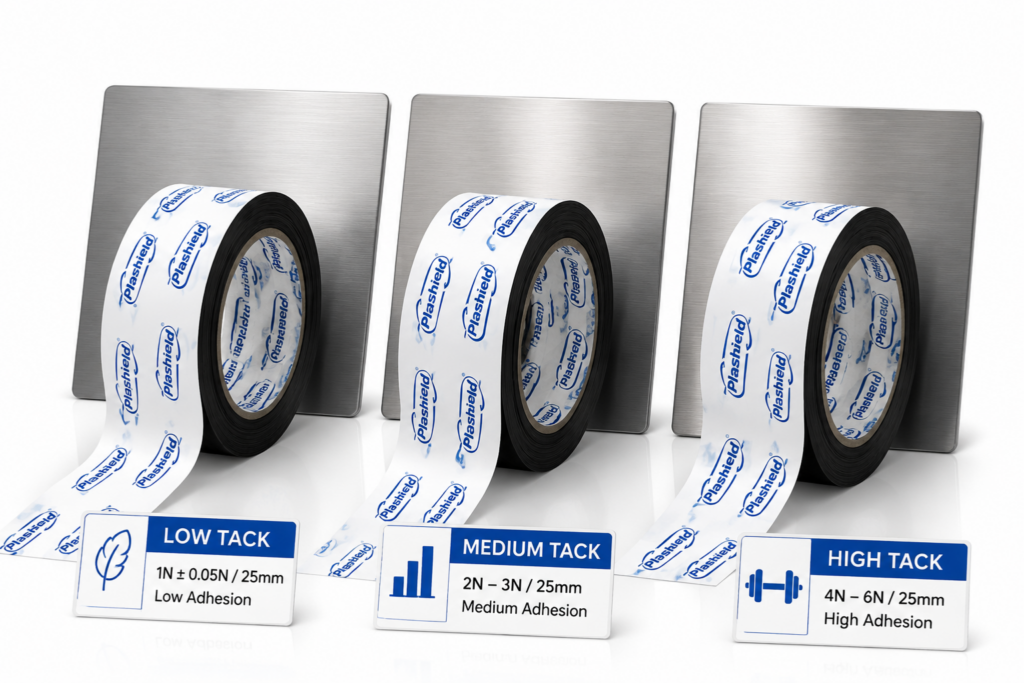
Tack level is the single most under-specified variable in stainless steel film procurement. The table below maps Plashield’s three confirmed tack grades to surface type and processing method. All values are per ASTM D3330 peel adhesion test standard.
| Tack Grade | Peel Adhesion (ASTM D3330) | Surface Type | Processing Method | Recommended Thickness |
| Low tack | 1N ± 0.05N / 25mm | No. 8 mirror polish; No. 4 brushed; BA finish | Transit protection; light handling; indoor storage | 50 – 75 μm |
| Medium tack | 2N – 3N / 25mm | 2B cold-rolled; No. 4 brushed; hairline finish | Bending; roll forming; standard stamping; outdoor storage | 75 – 100 μm |
| High tack | 4N – 6N / 25mm | 2B cold-rolled; hot-rolled No. 1 finish | Deep drawing; heavy stamping; high-abrasion fabrication | 100 – 150 μm |
Three rules govern tack selection for stainless steel specifically.
First, mirror-finish surfaces (No. 8 polish) require low tack without exception. The polished oxide layer has high surface energy, which causes even medium-tack adhesive to bond more aggressively than the nominal value suggests. Plashield recommends low tack (1N ± 0.05N / 25mm) for all No. 8 and BA finish applications regardless of processing intensity.
Second, outdoor storage duration drives weather resistance grade selection, not just tack level. A medium-tack film on a 2B finish panel stored outdoors for three months requires a different film grade than the same specification stored for twelve months. Plashield supplies 3-month, 6-month, and 12-month outdoor weather resistance grades across all tack levels.
Third, remove all film within six months of application. Beyond six months, water-based acrylic adhesive begins to cross-link with the stainless steel oxide layer under UV and humidity cycling. This is not a Plashield-specific limitation — it is a characteristic of acrylic PSA chemistry on high-energy metal surfaces generally. Plashield’s confirmed removal window is six months maximum for all grades.
Thickness Selection — 50 μm to 150 μm Decision Guide
Thickness controls scratch resistance and elongation at break. The correct thickness for a given application depends on the mechanical stress the film must absorb during processing and transit.
50 – 75 μm is appropriate for transit and indoor storage protection on finished stainless steel sheets. At this thickness, the film resists light abrasion from stacking, handling, and packaging contact. It is not designed to withstand sustained mechanical deformation. Plashield’s 50 μm grade is the standard specification for stainless steel sheet distributors protecting product between warehouse and end-customer delivery.
75 – 100 μm covers standard fabrication environments — bending, roll forming, and mild stamping operations. At 75–100 μm, the film maintains integrity through 90° bending on standard press brake tooling without tearing or delaminating at the bend radius. This is the most common specification for stainless steel kitchen equipment and architectural panel fabricators.
100 – 150 μm is the correct range for deep drawing, heavy stamping, and any process where the film must stretch with the metal substrate without tearing. Deep drawing of stainless steel sink blanks, for example, subjects the film to elongation forces that a 50 μm film cannot sustain. At 100–150 μm with high tack (4–6N / 25mm), Plashield PE film is designed to maintain surface adhesion and structural integrity through the full draw cycle. Per ASTM D882, tensile properties at this thickness range provide sufficient elongation at break for standard deep-draw ratios.
Plashield Stainless Steel PE Protective Film
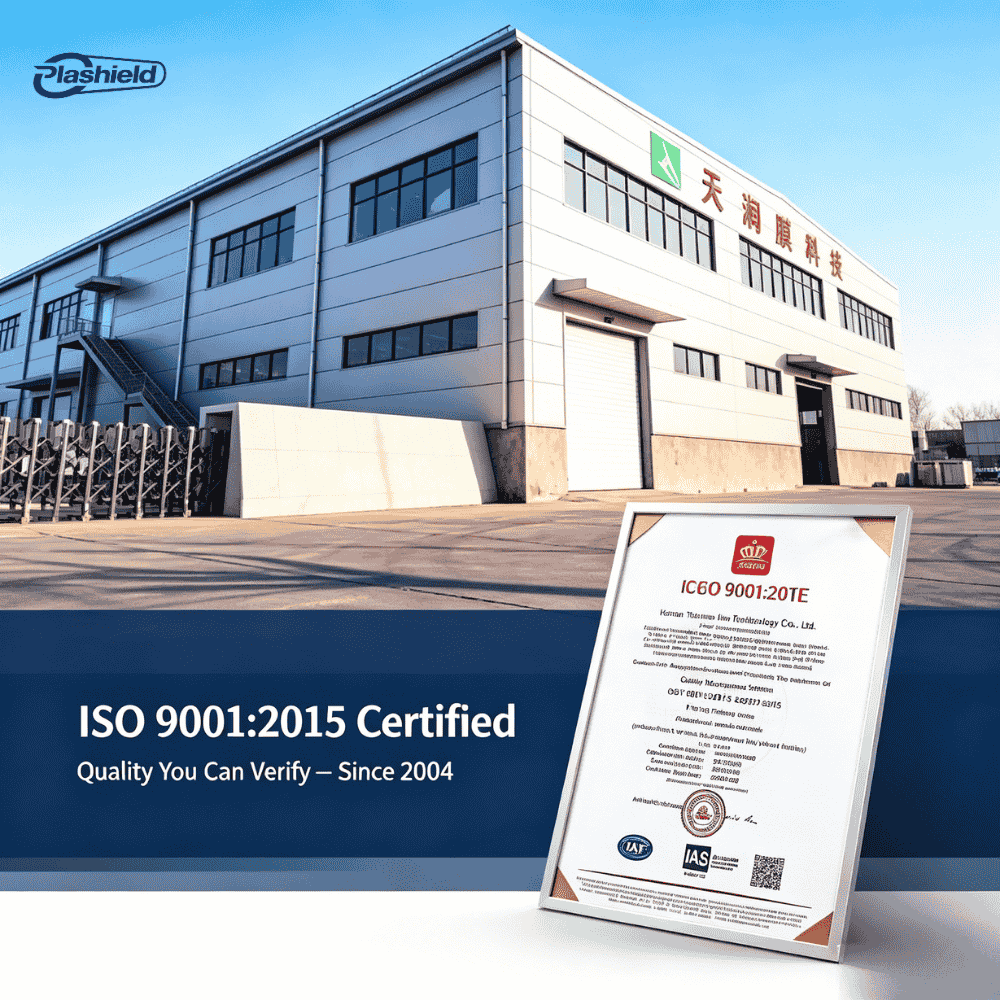
Plashield is the export brand of Henan Tianrun Film Technology Co., Ltd. The company is a manufacturer of polyethylene (PE) protective films, established in 2004 in Xinxiang City, Henan Province, China. The factory operates eight high-speed integrated production lines covering the entire process from film blowing to coating and slitting. Its product range spans nine major categories, with an annual production capacity of 200 million square meters.
All PE protective films specifically designed for stainless steel are manufactured in accordance with the ISO 9001:2015 quality management system. Plashield protective films exclusively use water-based acrylic pressure-sensitive adhesives (PSA); no solvent-based adhesives are used in any product grade, ensuring that the adhesive layer contains no phthalate plasticizers.
This product has undergone independent testing and received certification in accordance with the RoHS Directive. The scope of testing includes: lead, mercury, cadmium, hexavalent chromium, polybrominated biphenyls (PBB), polybrominated diphenyl ethers (PBDE), and four types of phthalate plasticizers. Upon customer request, this certificate can be included in the supplier qualification audit documentation package.
Standard product specifications:
- Adhesive: Water-based acrylic PSA
- Tack levels: Low (1N ± 0.05N), Medium (2–3N), High (4–6N) — per ASTM D3330
- Thickness: 50 – 150 μm
- Outdoor weather resistance: 3 months / 6 months / 12 months
- Film removal window: Within 6 months of application
- MOQ: 5,000 m² (standard) | 10,000 m² (custom printed logo)
- Customization: Width / thickness / color / logo print
Plashield supplies stainless steel protective film to fabricators, distributors, and OEM manufacturers across 60+ countries .Full product specifications for stainless steel grades are available at plashield.com.
FAQ
Q1: Why does PE film outperform PVC for most stainless steel applications today?
The core issue is plasticizer migration under heat. PVC film requires phthalate plasticizers — such as DEHP or DBP — to achieve its flexibility. During long-haul ocean freight, container interior temperatures regularly exceed 60°C in summer. At these temperatures, plasticizers migrate from the PVC adhesive layer into the stainless steel surface, embedding contamination into brushed or polished finishes that chemical cleaning cannot always fully reverse. PE film uses water-based acrylic adhesive, which contains no plasticizers. The adhesive system remains chemically stable at container shipping temperatures, and clean-removal performance at the destination is not affected by transit heat exposure. Beyond the migration issue, PE film is recyclable in standard polyethylene waste streams. PVC film is not accepted in most industrial recycling programs due to chlorine content, which adds disposal cost for fabricators processing high film volumes. For stainless steel sheet manufacturers supplying kitchen equipment, architectural cladding, or food processing equipment buyers, these two factors — predictable clean removal after heat-exposed transit, and simplified waste disposal — make PE the practical default specification for most standard applications.
Q2: What tack level should I use for mirror-finish (No. 8 polish) stainless steel?
Mirror-finish stainless steel requires low tack (1N ± 0.05N / 25mm) in all applications without exception. The No. 8 polishing process creates a highly reflective oxide layer with elevated surface energy. High surface energy increases the actual bond strength of any adhesive beyond its nominal tack value — a medium-tack film that performs correctly on a 2B cold-rolled surface will over-bond on No. 8 mirror polish under the same conditions. This means that even short transit periods with medium-tack film on mirror-polished surfaces carry a meaningful risk of adhesive residue on removal. Plashield’s low-tack grade at 1N ± 0.05N / 25mm is calibrated specifically for high-energy metal surfaces including No. 8, BA, and electropolished stainless steel finishes. For mirror-finish panels destined for architectural or decorative applications, the low-tack 50–75 μm grade is the standard recommendation.
Q3: Can Plashield PE film handle deep drawing of stainless steel without tearing?
Deep drawing subjects the protective film to significant elongation and shear stress as the metal blank is drawn into the die. The film must stretch with the stainless steel substrate without delaminating or tearing at the draw radius. Plashield’s high-tack grade (4–6N / 25mm) at 100–150 μm thickness is designed to maintain adhesion and structural integrity through standard deep-draw operations on stainless steel blanks. The high tack value prevents the film from lifting at the flange area during the draw stroke, which is the most common failure mode when under-specified film is used. Water-based acrylic adhesive maintains consistent bond strength during the mechanical deformation cycle without the adhesive fracturing or transferring. For deep-draw applications, Plashield recommends requesting a sample set of the high-tack 100μm and 150μm grades and conducting a press trial before committing to full-volume orders.
Q4: How long can Plashield PE film stay on stainless steel before removal becomes difficult?
Plashield’s confirmed maximum on-surface duration is six months from the date of application for all tack grades. Beyond six months, water-based acrylic PSA undergoes progressive cross-linking with the stainless steel oxide layer driven by UV exposure, humidity cycling, and temperature variation. This cross-linking increases the effective peel force required for removal above the nominal tack value and can result in adhesive residue on the surface. The six-month limit applies regardless of storage conditions — indoor storage slows the cross-linking rate but does not eliminate it. For projects with extended timelines such as architectural cladding installations or building envelope work where panels may be stored on-site for months before installation, Plashield recommends scheduling film application as close as possible to the final installation date, or selecting a film that is replaced at the six-month mark rather than left in place through the full construction timeline.
Q5: Is Plashield stainless steel PE film RoHS compliant for EU export products?
Yes. Plashield PE protective film is tested and certified under the RoHS framework (Certificate No. UTLR21057021C01), confirming that the film and its water-based acrylic adhesive are free from lead, mercury, cadmium, hexavalent chromium, PBB, PBDE, and phthalate plasticizers including DEHP, BBP, DBP, and DIBP. While RoHS Directive 2011/65/EU applies specifically to electrical and electronic equipment rather than to protective film as an industrial consumable, many buyers in the kitchen equipment, food processing, and architectural sectors require their material suppliers to hold this certification as part of their own supply chain compliance documentation. The certificate is available on request and can be included in supplier qualification packages.