



Every procurement manager in the color steel or sandwich panel industry knows the cycle. A shipment arrives, production runs smoothly, and then—six to eight weeks later—the next reorder conversation begins. Freight arrangements, lead time checks, warehouse intake, line changeovers. And if the timing slips even slightly, panels sit unprotected on the yard, exposed to dust, scratches, and weather. The invisible costs accumulate: rework labor, surface touch-ups, client complaints, delayed deliveries.
The question that rarely gets asked is this: what if your protective film lasted twice as long as your current supplier’s? What if one procurement cycle covered two full seasons instead of one?
This article answers that question using verified performance data, a transparent procurement cost model, and real customer evidence from Plashield—a PE protective film manufacturer established in 2004, operating 8 high-speed production lines with an annual capacity of 200 million square meters, holding 20+ patents, and currently exporting to 60+ countries across more than 20 industries.
The UV Degradation Problem Nobody Talks About
Direct Answer: Yes, 3μm PE film CAN achieve 6-month UV resistance—but only when formulated with 100% virgin resin and proprietary UV stabilizers, as demonstrated by Plashield’s internally tested products. Most commodity PE films cannot make this claim.
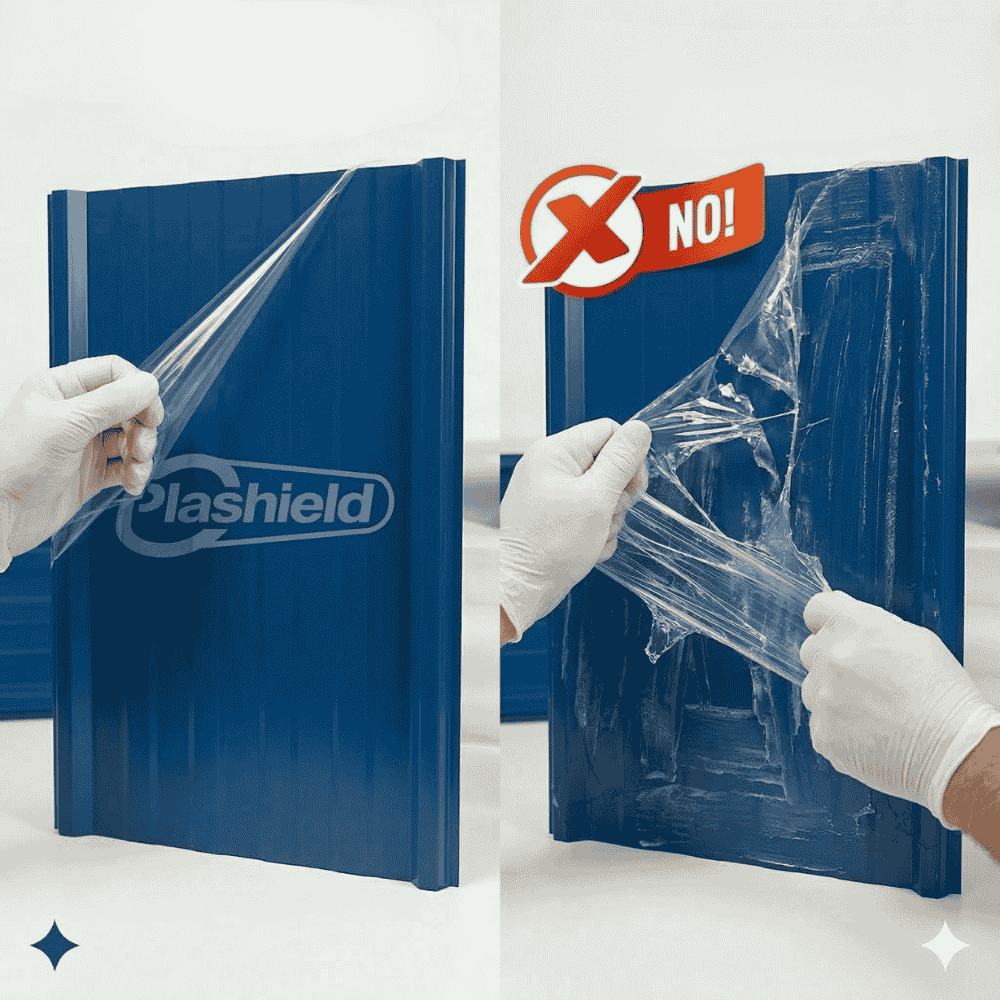
What is UV degradation in PE protective film? UV aging (UV degradation) refers to the breakdown of a film’s polymer chains and adhesive system when exposed to ultraviolet radiation—causing brittleness, adhesive residue transfer onto the protected surface, and spontaneous delamination before the film is intentionally removed. For procurement managers, UV degradation translates to one practical outcome: the film fails before the panel reaches its end destination.
A color-coated steel panel stored outdoors for 90 days with a film that degrades at 60 days is an unprotected panel for the final 30 days of that journey. That is not a theoretical risk—it is a documented failure mode reported consistently across Plashield’s international customer base.
Why do most PE films only last 1–3 months outdoors? The answer comes down to three formulation shortcuts that reduce manufacturing cost at the expense of field performance:
- Recycled or blended PE resin — introduces inconsistent polymer structure, accelerating UV-induced chain scission and adhesive breakdown
- No UV stabilizer loading — without HALS (Hindered Amine Light Stabilizers) or UV absorbers, the film has no chemical defense against photodegradation under sustained solar exposure
- Formulation compromise for margin compression — thin adhesive coat weights and low-grade additive packages that perform adequately indoors but fail rapidly under outdoor UV intensity
What are the quantified consequences of premature film failure? Based on industry experience reported by color steel and sandwich panel fabricators, rework costs associated with protective film failure—including surface cleaning, recoating, or panel rejection—typically range from USD 2–8 per affected panel, depending on coating type and surface finish. For a production batch of 5,000 panels, that range represents USD 10,000–40,000 in unplanned rework exposure.
(Note: These are conservative estimates based on industry experience values reported by Plashield customers. Individual costs vary by factory, coating type, and surface specification.)
Source: Industry experience values reported by Plashield customers across color steel and sandwich panel applications.
What Makes Plashield’s 3μm Film Different
Common Question: Can a 3μm film really deliver 6-month UV resistance—isn’t thinner always weaker?
Clear Answer: Film thickness and UV resistance are separate and independent performance dimensions. UV resistance is determined by resin purity, UV stabilizer type, and loading concentration—not by thickness alone. Plashield’s 3μm film achieves ≥6 months outdoor UV resistance through a proprietary UV additive formulation applied to 100% virgin PE resin, validated through internal UV aging tests. Thickness governs mechanical properties such as puncture resistance and tear strength. UV resistance governs how long the film retains those properties outdoors.
Virgin PE resin is defined as polyethylene produced from new, unrecycled raw material—free from contaminants, polymer degradation products, or density-shifting fillers that compromise UV stability and adhesive performance. Plashield uses 100% virgin PE across all production lines with zero recycled content and zero calcium carbonate filler.
The technical differentiation of Plashield’s 3μm UV-resistant film rests on four pillars:
1. Proprietary UV Additive Formulation
Plashield’s 3μm UV-resistant film incorporates a proprietary UV stabilizer package engineered to maintain adhesive stability, film integrity, and clean removability under prolonged outdoor UV exposure. The specific formulation details are protected under Plashield’s 20+ patent portfolio. What is confirmed through testing: the film maintains stable peel adhesion and residue-free removability for a minimum of 6 months under standard outdoor exposure conditions.
2. 8-Line Full Supply Chain Production Consistency
Plashield operates 8 high-speed production lines covering film blowing, printing, and coating—an integrated supply chain that eliminates inter-batch formulation variance. Every roll of 3μm UV film is produced under identical resin sourcing, additive loading, and process parameters. Batch-to-batch consistency is not an assumption—it is a structural outcome of vertically integrated manufacturing.
3. 20+ Patent Technologies
Plashield’s formulation and process innovations are protected by 20+ patents, covering adhesive system development and UV-resistance enhancement techniques. This intellectual property investment is the reason the 6-month outdoor performance standard is not easily replicated by commodity film producers operating without equivalent R&D infrastructure.
4. Certified Quality Management
Plashield holds ISO9001, CNAS, CE, RoHS, and IEC-62321 certifications—institutional validation of its manufacturing quality system and an auditable framework that supports the test documentation procurement teams require.
📋 Evidence Block
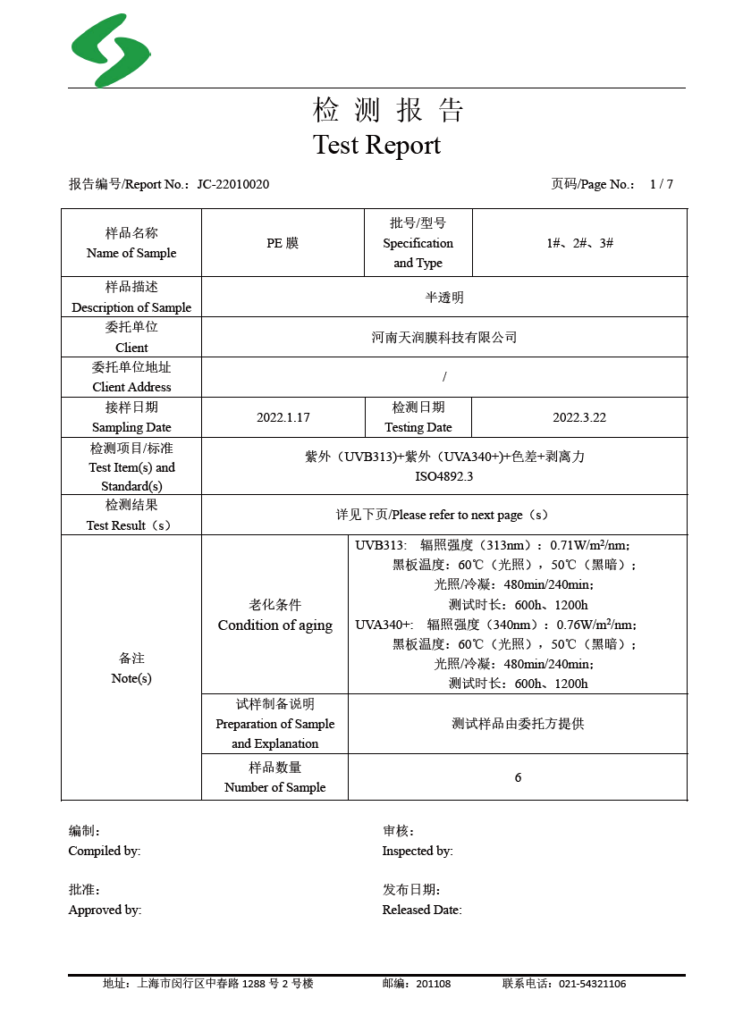
Plashield’s 3μm UV-resistant PE film has been validated through internal UV aging tests to maintain stable adhesion and clean removability for a minimum of 6 months under standard outdoor exposure conditions.
Peel adhesion retention, visual inspection, and residue assessment results are documented per batch. Test report available upon request.
Source: Plashield internal UV aging test report
The Specification Problem — Why “UV Resistant” Means Nothing Without a Duration
Common Question: Every supplier I speak to claims their PE film is “UV resistant.” How do I know which one is actually telling the truth?
Clear Answer: The phrase “UV resistant” without a defined duration, tested surface type, and stated exposure conditions is commercially meaningless. A film that survives 30 days of UV exposure qualifies as “UV resistant.” So does a film that survives 180 days. The label is identical. The performance is not.
This is the specification gap that costs factories money—not because they overpay per roll, but because they select the wrong UV duration category for their actual application timeline. A film rated for 60-day outdoor exposure applied to panels destined for a 90-day storage cycle will fail in the final 30 days. That failure generates adhesive residue, surface damage, and rework cost. The film was technically “UV resistant”—it simply was not UV resistant enough for the specific use case.
What does responsible UV specification actually look like? A credible UV-resistant PE film supplier should be able to answer three questions before you place an order:
- What is the tested UV duration for this specific grade? — Stated in days or months, under a defined test method (e.g., ASTM G154 or equivalent outdoor exposure protocol)
- Under what surface and coating conditions was that duration validated? — PVDF, polyester, SMP, HDP, glass, and stainless steel all present different UV stress environments to the adhesive system
- What are the observable failure criteria? — At what point does adhesion retention drop below acceptable levels, and what does that look like on your specific substrate?
If a supplier cannot answer all three questions with documented test data, their UV resistance claim is a marketing statement, not a performance specification.
How Plashield Specifies UV Resistance — By Application Scenario
Most suppliers offer a single “UV grade” film and apply it across all outdoor use cases. Plashield’s approach is different: UV resistance is specified by application scenario, with separate formulations developed for indoor, semi-outdoor, and fully outdoor exposure conditions.
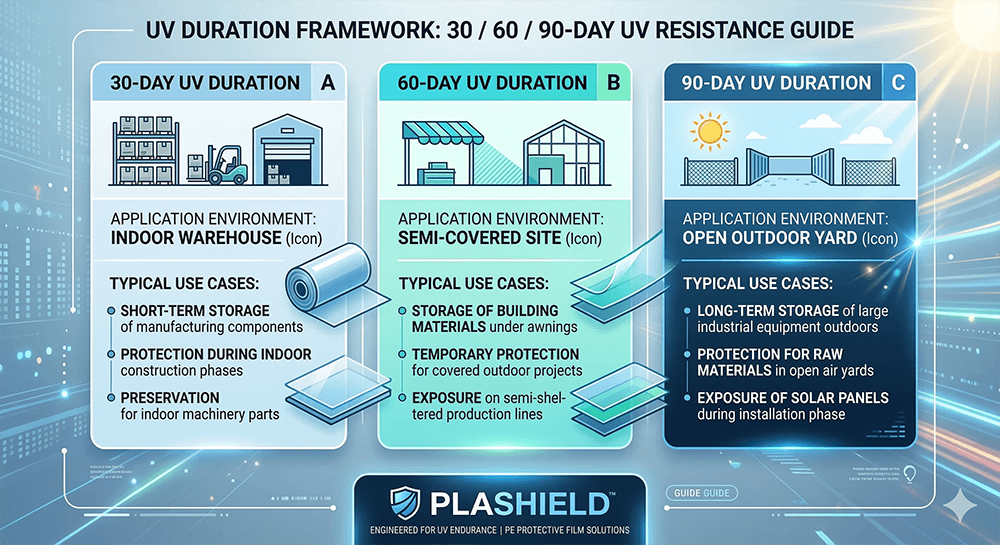
The practical output of this approach is a clear UV duration guidance framework:
| UV Duration Grade | Intended Application | Typical Use Cases |
|---|---|---|
| 30-day UV | Indoor / semi-covered storage | Factory-to-factory transfer, covered warehouse staging, short-cycle domestic distribution |
| 60-day UV | Semi-outdoor / partial exposure | Covered job sites, seasonal outdoor storage with intermittent exposure, short sea freight routes |
| 90-day UV | Full outdoor / sustained exposure | Open yard storage, international sea freight, construction site installation phases, high-UV destination markets |
This framework solves the core procurement problem: you select the grade that matches your project timeline—not the highest grade available, and not the cheapest grade on the market.
Selecting a 30-day UV film for a 90-day outdoor application creates failure and rework cost. Selecting a 90-day UV film for a 30-day indoor application creates unnecessary unit cost. Neither outcome serves the factory’s interest. Matching the UV duration specification to the actual application timeline is the correct procurement decision—and it requires a supplier who can define those categories clearly.
Adhesive Behavior Under UV Stress — Why Surface Matching Matters
Common Question: If two films both claim 90-day UV resistance, are they interchangeable across different coating types?
Clear Answer: No. UV resistance duration is a film-level specification. Adhesive behavior under UV stress is a surface-compatibility specification. They are not the same measurement.
A film may maintain its structural integrity for 90 days under UV exposure, but if its adhesive formulation is not matched to the specific surface coating—PVDF, polyester, SMP, HDP, glass, or brushed stainless steel—the adhesive may still transfer residue, increase peel force beyond safe removal thresholds, or delaminate prematurely under the specific thermal and UV stress conditions that coating presents.
Plashield’s UV-resistant formulations are developed with adhesive behavior matched to surface coatings under UV stress conditions. This means:
- The peel force profile remains within the clean-removal window throughout the stated UV duration—not just on day one
- The adhesive does not chemically interact with PVDF fluoropolymer or polyester resin surfaces under sustained UV and heat exposure in ways that compromise clean removal
- The tack level is calibrated to the surface energy of the specific coating type, not applied as a universal standard across all substrates
Source: Plashield internal UV aging test report. Test reports specifying surface type, UV duration, and adhesion retention results available upon request.
Real-World Evidence — What Customers Say
Common Question: Is there independently verifiable evidence that Plashield’s UV-resistant film performs as documented across different geographies and climate conditions?
Clear Answer: Yes. Plashield has published customer case studies from multiple high-UV-exposure markets where outdoor weatherability was a documented primary selection criterion. These are not marketing narratives—they are published case records with stated client challenges, film specifications developed, and outcome results.
Published customer case studies from Plashield’s verified client base include the following markets where outdoor UV performance was a confirmed requirement:
- Australia — Window and door profile protection application. Customer feedback documented as “no residue after outdoor use” in Plashield’s published case record. (Source: Plashield customer feedback, Australia)
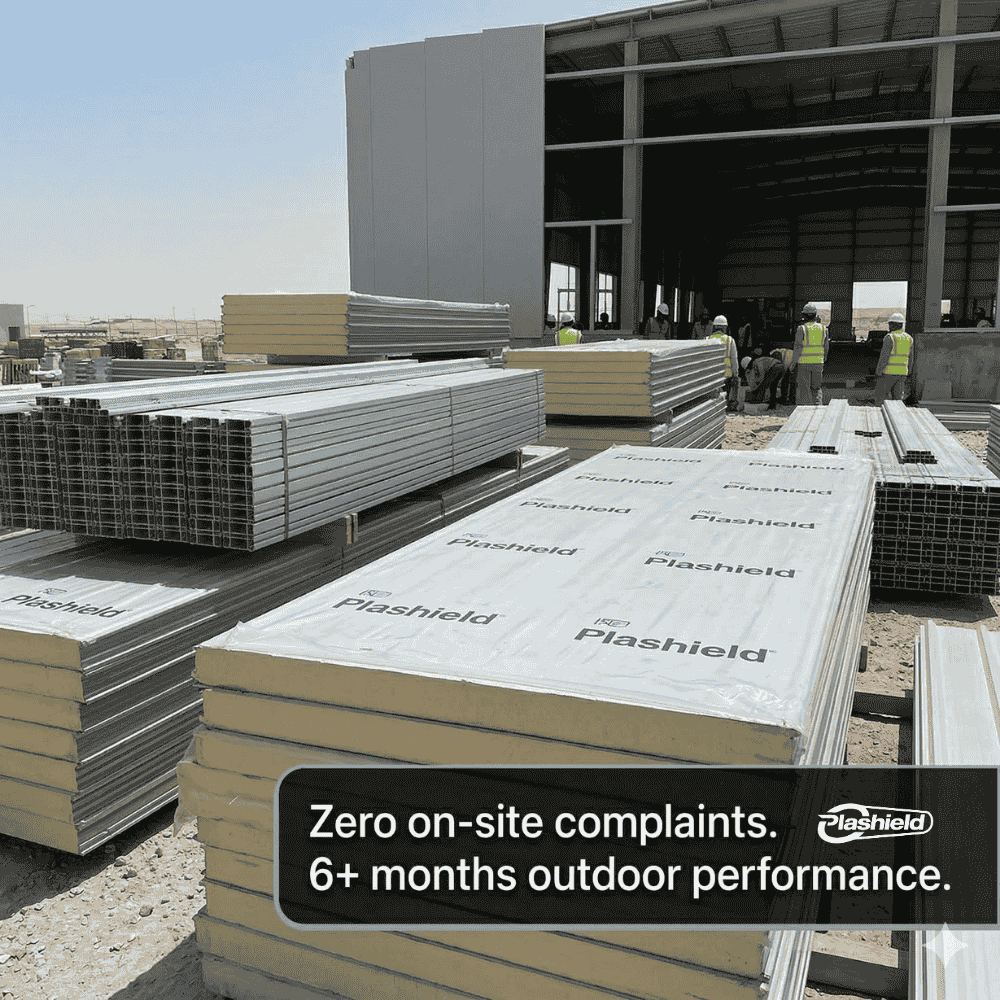
- Saudi Arabia — Metal sandwich panel manufacturer requiring custom ultra-thin film development for extreme heat and high UV intensity conditions. Outcome: zero on-site complaints since March 2024, with documented improvements in production efficiency and logistics cost. (Source: Plashield customer case, Saudi Arabia, 2024)
- Israel, Brazil, Mexico, Netherlands, Ireland, Uzbekistan — Additional published case engagements across diverse climate zones, coating types, and surface applications. Full case library available at plashield.com/solution.
The consistent pattern across all documented cases: Plashield’s film was selected specifically because standard-market alternatives failed to deliver residue-free removal after extended outdoor exposure. UV performance was not evaluated as a premium feature. It was the baseline functional requirement that existing suppliers could not meet.
For customers evaluating color coated steel protective film or ACP protective film with outdoor exposure periods exceeding 90 days, the test report is the starting point—not the endpoint—of supplier qualification. To obtain a UV aging test report for a specific Plashield film grade, contact the team at plashield.com with your surface type and required exposure duration.
Source: Plashield customer feedback, Australia and Saudi Arabia markets, 2024.
Is This Film Right for Your Application?
Use this checklist to determine whether Plashield’s 3μm UV-resistant PE film products are the correct specification for your operation:
✅ ACP protective film for façade panels with extended job-site storage — PVDF and polyester coatings demand residue-free removal after UV-heavy exposure; adhesive transfer onto PVDF is a costly remediation that UV-stabilized film prevents
✅ Profile protective film for aluminum window and door manufacturers exporting to high-UV markets — the combined sea transit and destination warehouse storage cycle in markets such as the Middle East, Australia, Brazil, and Southeast Asia routinely creates 4–6 month total exposure windows
✅ Color coated steel protective film for roofing and cladding panels with uncertain delivery timelines — a 6-month UV resistance buffer absorbs schedule slippage without creating surface exposure risk at the receiving site
✅ Window glass protective film for architectural glass panels stored or installed in direct sunlight — glass surfaces combined with high UV reflectivity accelerate adhesive degradation in standard film; UV-stabilized film prevents adhesive haze and residue bonding to the glass surface during extended outdoor exposure
✅ Stainless steel protective film for decorative or structural stainless steel components in outdoor construction projects — stainless steel used in façades, handrails, and cladding is often exposed for months before final installation; standard film that degrades in UV conditions leaves adhesive contamination on polished or brushed stainless finishes that requires abrasive correction
✅ Export manufacturers with annual film volumes ≥ 50,000 m² — at this scale, reducing procurement rounds from 4× to 2× per year delivers measurable freight and operational savings; customers who inspect panels or profiles on arrival also carry reduced rejection risk when film integrity is maintained throughout transit
❌ STANDARD FILM IS MORE APPROPRIATE:
❌ Indoor short-cycle applications with ≤30 days turnover — UV-enhanced specification adds unit cost without delivering functional benefit when no outdoor UV exposure occurs at any stage
❌ Controlled factory-to-factory transfers with no outdoor storage or transit — where the film is applied and removed entirely within covered facilities, standard PE film is the more economical choice
❌ Very low volume procurement (< 5,000 m² per order) — the logistics savings generated by reducing procurement frequency are minimal relative to any unit price differential at this order scale
Get the Right Film Spec for Your Surface — Free Technical Consultation
If your factory stores finished panels outdoors for more than 60 days, ships product to markets with high UV exposure, or has experienced residue or film failure after extended application periods—this is a specification conversation worth having before your next procurement cycle.
The right answer is not always the UV-enhanced grade. But for outdoor applications with exposure periods exceeding 90 days, defaulting to standard film because it costs less per roll is a decision that typically costs more in total.
Send the following details to Plashield’s engineering team for a free technical consultation and sample evaluation:
- Surface material — coating type (PVDF, polyester, SMP, HDP), texture (smooth, embossed, matte, high-gloss)
- Storage or transit environment — indoor warehouse / outdoor yard / sea freight container / construction site
- Estimated UV exposure duration — total months from film application to planned removal
- Country or region of destination — determines ambient UV index and temperature range for spec recommendation
- Annual consumption volume (m²) — determines whether procurement frequency reduction delivers meaningful logistics savings for your operation
The team will review your application requirements, confirm whether the 3μm UV-resistant grade is the correct specification, recommend the appropriate color coated steel protective film or profile protective film grade, and arrange a free sample for on-surface compatibility testing on your actual coating type.
Contact the PE protective film manufacturer trusted by clients in 60+ countries: plashield.com