



A procurement manager reviews three quotes for a 500,000 m² PE protective film order. All three suppliers describe themselves as manufacturers. One owns a factory. Two resell from contract producers. The price difference is small. The supply chain risk, however, is not.
Plashield manufactures PE protective film directly, operating 8 high-speed integrated production lines since 2004. The company runs blown film, coating, and slitting processes entirely in-house. Annual production capacity reaches 200 million m² with no outsourcing at any stage.
This article explains where that distinction matters in practice. It also provides specific signals buyers can use to verify any supplier’s manufacturing status before committing to a large order.
Why the Manufacturer vs. Trader Distinction Matters More Than Price
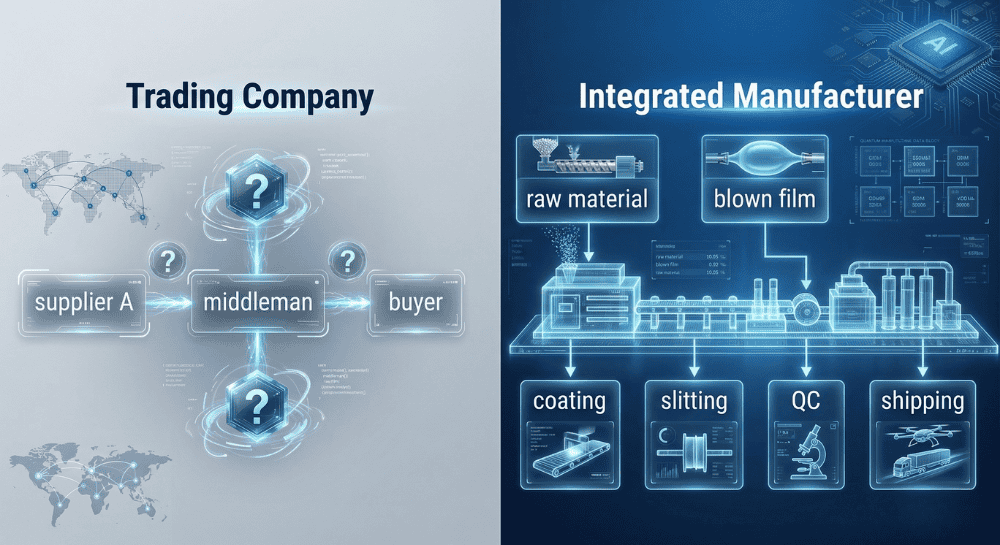
Choosing a trading company over a real manufacturer often begins with a price advantage. However, that advantage disappears when supply chain control breaks down. A trading company places your order with a contract factory they do not own. As a result, the buyer loses three controls they assumed were in place. These include batch consistency, capacity priority, and technical response capability.
Batch Consistency Across Reorders
Specifically, trading companies place reorders with whichever contract factory has available capacity. Different factories run different formulas. Therefore, adhesion level, film thickness, and surface finish can vary between batches. This creates unpredictable quality issues on the buyer’s production line — commonly observed in B2B sourcing practice.
In contrast, an integrated manufacturer runs the same formula on the same equipment for every order. The same coating weight applies to every batch. Plashield controls this directly across all 8 production lines. As a result, buyers receive consistent performance on reorder 10 exactly as on reorder .
Capacity Priority During Peak Demand
Furthermore, capacity allocation becomes a critical risk during demand peaks. When market demand spikes, trading companies compete for contract factory floor time. The factory fills its largest direct-buyer orders first. Therefore, reseller-model suppliers move to the back of the queue. Your order waits — without a guaranteed delivery date.
Plashield operates 8 production lines with 200 million m² annual capacity. The company fills orders from its own floor on its own production schedule. No contract factory queue affects your delivery timeline.
For large-volume buyers, this structural gap matters more than the unit price difference.
Plashield Manufacturing Credentials — The Specifics
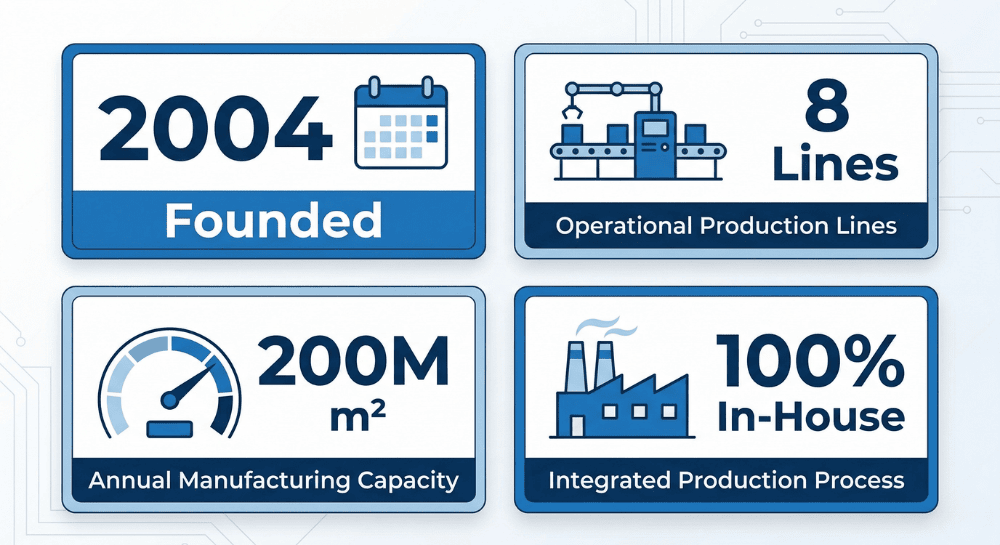
Since 2004, Plashield has built its manufacturing capability around four measurable pillars. Together, these pillars set it apart from reseller-model suppliers. Each one addresses a specific supply chain risk that trading companies cannot resolve with contracts alone.
Twenty Years of Process Knowledge
First, Plashield has manufactured PE protective film since 2004. The blown film formulas in production today are not experimental. They are production-proven across 20+ years of real application data. When a buyer introduces a new substrate, Plashield draws on that accumulated process history.
In contrast, a trading company has no process history of its own. They relay the specification to whichever factory accepts the order. That factory may or may not have experience with the target substrate. Therefore, the buyer carries the trial-and-error risk themselves.
Eight Integrated Lines and What They Deliver
Furthermore, Plashield runs 8+ high-speed integrated production lines. An integrated production line combines blown film extrusion, adhesive coating, and precision slitting under one roof. Each line handles all three processes as a single connected sequence. This eliminates quality gaps that appear when separate facilities handle each stage independently.
As a result, 8 parallel lines allow simultaneous production runs for multiple specifications. Annual production capacity reaches 200 million m². A standard import order of 500,000 m² represents 0.25% of that annual output. Plashield treats this as a routine production run — not a capacity stretch.
Full In-House Control from Resin to Roll
Most importantly, Plashield completes 100% of production in-house. No process stage goes to an external facility. Blown film extrusion is the process of extruding molten PE resin through a circular die to form a continuous film substrate. Plashield controls this stage — and every stage after it — on the same production floor. Consequently, every quality variable stays under one management team.
These four pillars form a verifiable manufacturing foundation — not a marketing claim.
How to Distinguish a Manufacturer from a Reseller
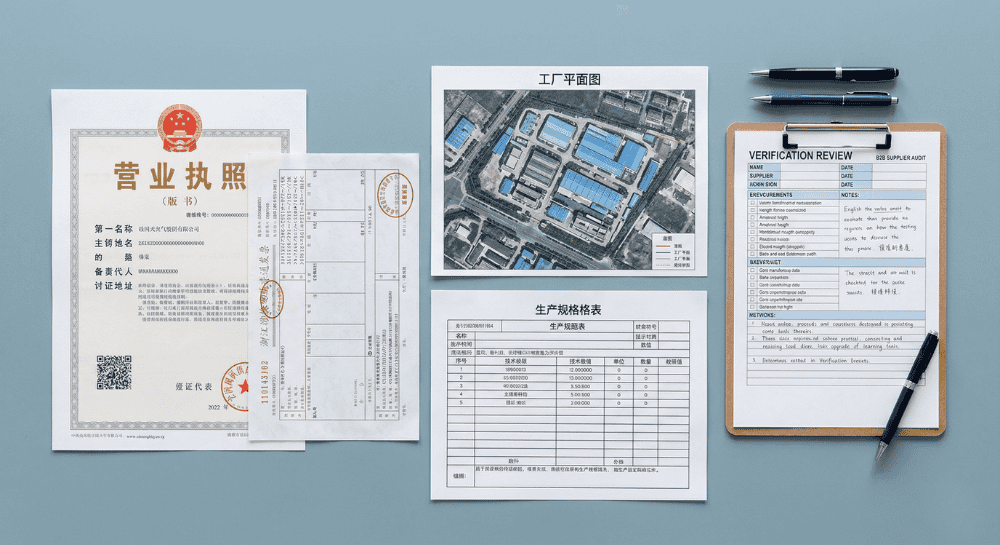
However, self-description is not evidence. Any supplier can label themselves a manufacturer on a website or trade platform. Experienced procurement managers therefore apply document-level verification — not profile-level reading. The following signals apply to any PE protective film supplier under evaluation.[Source:advantasourcing]
Business License Scope Check
First, request the supplier’s Chinese business license and examine the “Business Scope” (经营范围) section. This is the single most reliable document-level verification method available to buyers. A genuine manufacturer’s business scope explicitly includes terms such as 生产 (produce), 加工 (process), or manufacture). A trading company’s business scope will not contain these terms — regardless of what their website or sales team claims. This document cannot be counterfeited, and a real manufacturer provides it without hesitation.
Furthermore, cross-check the registered address against satellite imagery on Google Maps or Baidu Maps. A manufacturing facility sits in an industrial zone. An office building or residential address confirms a trading company model. This single check takes under three minutes and eliminates a significant number of reseller-model suppliers from further evaluation.
VAT Invoice Type as a Factory Signal
In addition, China’s tax system provides an indirect but reliable verification mechanism. Ask the supplier whether they can issue a 17% VAT manufacturing invoice (增值税专用发票). Only registered manufacturers — not trading companies — can issue this invoice type. Trading companies issue a commercial VAT invoice at a different rate. If a supplier hesitates, deflects the question, or claims this is unnecessary, they are most likely operating as a reseller. This signal is especially useful because it is grounded in Chinese tax law — not supplier self-reporting.
Product Range as a Structural Indicator
Moreover, examine the supplier’s full product catalog. Factories specialize. Their product range is narrow and technically coherent — typically variations of one product type across different specifications. A trading company, by contrast, offers broad, cross-category catalogs. If a supplier lists PE protective film alongside unrelated product categories — packaging tape, stretch wrap, or construction materials — this pattern is consistent with a trading company aggregating from multiple factories.
Plashield manufactures PE protective film exclusively. Every product in the catalog is a variation of PE film specification — different thicknesses, widths, adhesion levels, and surface compatibility grades. This product depth reflects a manufacturer’s focus. It does not reflect a trading company’s breadth.
Minimum Order Quantity as a Capacity Signal
Manufacturers set higher minimum order quantities than trading companies — because their production economics require it. This is commonly observed in B2B sourcing practice. If a supplier accepts a very small trial order without hesitation on a custom specification, this is a structural indicator of a trading company. They source from whichever factory accepts the small run. In contrast, a real manufacturer answers with a specific MOQ tied to their minimum viable production run per line.
Plashield operates 8+ high-speed integrated production lines at 200 million m² annual capacity. As a result, their MOQ structure reflects actual production line economics — not the flexible sourcing of a reseller.
Capacity Questions That Separate Factories from Traders
Finally, ask any prospective supplier one direct capacity question. Specifically, ask: “What is your weekly production output for this exact specification — in m² per line per day?” A manufacturer answers with a specific throughput figure tied to their equipment. They explain it in terms of line output, shift hours, and setup time. In contrast, a trading company answers in lead time days. They do not control the production floor. Therefore, they cannot describe it in production terms. This distinction is more reliable than any profile verification or platform badge — because it requires knowledge that only an operator of the equipment can hold.
Additionally, request a factory audit for any high-volume or long-term supply relationship. Legitimate manufacturers welcome scheduled audits. Reseller-model suppliers commonly delay, redirect, or decline — because the facility being reviewed is not theirs to authorize. Plashield holds 4-star Certified Supplier status on Alibaba.com, reflecting platform-level audit verification. For buyers requiring deeper qualification, Plashield provides direct factory audit access on request.
In short, document-level verification — not supplier self-description — is the reliable method for qualifying any PE protective film manufacturer before a large order.
What Integrated Production Means for Quality Consistency
Vertical integration in PE protective film manufacturing delivers three measurable quality outcomes. These outcomes are not available from a reseller-model supplier — regardless of contract terms.
Formula Control Across Every Batch
Specifically, when one facility controls blown film thickness, coating weight, and slitting precision, the formula stays consistent. The same inputs run on every production batch. Plashield manages all three stages in-house. [Source: Plashield official] As a result, adhesion performance, UV stability, and roll geometry remain consistent across every reorder.
Technical Adjustment at the Process Level
Moreover, when a buyer needs an adhesion adjustment or a thickness tolerance change, Plashield’s engineering team executes it directly. This happens at the process level — on their own equipment, in their own facility. A trading company relays the same request to a sub-supplier. They have no guarantee of interpretation accuracy or response speed. Therefore, the buyer waits for a response from a facility they have never qualified.
In short, integrated production is the structural condition that makes consistent quality and technical support possible.
Next Step for Qualified Buyers
Buyers qualifying Plashield as a protective film manufacturer China source can request four documents. These include a production line specification sheet and a factory audit invitation. Sample orders with lot traceability records and capacity confirmations are also available.
“To confirm Plashield’s manufacturing capability for your specific film specification, contact the team directly. Send your required substrate, film thickness, adhesion level, and estimated annual volume. The team will deliver a production feasibility response within one business day.”
Contact: plashield.com | [email protected] | WhatsApp: +86 198 3620 1567
FAQ
Q1: Is Plashield a manufacturer or a trading company?
Plashield is a PE protective film manufacturer, not a trading company. The company has operated its own production facility since 2004, running 8 high-speed integrated production lines covering blown film extrusion, adhesive coating, and precision slitting — all in-house with zero outsourcing. There is no third-party factory involved at any production stage.
Q2: What is Plashield’s annual production capacity?
Plashield’s annual production capacity is 200 million m². [Source: Plashield official] This output is generated across 8 integrated production lines operating from a single manufacturing facility. At this scale, a standard import volume of 500,000 m² represents approximately 0.25% of annual output — meaning volume is not a constraint for most procurement quantities.
Q3: What does “integrated production line” mean in protective film manufacturing?
An integrated production line in PE protective film manufacturing means that blown film extrusion, adhesive coating, and slitting all occur within one facility under unified process control — without outsourcing any stage to a third party. This integration means the same team controls raw material input, adhesive formula, thickness tolerance, and roll geometry simultaneously. [Source: Plashield official — integrated line configuration] It eliminates the quality hand-off risk introduced when different production stages are managed by separate facilities.
Q4: How can I verify a PE film supplier’s manufacturing status?
Eight verification steps apply to any supplier: request production line photos and equipment specifications; ask for in-process QC records (not only final inspection); confirm whether adhesive coating is in-house or outsourced; request lot traceability records; check platform certification level (Plashield holds Alibaba 4-star status [Source: Plashield official]); ask for weekly production capacity in m² per line; and request a factory audit. A genuine manufacturer can respond to all eight immediately.
Q5: What production documentation can Plashield provide to buyers?
Plashield can provide a production line specification sheet, factory audit access, lot traceability records linking raw material batch to finished roll to shipping documentation, and capacity confirmation for specific film grades and annual volumes. [Source: Plashield official] Buyers can request a production feasibility assessment by submitting substrate type, film thickness, adhesion level, and estimated annual volume to the engineering team.