



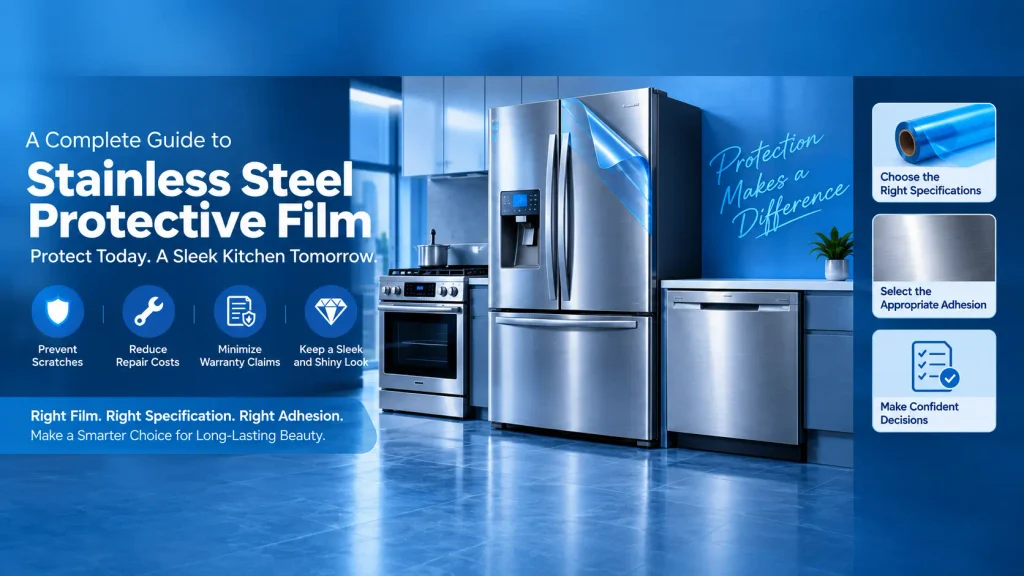
The surfaces of kitchen appliances are prone to scratches and damage, and cosmetic damage is not merely an aesthetic issue. It can lead to repairs, panel replacements, and warranty claims. Stainless steel protective film effectively shields appliance surfaces from damage, determining whether a kitchen will remain sleek and shiny after years of use or look worn out after only a short time. Therefore, stainless steel protective film is a cost-effective protective measure.
This guide will explain in detail the specific function of stainless steel protective film, what specifications of protective film should be selected for different electrical equipment, and how to choose the appropriate adhesion level. After reading this article, you will be able to make decisions confidently.
What Is a Stainless Steel Protective Film for Kitchen Appliances?
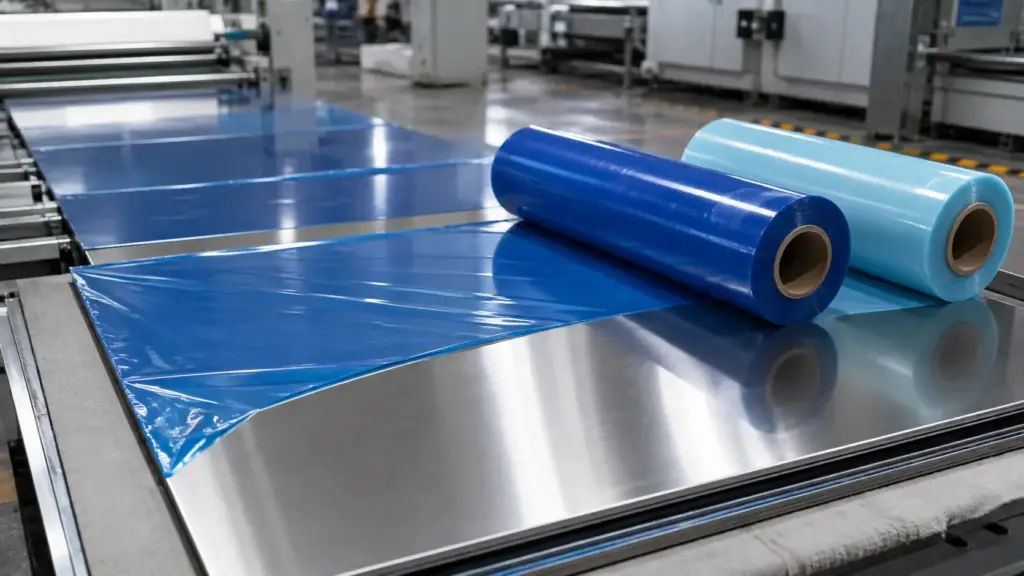
Household-grade stainless steel protective film is a PE film specifically designed to protect metal surfaces. It can be laminated inline onto the surface of stainless steel coils or sheets, providing comprehensive protection during manufacturing, transportation, and processing. It should be noted that protective films applied on production lines like this differ from DIY films that consumers apply themselves during home renovations. In practical application, high-quality stainless steel protective film can not only conform to molding processes such as cutting, stamping and light rolling, but also can be cleanly peeled off within the expected cycle.
Which Kitchen Appliances Need Protective Film & What Each One Demands
| Application Scenario | Surface Example | Recommended Tack | Recommended Product Features |
| Flat Refrigerator Door Panels | Brushed / Matte SS | Medium Tack | Residue-free removal; Flexible PE substrate; Good aesthetic finish |
| Dishwasher / Oven Housings | Smooth Pre-painted or Brushed SS | Medium-High Tack | Excellent formability; Edge retention during stamping |
| Mirror / Polished SS Panels | Mirror SS | Low Tack | Ultra-clean removal; Zero residue glue |
| Long-term Outdoor Storage / Export | Pre-painted or Brushed SS | Medium-High Tack | UV-stabilized adhesive layer; Moisture resistance |
| Embossed / Textured SS | Patterned SS | High Tack | High wet-out adhesion; High-strength substrate |
| Deep-Drawn Parts | Stainless Steel Deep-Drawn Parts | Medium Tack and Elongation Requirement | High elongation at break; Non-yellowing |
How to Choose a Stainless Steel Protective Film: Criteria That Decide Performance
Film Thickness
The thickness of the film will affect the protective strength, flexibility and processing suitability of the stainless steel protective film. The thinner film can provide basic protection against dust and minor surface scratches, and has good fit in the subsequent processing process; while the thicker film has stronger wear resistance, impact resistance and handling damage resistance, and is more suitable for demanding forming processes or longer transportation cycles. However, increasing the thickness of the film does not mean the improvement of the overall performance. Too thick film may reduce the flexibility and fit in the process of stamping, bending or forming, and increase the cost of materials. Therefore, the thickness of the film should be determined according to the specific situation, not the thicker the better.
Surface Type and Adhesion Level
The tack level of stainless steel protective film is usually matched according to the surface type of stainless steel and subsequent processing conditions. For 2B and BA surfaces with relatively smooth surfaces, priority can be given to low to medium tack levels. While ensuring the stable fit of the film material, it is also convenient for subsequent tearing. No.4 brushed surface has obvious texture. It usually requires medium tack to improve adhesion stability between the film. Mirror stainless steel is more suitable for low to medium adhesion levels, and excessive adhesion may lead to the risk of adhesive residue. In addition to the surface type, the adhesion level should be adjusted according to the actual processing conditions. If stainless steel needs to undergo strong molding, frequent handling or a long protection cycle, a higher adhesion level can be considered.
The adhesion ratings listed above serve as a starting point for product selection. Due to significant variations in actual surface roughness, manufacturing processes, and environmental conditions, we recommend conducting test samples to verify suitability for your specific application. Plashield offers free samples and technical support for product selection.
Processing and Forming Compatibility
The stainless steel coated in the production line usually undergoes subsequent processing such as stamping, bending, stretching, shearing and punching. Therefore, a protective film with high elongation rate and good flexibility should be given priority, so that the film can follow the deformation of the substrate without cracking or peeling off. Conventional protective film can be selected for simple slitting and light processing; medium-intensity processing such as stamping and bending should choose films with better extensibility and tear resistance; for deep punching or complex molding, priority should be given to actual process tests to confirm that the film will not crack, wrinkle or warp during processing. The adhesion level should also be adjusted according to the processing strength. If it is easy to be stretched or the edge is subjected to great stress during the processing process, the adhesion level that can maintain a stable fit should be selected.
Removability and Storage Stability
If stainless steel protective film is removed after short-term processing, the focus should be on the initial adhesion and clean peeling; if the product needs to be stored and transported for weeks or even months, the film material with better adhesive stability should be selected, and the aging test and tear film test should be carried out under actual conditions. At the same time, avoid choosing a adhesive system that is prone to increased tackiness after exposure to high temperatures or prolonged adhesion; otherwise there may be an increase in tearing resistance and adhesive residue. The longer the protection period, the higher the requirements for the stability of the adhesive.
Selection Recommendations
When choosing a stainless steel protective film, the tack level should be matched according to the surface type: smooth surfaces such as 2B and BA can usually be selected from low to medium tack options, No. 4 textured surfaces such as drawing require more stable adhesion to reduce warping and displacement during the processing process. Then determine the performance and thickness of the membrane according to the processing method and protection requirements. Conventional specifications can be used for general slitting and handling; for stamping, bending, and deep drawing, priority should be given to films with good flexibility, elongation and tear resistance, and the film thickness should be determined according to the actual surface protection requirements. In addition, for products that require long-term film application, storage or transportation, we should also focus on evaluating the adhesive stability and aging resistance to ensure that the protective film maintains a reliable fit throughout the use cycle, and can be easy to peel off without leaving adhesive residue when tearing the film.
If you are not sure which protective film is more suitable for your stainless steel surface and production process, Plashield can provide selection suggestions according to specific applications to help you find a more suitable surface protection solution.
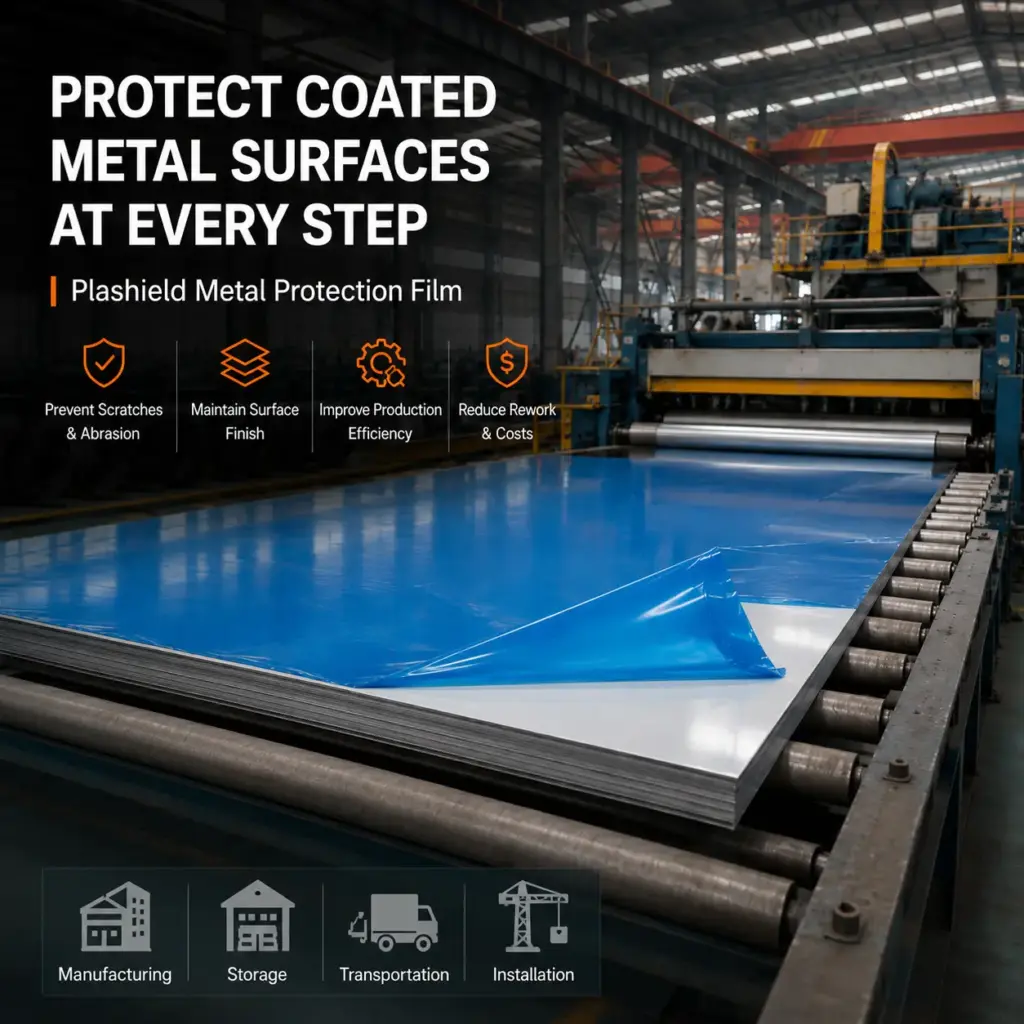
Why Buy Factory-Direct from Plashield
As a professional PE protective film manufacturer with over 20 years of industry experience, Plashield is committed to providing customized protection solutions for delicate surfaces such as metals and waterproof membranes. Compared to purchasing through intermediaries, direct factory supply eliminates communication barriers and markups. Additionally, Plashield can flexibly adjust the width and thickness of the film based on your specific requirements, surface roughness, and operating environment, and offers a range of adhesive strengths from low to high.
If you need to get the appropriate protection plan, welcome to contact Plashield, and we will provide you with factory quotation and sample support.
FAQs
- What thickness of stainless steel protective film is recommended for kitchen appliances?
For most kitchen appliance applications, 40–50μm is a practical thickness range, while commonly used protective films generally fall within 30–60μm. Thinner films are suitable for basic dust and scratch protection and offer better flexibility during processing, whereas thicker films provide greater resistance to wear, impact, and handling damage. However, excessive thickness can reduce conformability during stamping, bending, or forming, so the film thickness should be selected according to the actual processing and protection requirements.
- How should the adhesive tack level be selected for different stainless steel surfaces?
Adhesive tack should be matched to both the stainless steel surface and the subsequent processing conditions. Smooth 2B and BA surfaces generally work well with low- to medium-tack films, while No.4 brushed stainless steel typically requires medium tack to prevent curling, shifting, or lifting during handling and forming. Mirror-polished stainless steel is usually better suited to low- to medium-tack films because excessive adhesion can increase the risk of adhesive residue.
- What should manufacturers consider when stainless steel appliances will be stored or transported for several months?
For extended storage or transportation, adhesive stability and aging resistance become more important than simply maximizing initial tack. The film should maintain stable adhesion throughout the protection period while remaining removable without significant residue. Aging tests and actual-condition peel tests are recommended, particularly when the products may experience elevated temperatures or prolonged adhesion.
- How does protective film performance change when stainless steel undergoes complex forming?
During stamping, bending, stretching, shearing, or punching, the protective film must deform together with the stainless steel substrate. If the film has insufficient elongation or flexibility, it may crack, wrinkle, peel from the surface, or become distorted around stressed edges. Therefore, film selection for complex forming should consider not only adhesive strength but also elongation, flexibility, and tear resistance.
- How can manufacturers reduce the risk of adhesive residue after removing stainless steel protective film?
The adhesive system should be selected according to the stainless steel surface and the expected application period. Clean-peel performance is particularly important for smooth and mirror surfaces. For products stored or transported for weeks or months, manufacturers should also evaluate aging stability because prolonged adhesion or high-temperature exposure may increase tack and peeling resistance, potentially resulting in residue.