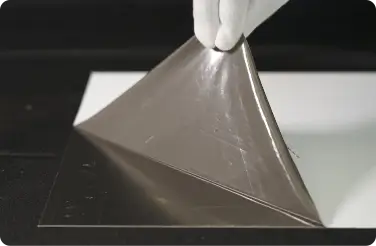




The function of stainless steel sheet surface protective film is to prevent the sheet from being scratched or contaminated during production, processing, transportation and installation, but if the film cannot be peeled off cleanly when tearing, leaves adhesive residue, the protective film can become a new quality problem. Subsequent cleaning not only increases labor costs, but also may affect the appearance of the sheet, and in serious cases, it may even cause customers to refuse to accept it.
This guide will analyze seven common causes of adhesive residue from stainless steel protective film, and introduce methods for addressing the issue when residual has already formed, and how to choose suitable protective film and adhesive according to different stainless steel surfaces to reduce the problem of adhesive residue at its source.
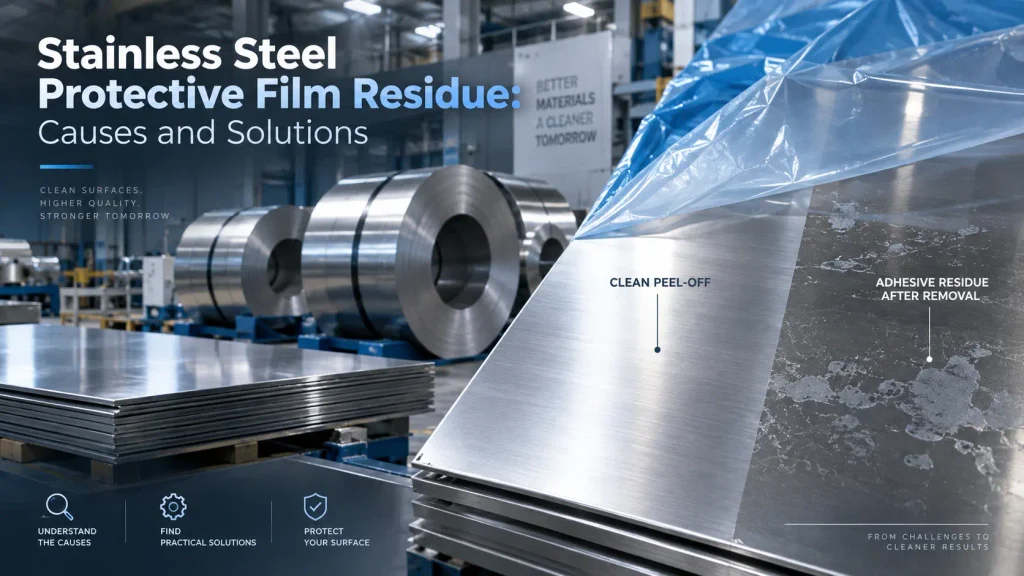
Why Does Adhesive Residue Remain After Removing Stainless Steel Protective Film?
Adhesive residue left behind after removing a stainless steel protective film is usually not caused by a single factor. The type of adhesive, the amount of glue applied, the degree of curing, the film application time and the condition of the surface may change the peeling performance of the protective film. Below are the seven most common causes and their corresponding solutions.
Incompatibility between adhesive type and stainless steel surface
Different stainless steel surfaces have different requirements for the adhesion of the protective film. The surface of 8K mirror finish and BA are relatively smooth, if an adhesive with excessively high tack is used, adhesive residue may remain on the film when it is peeled off. For surfaces with a certain texture, such as brushed finishes, stronger adhesion is usually required.
Solution: The appropriate adhesive system and tack level should be selected according to the surface characteristics of stainless steel. It is not the more sticky the better. It should be confirmed through the actual peel test before use.
Excessive adhesive application on the protective film
Excessive adhesive application may increase the risk of adhesive residue. When the adhesive layer of the protective film is too thick, cohesive failure is more likely to occur within the adhesive during the peeling process, resulting in the transfer of part of the adhesive layer from the protective film to the stainless steel surface. In addition, an excessively thick adhesive layer may also alter the peel strength of the protective film, especially after prolonged adhesion or in high-temperature environments.
Solution: The amount of adhesive applied should be adjusted according to the film material, adhesive system, stainless steel surface and the expected protection period, rather than simply increasing the amount of adhesive to enhance the adhesion.
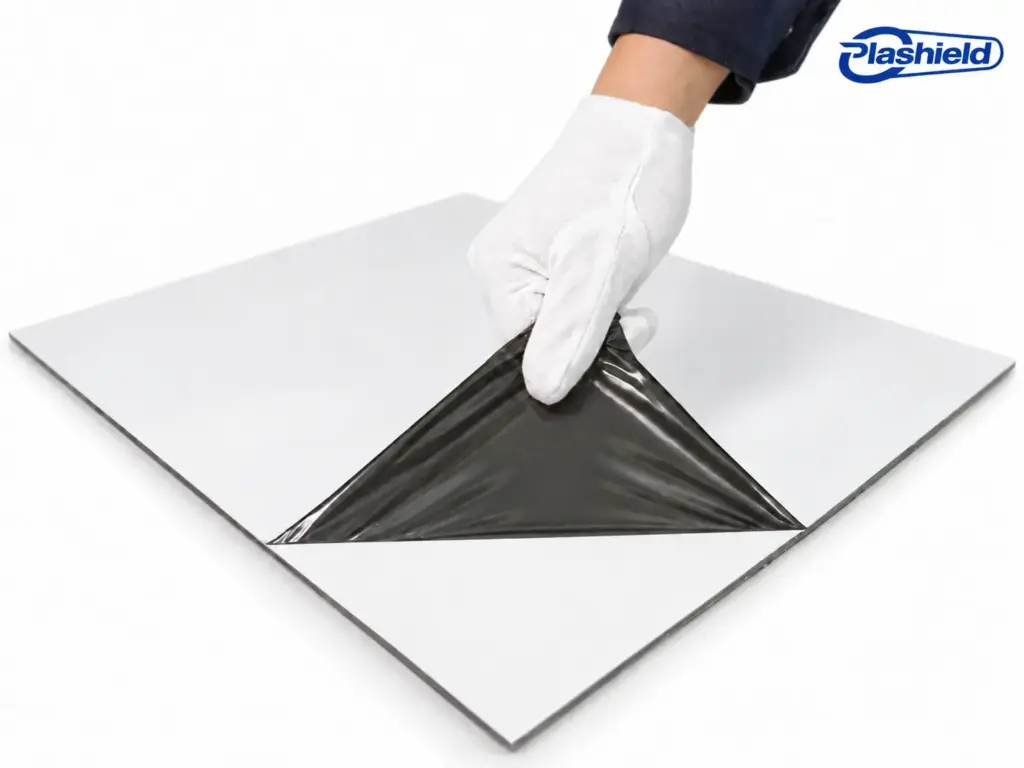
Insufficient curing of the adhesive
The adhesive needs to be fully dried and cured to form a stable adhesive layer after application. If the drying temperature is insufficient, the drying time is too short or the production speed is too fast, the adhesive layer may not reach the expected curing state. After the protective film is applied to the surface of stainless steel, the properties of the adhesive may continue to change, resulting in abnormal increase in peeling strength or the presence of adhesive residue.
Solution: The drying temperature, drying time and production speed should be optimized according to the specific adhesive system, and it should be confirmed whether the adhesive layer has reached a stable state according to the peeling and residual test.
Protective film left in place for too long
With the increase of the adhesion time, the adhesive may be continuously affected by temperature, humidity and the surface environment, and gradually age or change in tack. After exceeding the recommended service life, the protective film may become more difficult to peel off, and even adhesive transfer may occur. Especially for stainless steel sheets that need to be stored for a long time, a reasonable application cycle should be determined according to the actual performance of the protective film.
Solution: For long-term protection needs, an adhesive system that has undergone long-term adhesion and aging tests should be selected.
High temperatures and direct sunlight accelerate adhesive layer aging
High temperature and prolonged exposure to UV radiation will accelerate the aging process of some adhesives. In the process of outdoor transportation, stored, or installed of stainless steel sheets, if the protective film is exposed to the sunlight for an extended period, the performance of the adhesive layer may gradually change, which will increase the peeling strength and increase the problem of adhesive residue or difficulty in removal.
Solution: For outdoor or high-temperature environments, a protective film with UV and temperature resistance should be selected, and the aging test should be conducted according to the actual operating environment.
Oil stains or other contaminants on the stainless steel surface
Oil stains or other contaminants on the surface of stainless steel sheets may also affect the adhesion of the protective film. When there is oil on the sheet surface, the adhesive and the substrate cannot form uniform and stable contact, which is easy to cause local adhesion differences. When peeling the film, different areas are subjected to varying peel forces, which may result in localized adhesive marks or residue.
Solution: You should assess the actual condition of the sheet surface first, and then choose the matching adhesive system. Simply increasing the amount of adhesive applied can’t fundamentally solve the problem.
Increased tackiness in water-based adhesive films
For some water-based adhesive protective films, the adhesive strength may change over time after application, which is often called “post-cure tack.” If the peeling performance of the protective film is normal immediately after application, but the adhesive strength increases significantly after a period of time, it may require greater peeling force when removing the film, which may also increase the risk of adhesive residue.
Solution: When choosing water-based protective films, you should not only pay attention to the initial tack, but also consider the change of tack after application. By adjusting the adhesive formula, curing process and actual aging test, post-cure tack gain can be better controlled, thereby reducing the risk of adhesive residue.
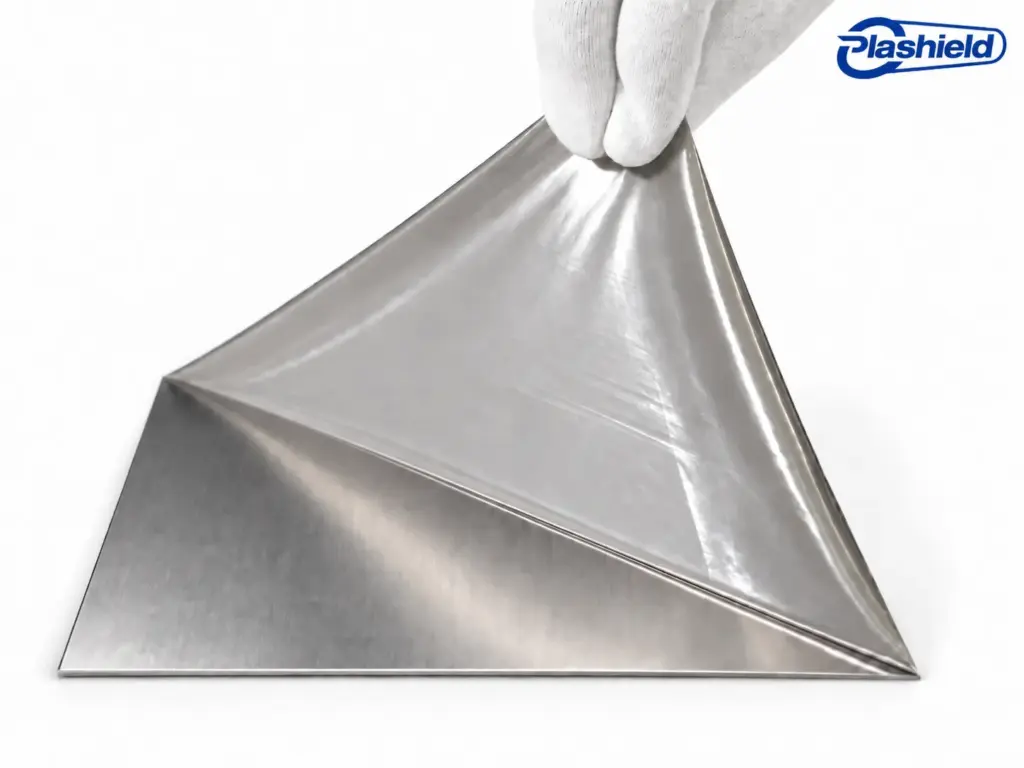
What Should You Do If Adhesive Residue Remains on the Stainless Steel Protective Film?
If you are wondering how to get blue protective film from stainless steel, you should first select an appropriate removal method based on how long the film has been in place, the type of adhesive, and the condition of the stainless steel surface. If adhesive residue remains after peeling off the film, light residue can be gently wiped away with alcohol or a suitable cleaner using a soft non-woven cloth. For more stubborn residue, consider using a specialized adhesive remover; however, before treating a large area, perform a small-scale test first to ensure it does not cause surface damage. At the same time, you should avoid using steel wool, hard scrapers and other tools that are easy to scratch the surface.
How to Prevent Adhesive Residue on Stainless Steel Protective Film from the Start?
To reduce the adhesive residue of stainless steel protective film from the source, the key is to choose the matching adhesive and protective film according to the stainless steel surface, protection period and usage environment. For example, smooth surfaces such as 8K mirror finishes are usually suitable for low-tack and easy-to-peel adhesives, while the brushed surface may require protective films with medium tack according to the texture and processing requirements. For long-term storage or outdoor application, the aging resistance and UV resistance of the adhesive should also be considered. Before formal mass production, it is recommended to conduct initial peeling, long-term adhesion, high temperature and UV aging and other tests to confirm that the protective film can maintain stable peeling and no adhesive transfer throughout its entire service life.
Why Choose Plashield for Stainless Steel Protective Film
Plashield is a PE protective film manufacturer with more than 20 years of professional manufacturing experience. We not only offer cost-effective products but also provide customized technical support based on material, processing methods, and application duration from the very beginning of the selection process, helping you protect your panels while minimizing the difficulty of removal and the risk of adhesive residue.
If you’re unsure how to choose the right adhesive strength or protective film type, contact us immediately. Tell us your surface material and processing requirements to receive professional selection advice and samples.
FAQs
- How can you determine whether the tack level of a protective film is suitable for a specific stainless steel surface?
Initial tack alone is not enough to determine suitability. The evaluation should consider the smoothness, texture, processing condition, and expected protection period of the stainless steel surface. Practical application and peel testing should then be used to verify whether the film can provide stable protection while remaining cleanly removable without significant adhesive transfer.
- Why can a protective film peel normally at first but leave adhesive residue after being applied for a period of time?
Some adhesive systems continue to change after application. Water-based adhesive films, for example, may experience post-cure tack gain, meaning their adhesion increases over time. Although the initial peel performance may appear normal, increased adhesion after aging can raise the required peeling force and increase the possibility of adhesive transfer.
- How can a protective film solution be customized for different stainless steel finishes?
The selection process should begin with the stainless steel surface type, subsequent processing requirements, expected protection period, and storage or transportation environment. The film material and adhesive system can then be matched to these conditions. For demanding applications, sample application, peel testing, and aging evaluation are recommended before finalizing the specification rather than relying on a single tack value or theoretical parameter.
- What tests should be conducted before applying stainless steel protective film in mass production?
At minimum, the initial peeling performance and the peeling behavior after prolonged adhesion should be evaluated. If the film will be used for long-term storage, outdoor transportation, or high-temperature applications, additional heat and UV aging tests are recommended. The goal is to verify not only adhesion during protection but also clean removability at the end of the service period.
- Why can the same protective film produce different peeling results on different stainless steel products?
Peeling performance is closely related to the actual surface condition of the stainless steel. Smooth surfaces such as mirror and BA finishes have different adhesion requirements from textured surfaces such as brushed finishes. Surface cleanliness, processing conditions, and storage environments can also affect adhesion, so one protective film specification may not perform equally well across all stainless steel surfaces.