



During the renovation or construction of buildings, the floor is often easily overlooked. Ignoring floor damage is one of the most common and costly mistakes. The large flow of people and the frequent use of tools and equipment will lead to the rapid appearance of scratches, stains, cracks and impact damage to the floor. Choosing the right floor protection film helps to maintain the original appearance of the floor from the beginning to the end of the project without frequent cleaning or worrying about damage. So, how to choose a suitable protective film?
This guide addresses exactly that question. Whether you are a contractor, property manager or homeowner, this guide is suitable for you. It will discuss how to choose the best floor protection solution for your specific project. We will make it clear what role the floor protective film used in residential construction sites plays, how to choose the appropriate adhesion rating and thickness, and how to buy it directly from the factory, including how manufacturers like Plashield support OEM subcontracting and branded supply.
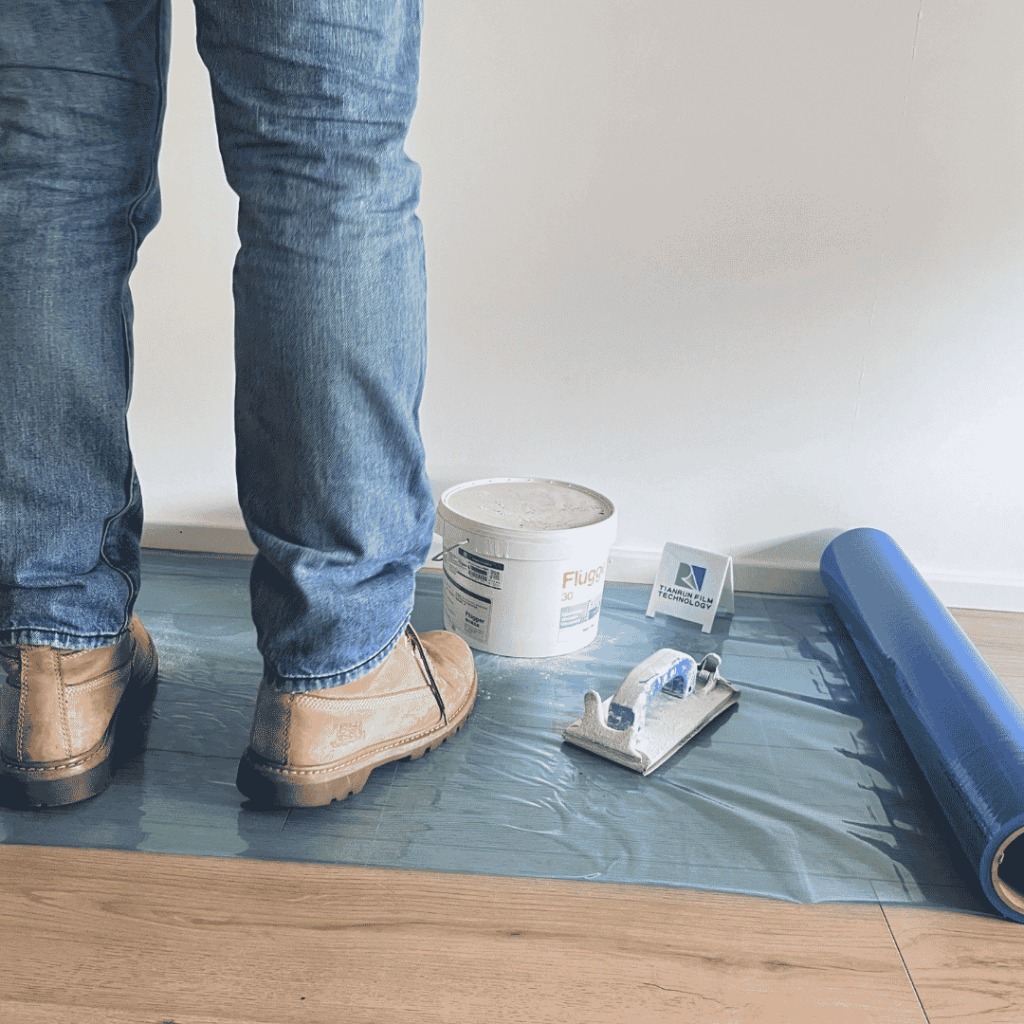
Quick Answer: What Is the Best Floor Protection Film for a Residential Site?
For most residential construction and decoration projects, the best floor protection film is usually a product that uses professional PE film and pressure-sensitive acrylic adhesive layer. The key is not only the material of the film itself, but also to choose the appropriate adhesion and thickness according to the ground material, construction cycle, personnel walking frequency and other factors. The ideal residential floor protection film should provide reliable surface protection. At the same time, it can be easily removed after construction, leaving no adhesive residue and damaging the finished ground. Quick selection can refer to the following criteria:
- Finished wood flooring, tiles, marble and PVC flooring: choose a low to medium tack protective film with a thickness of usually 50-80 microns.
- Rough or semi-rough surfaces, and projects with long construction cycles: choose a medium to high tack protective film, usually with a thickness of more than 60–100 microns, for better adhesion and durability.
- Areas near windows or exposed to sunlight for a long time: It is recommended to choose a protective film with anti-UV performance to help slow down the aging of the adhesive layer and maintain good removable properties during a long installation cycle.
Plashield provides PE floor protection film directly from the factory, supports width customization and branded production, and can apply for samples for actual testing.
What Is Floor Protection Film?
Floor protection film is a temporary protective material used to protect the ground surface during construction, decoration and renovation. It is usually made of PE film and coated with a pressure-sensitive adhesive layer on one side. During construction, it can form a physical barrier to help reduce scratches, stains and wear caused by dust, sand, paint and people walking, thus reducing the risk of damage to the floor.
Unlike ordinary plastic films, self-adhesive floor protection film can be fixed on the ground through the adhesive layer, and it is not easy to shift and curl edges due to personnel walking or construction activities. According to different application scenarios, the required adhesion, thickness and weather resistance are also different, which need to be selected according to the ground material and construction cycle. After the construction is completed, the high-quality protective film should be easily torn off and leave no adhesive residue or damage to the ground as much as possible.
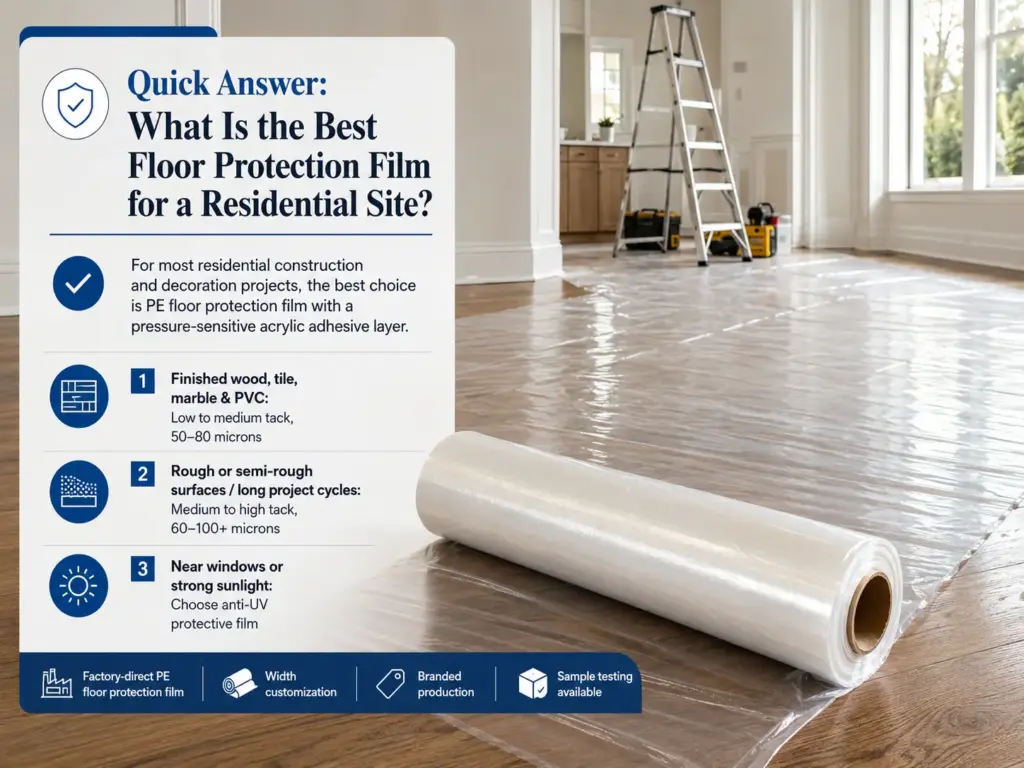
Where to Use Floor Protection Film on a Residential Site
Floor protection film is widely applicable to a variety of materials such as solid wood and composite floors, ceramic tiles, polished bricks, stone and cement floors. Whether it is a new construction project or an old house renovation, laying a protective film in advance can resist the damage of paint, dust and various scratches on the floor. In actual construction, the needs of different areas have their own emphasis. For example, high-flow channels, due to the frequent traffic between personnel and carts, it is recommended to choose a protective film with high-adhesive and better thickness to prevent displacement and wear; near direct sunlight areas such as windows or balconies, anti-UV protective film should be used to avoid the glue layer aging due to high temperature. When purchasing, you should choose according to the actual needs.
It should be noted that the floor protective film needs to avoid the surfaces that are not yet dry. New lacquered wood floors that have not been fully cured, wet or undried floors must wait for the surface to dry and completely cure before laying, so as not to damage the paint or cause mold.
How to Choose the Right Floor Protection Film
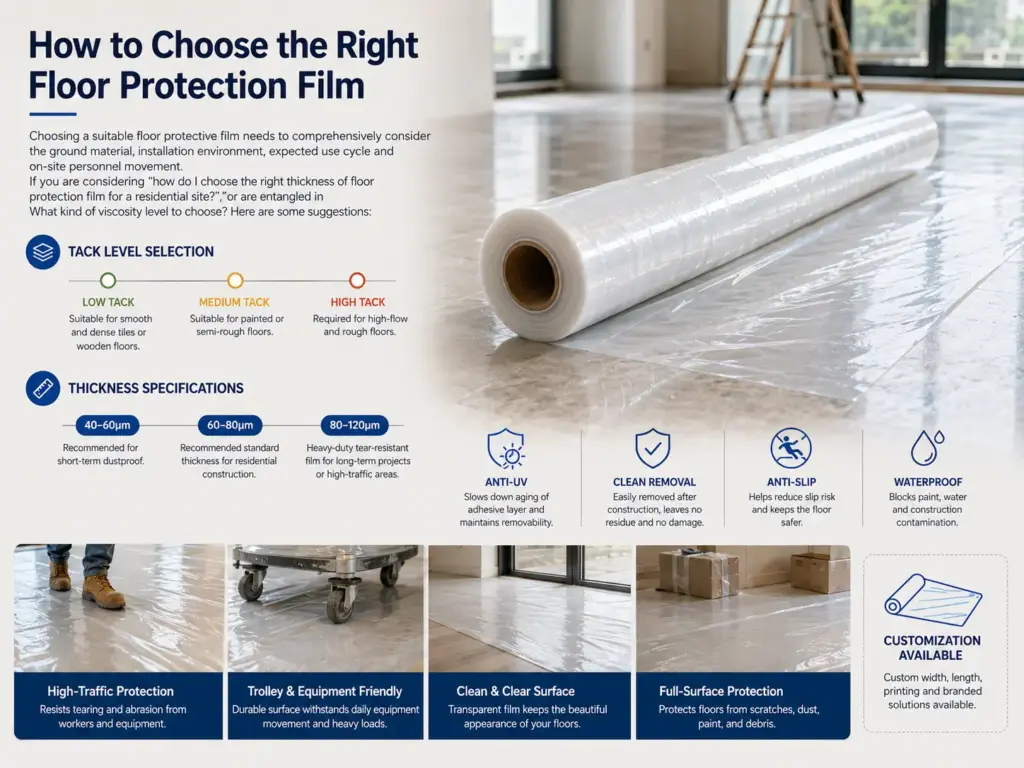
Choosing a suitable floor protective film needs to comprehensively consider the ground material, installation environment, expected use cycle and on-site personnel movement. If you are considering “how do I choose the right thickness of floor protection film for a residential site?”, or are entangled in What kind of viscosity level to choose? Here are some suggestions:
Tack Level Selection: low-tack floor protection film is suitable for smooth and dense tiles or wooden floors; painted or semi-rough floors are suitable for medium-tack film; high-tack protective film is required for high-flow and rough floors.
Thickness Specifications: 40-60 microns is recommended for short-term dustproof; 60-80 microns of standard thickness is recommended for residential construction; 80-120 microns of heavy-duty tear-resistant film should be selected for long-term projects that require frequent walking or trolley passage.
In addition, if you are close to the window or outdoors, choosing an anti-UV formula can prevent residual glue, ensure that the floor protective film is cleanly peeled off after use, and support anti-slip and waterproofing. Before laying a large area, it is recommended to carry out a 48-hour application test on a small area. At the same time, you can customize the cutting width or print the brand logo according to your own needs.
Why Choose Plashield for Residential Floor Protection?
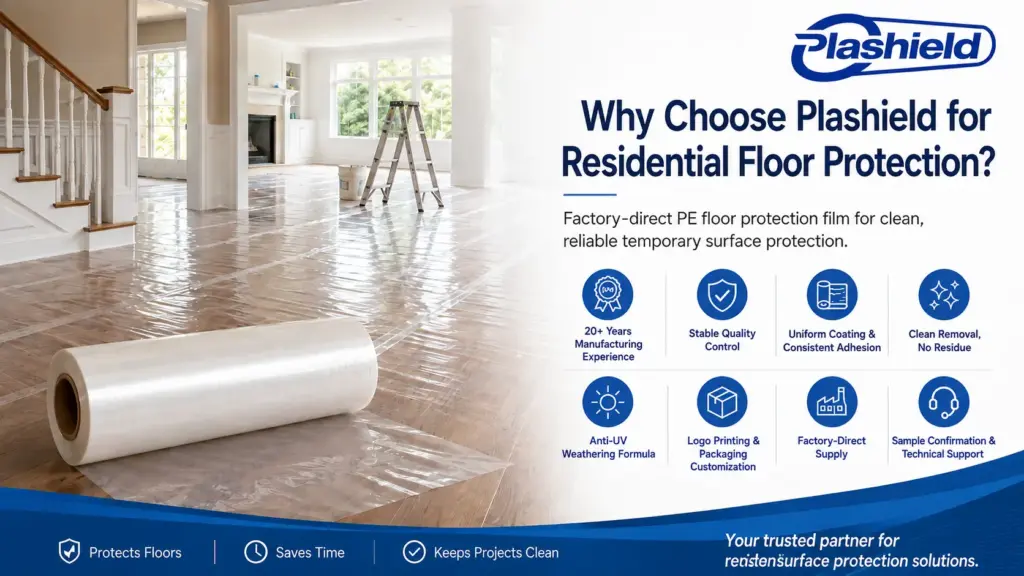
As a professional PE protective film manufacturer with more than 20 years of manufacturing experience, Plashield is deeply engaged in the field of surface protection, focusing on providing high-quality protection solutions for ground, metal, glass and multi-fields. Plashield ensures stable quality control, uniform coating, consistent batch adhesion, clean stripping without residual glue, and has a mature anti-UV weathering formula. At the same time, we support flexible customization standards, including brand Logo printing of film and outer packaging, to help you create your own brand. At the same time, choosing factory-direct floor film can bypass intermediate traders and significantly reduce the cost of procurement.
Plashield provides professional guidance to help owners choose the most suitable protective film solution, provide sample confirmation and all-round technical support, and is your trusted supply chain partner. Welcome your consultation to discuss the most suitable solution for your business roof.
Plashield Floor Protection Film Selector
| Product Type | Typical Thickness | Tack Level | Best Application | Removal Characteristics |
| Low-Tack Smooth Surface Film | 50–60 µm | Low (10–50 g/25mm) | Polished tiles, marble, hardwood, smooth PVC | Clean, residue-free |
| Medium-Tack General Construction Film | 60–80 µm | Medium (50–150 g/25mm) | Residential builds, renovations, semi-rough surfaces | Clean removal even after several weeks; contractor-friendly |
| High-Tack / Rough Surface Film | 80–120 µm | High (150–400 g/25mm) | Rough surfaces, high traffic, corridors, stairs, long-term | Strong grip, clean removal |
| UV-Resistant Outdoor / Near-Window Film | 60–100 µm | Low–Medium | Windows, outdoor storage, roofing & sandwich panels | UV-resistant, residue-free |
FAQs
- What type of floor protection film is best for residential construction and renovation projects?
For most residential construction and renovation projects, professional-grade PE floor protection film with a pressure-sensitive acrylic adhesive is a practical choice. The film should be selected according to the flooring material, expected construction period, foot traffic, and installation environment. Smooth surfaces such as hardwood, marble, polished tile, and PVC generally require low- to medium-tack film, while rough surfaces and high-traffic areas may require higher tack and greater thickness.
- How thick should floor protection film be for a residential construction site?
The appropriate thickness depends on the level and duration of exposure. For short-term dust protection, 40–60 microns may be sufficient. For general residential construction and renovation, 60–80 microns is typically recommended. Projects involving prolonged construction, frequent foot traffic, carts, or greater mechanical wear may require heavy-duty film in the 80–120 micron range with improved tear resistance.
- How do I choose the right tack level for floor protection film?
Tack should be matched to both the floor surface and site conditions. Low-tack film is generally suitable for smooth, dense surfaces such as polished tile, marble, and finished hardwood. Medium-tack film works well for painted or semi-rough surfaces and general renovation work. High-tack film is more appropriate for rough surfaces, high-traffic corridors, stairs, and areas where frequent movement could cause the film to shift or curl.
- How long can self-adhesive floor protection film remain on a residential floor?
The usable installation period depends on the adhesive formulation, floor material, environmental conditions, and exposure to sunlight and heat. Standard films can be suitable for residential construction lasting several weeks, while longer projects require a formulation designed for extended adhesion and clean removal. In areas exposed to prolonged sunlight, UV-resistant film is recommended because UV exposure and heat can accelerate adhesive aging and increase the risk of residue.
- What should contractors consider when purchasing floor protection film in bulk?
Contractors should evaluate more than the film’s price per roll. Key purchasing specifications include film material, thickness, tack level, tear resistance, UV resistance, water resistance, slip resistance, expected installation period, and compatibility with the flooring surface. Roll width and packaging should also match the installation process. For larger projects or private-label requirements, manufacturers may provide custom slitting widths, logo printing, packaging customization, samples, and technical support.