



Quick answer: PE protective film prices change with raw-material inputs, the film specification, factory conversion work and delivery terms. Oil can influence PE resin through the petrochemical chain, but the effect is not direct or immediate. To compare quotes, you need the same resin basis, backing thickness, adhesive requirement, printing, quantity, packaging and Incoterm.
A universal price per roll, kilogram or square metre would be misleading. A plain 50 µm indoor film for a smooth panel is not equivalent to a printed 80 µm film with an application-specific adhesive and export packaging.
This guide explains how factories build a quotation, which cost changes you can calculate and which values require a dated supplier quote. When you need a current buying price, Plashield can update the quotation against your surface, film specification, quantity, destination and required delivery date.
Why PE protective film prices change
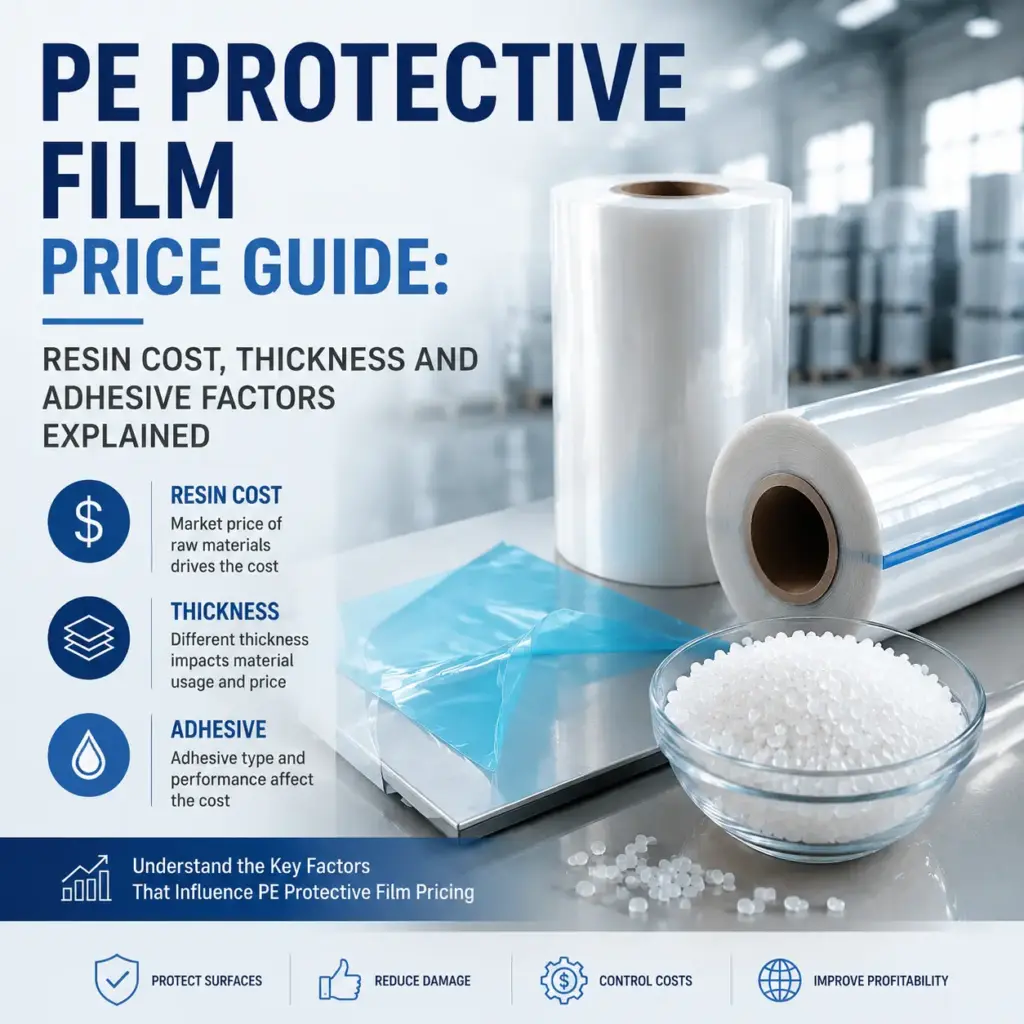
Protective film is a converted product, not a single raw material. Four cost layers sit behind the number on your quotation:
- Market inputs: PE resin, acrylic adhesive inputs, pigment, additives, energy and exchange rates.
- Product specification: PE material basis, backing thickness, density, adhesive system, peel target, colour and printing.
- Factory conversion: film blowing, coating, drying, printing, slitting, winding, cores, testing and packaging.
- Commercial terms: order quantity, currency, payment terms, quote validity, Incoterm, freight, insurance, duty and destination handling.
A movement in one layer does not cause the same percentage change in the final quote. For example, a 10% change in the PE resin input should not automatically produce a 10% increase in the finished-film price. Adhesive, conversion, packaging and freight do not all move with resin.
Timing also matters. A factory may be consuming resin purchased earlier, while a public market index reflects a different month, region or producer group. The supplier may update a quote when replacement resin is purchased rather than on the day an oil headline appears.
Before treating a price as comparable, confirm:
- The exact film specification
- Whether the price is per roll, kilogram or square metre
- The quote date and expiry date
- The currency and payment terms
- The Incoterm and named port or destination
- Which packaging, freight and documentation costs are included
The number alone is not enough. You need to know what the number buys and where the supplier’s responsibility ends.
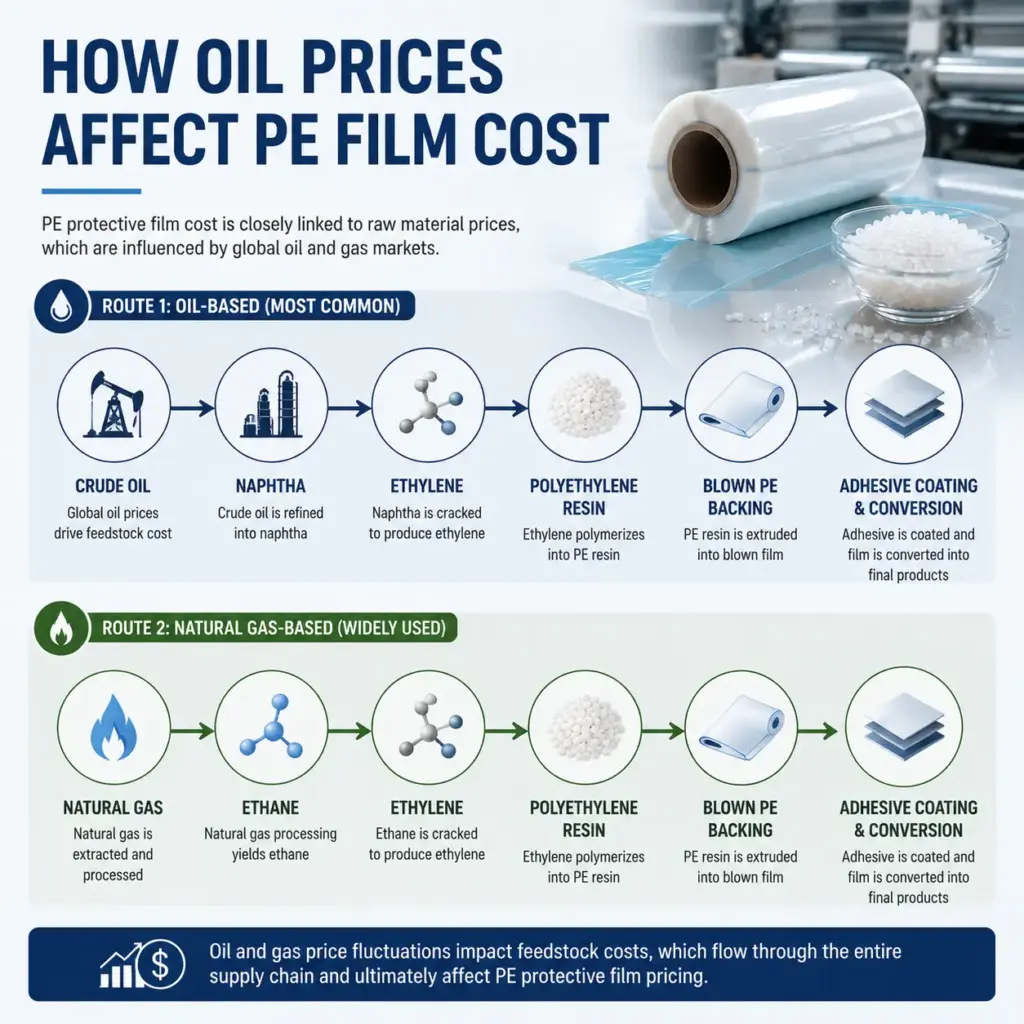
How oil prices affect PE film cost
Oil can affect PE protective film through one petrochemical route:
Crude oil -> naphtha -> ethylene -> polyethylene resin -> blown PE backing -> adhesive coating and conversion
It is not the only route. Ethane from natural-gas processing is also widely used:
Natural gas -> ethane -> ethylene -> polyethylene resin -> blown PE backing -> adhesive coating and conversion
The US Energy Information Administration explains that ethylene crackers commonly process ethane or naphtha, and that naphtha is produced through crude-oil refining. EIA also identifies ethane, propane and naphtha as petrochemical feedstocks, while ethylene is commonly polymerised to make polyethylene. See the EIA explanations of petrochemical cracker feedstocks, hydrocarbon gas liquid uses and ethylene-to-polyethylene production.
This is why oil and PE prices do not move one-for-one:
- Naphtha-based producers may be more exposed to crude-oil and refining economics.
- Ethane-based producers are affected by natural-gas liquids supply and ethane economics.
- PE resin prices also respond to plant operating rates, maintenance, imports, exports, inventories and downstream demand.
- Your factory quote includes adhesive, processing, packaging and commercial terms after the resin stage.
- Currency and freight can move in a different direction from resin.
You can monitor public producer-price data as a direction check. You cannot use an index point as a supplier’s dollar-per-kilogram input.
| June 2026 US producer index | Observation | Base |
| Plastics material and resin manufacturing | 368.751 | December 1980 = 100 |
| Unlaminated polyethylene film and sheet | 351.298 | June 1993 = 100 |
| Adhesive manufacturing | 234.459 | December 2003 = 100 |
Sources: BLS Producer Price Index, plastics material and resin manufacturing, unlaminated PE film and sheet and adhesive manufacturing. The FRED observations were updated on July 15, 2026.
The three index levels have different base periods. Do not add them together or interpret the highest index as the largest cost input. Track movement within each series instead.
If a supplier attributes a price change to feedstock volatility, ask four questions:
- When does the new price take effect?
- How long is the quotation valid?
- Which resin or material basis is covered?
- Does the adjustment apply only to new orders or also to an existing agreement?
This gives you a commercial explanation you can verify. An oil-price headline cannot do that.
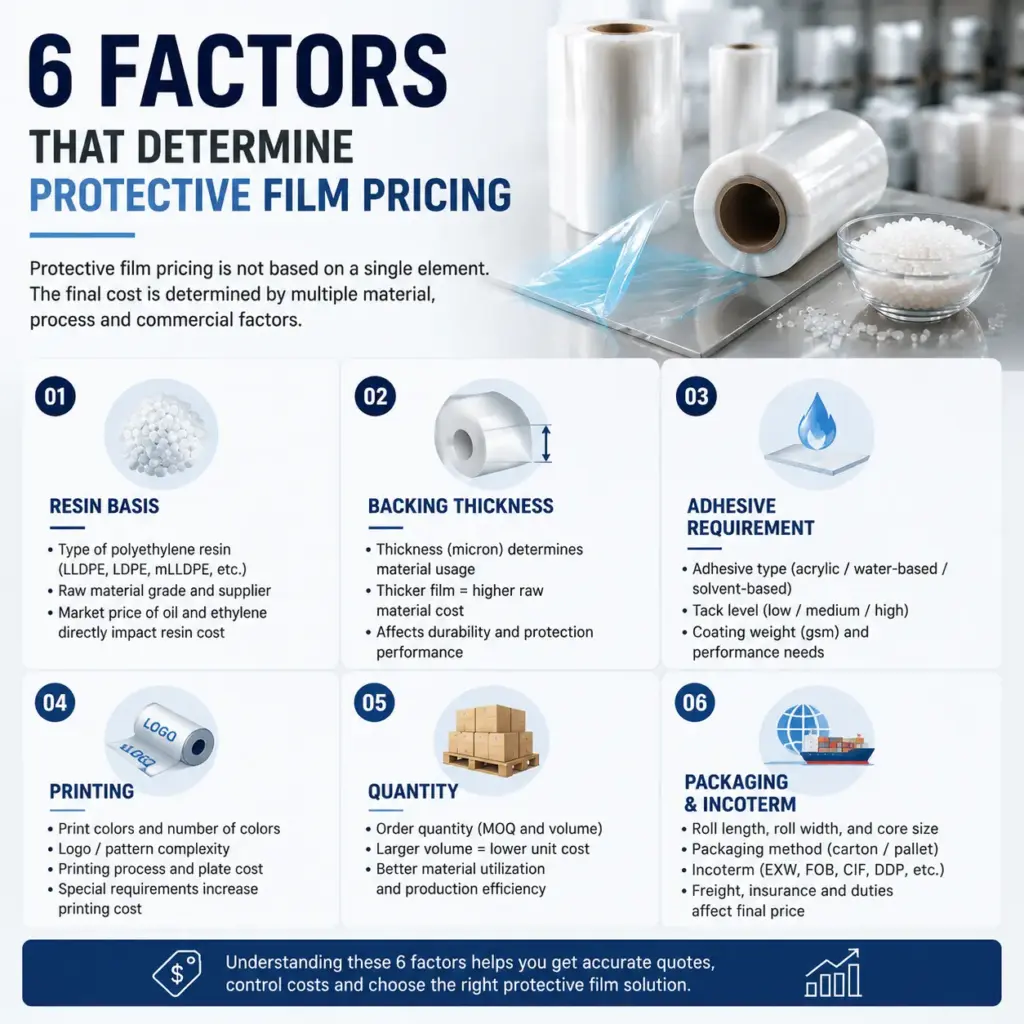
6 factors that determine protective film pricing
1. PE resin
PE resin determines the material basis of the backing. The quoted product may use a particular PE grade or blend to achieve the required extrusion, tensile, elongation, colour and processing behaviour.
Do not compare vague descriptions such as “standard PE” or “premium PE.” Ask the supplier to state the agreed material basis and the batch documents that will accompany the order.
When backing thickness and density are known:
PE input cost/m² = backing thickness (µm) × density (g/cm³) ÷ 1,000 × resin price/kg
This formula calculates the resin component of the PE backing. It does not include adhesive, pigment, process loss, conversion, packaging, margin or freight.
Some Plashield product data sheets list a density of 0.925 g/cm³ for specific grades. That value is useful for a calculation tied to those grades. It should not be presented as the universal density of every protective film.
2. Thickness
Backing thickness has a direct effect on PE consumption per square metre. If density and area stay the same, a 60 µm backing uses 20% more PE than a 50 µm backing.
Using the 0.925 g/cm³ example-grade density:
| PE backing thickness | Calculated PE mass | PE use versus 50 µm |
| 50 µm | 46.25 g/m² | Baseline |
| 60 µm | 55.50 g/m² | 20% more |
| 70 µm | 64.75 g/m² | 40% more |
| 80 µm | 74.00 g/m² | 60% more |
| 100 µm | 92.50 g/m² | 100% more |
The table shows backing mass, not the finished-film price.
Before using the formula, find out what “thickness” means in each quotation. One supplier may state PE backing thickness. Another may state total construction thickness after adhesive coating. If you put total thickness into the backing formula, you overstate PE consumption because part of the construction is adhesive.
You should also compare:
- Nominal thickness
- Tolerance in µm or percent
- Whether the tolerance is bilateral
- Measurement method and sampling positions
- Batch average, minimum and maximum
Thicker film can improve stiffness or puncture resistance, but it cannot correct an adhesive mismatch. Choose the thinnest construction that passes your handling, processing, transport, dwell and removal tests.
3. Adhesive type
The adhesive has to wet the protected surface, remain stable during use and peel without an unacceptable change to the surface. A generic low, medium or high tack label does not define that performance.
Plashield’s current material documents describe a water-based acrylic pressure-sensitive adhesive for multiple PE film grades. The corresponding emulsion adhesive SDS lists 49 to 51% solids. Confirm the current SDS and product data sheet for the grade quoted to you.
For a water-based adhesive:
Wet adhesive usage (g/m²) = dry coat weight (g/m²) ÷ solids fraction
If a calculation assumes 12 g/m² of dry adhesive at 50% solids, the coating line needs 24 g/m² of wet emulsion before process loss. The 12 g/m² value is an example input, not a universal Plashield specification.
Adhesive cost changes with:
- Polymer formulation and additives
- Dry coat weight and coating tolerance
- Solids content
- Drying energy and line speed
- Smooth, coated, matte, embossed or textured surfaces
- Application temperature and protection period
- UV, aging and removal requirements
- Coating loss and quality-control limits
Higher peel does not necessarily mean that the factory simply applies more adhesive. Formulation, wetting and cohesion can change peel behaviour without a proportional change in coat weight.
A peel value is incomplete unless the quote states the test substrate, peel angle, dwell time, test speed, conditioning, unit and tolerance. Data measured on stainless steel cannot automatically predict behaviour on glass, powder-coated aluminium, carpet, acrylic or another surface.
4. Printing
Printed protective film costs more to convert because the factory has to prepare artwork, plates or cylinders, ink, setup, registration control, cleaning and startup material.
The price depends on:
- Number of colours
- Print coverage
- Repeat length
- Artwork complexity
- Ink and colour-matching requirements
- Roll width and production quantity
- Frequency of artwork changes
Ask whether the printing setup is included in the unit price, charged separately or amortised across a minimum production quantity. A small printed order can have a higher unit cost because fewer square metres absorb the same setup work.
Do not evaluate printing only as decoration. Direction arrows, removal instructions, batch identification and private-label information may have operational value. The quotation still needs to separate one-time setup from recurring conversion cost.
5. Order quantity
The factory incurs setup, cleaning, colour change, coating adjustment, slitting, testing and packaging work for each production run. A larger order can spread those costs across more square metres.
That does not mean every larger order automatically receives the same discount. The price break depends on whether the quantity can run under one approved specification and one production setup.
Ask for:
- MOQ for the exact thickness, adhesive, colour, print, width and roll length
- Price breaks at realistic annual or shipment volumes
- Whether multiple widths can be combined
- Whether separate print designs count as separate setups
- Storage or split-shipment cost
- Quote validity at each volume
There is no verified public Plashield MOQ or price tier that applies to every protective-film specification. These values should remain dated quotation fields.
6. Packaging
Packaging affects factory labour, material use, shipment density and damage risk. A quote for unpalletised jumbo rolls is not comparable with individually protected rolls in labelled cartons on export pallets.
Confirm:
- Core material, internal diameter and core weight
- Roll width, length, outside diameter and maximum weight
- Maximum permitted joints
- Individual wrapping or end protection
- Carton strength and quantity per carton
- Pallet material, dimensions and stacking
- Labels, batch identification and private-label requirements
- Container loading quantity
Narrow slit rolls can require more cores, cartons and handling per square metre. Oversized rolls may reduce line changeovers at your facility but increase handling and packaging requirements.
Packaging also changes freight. Compare chargeable weight or container utilisation, not only the product’s net weight.
How to compare protective film quotes correctly
Put each offer into the same comparison sheet. A blank specification field is not a harmless omission. It may explain the apparent price advantage.
| Comparison field | Quote A | Quote B |
| Protected substrate and surface finish | ||
| PE material basis | ||
| Backing thickness and tolerance | ||
| Total construction thickness, if stated | ||
| Density | ||
| Adhesive chemistry | ||
| Peel target, substrate, method and tolerance | ||
| Protection period and exposure | ||
| Width, length, core and joints | ||
| Colour and printing | ||
| Quantity and specification-level MOQ | ||
| Packaging and pallet | ||
| Price basis: roll, kg or m² | ||
| Incoterm and named place | ||
| Currency, quote date and validity | ||
| Landed cost per usable m² | ||
| Sample, TDS, SDS, COA and batch documents |
Reject a direct price comparison when:
- Thickness is given without saying backing or total construction.
- A peel value has no test substrate, conditions or tolerance.
- A roll price has no verified width and length.
- Printing setup and recurring print cost are mixed together.
- Packaging or pallet requirements differ.
- The Incoterm, destination or quotation-validity period is missing.
Your final comparison metric should be landed cost per usable square metre for a film that passes the application test. If suppliers quote per kilogram or per square metre, use the separate Plashield guide, Is PE Protective Film More Cost-Effective by Kilogram or by Square Meter?, to normalise the basis.
First verify what the film is. Then compare how it is priced.
If the quotation has expired or your Q4 quantity, specification or delivery plan has changed, request a current Plashield price before approving the order. The updated quotation should confirm the specification, validity period, production window and delivery basis.
Get a current Plashield price and plan your Q4 order
Plashield provides PE protective film for applications including aluminum composite panels, aluminum and PVC profiles, coated metal, stainless steel, glass, MDF, stone and carpet. The suitable backing thickness, adhesive and roll configuration depend on the protected surface and your process, so a current price needs to be tied to the actual application rather than a generic market number.
Send the following information when you request a price update:
| RFQ field | Why the factory needs it |
| Protected material and finish | Selects the adhesive and test surface |
| Manufacturing operations | Checks cutting, bending, forming or handling conditions |
| Application and removal conditions | Defines temperature, dwell and removal risk |
| Backing thickness or performance target | Determines material use and qualification |
| Width, length, core and winding | Determines slitting, winding and packaging work |
| Colour and print artwork | Determines masterbatch, ink and setup |
| Quantity by specification | Determines MOQ, production setup and price break |
| Packaging | Determines cores, cartons, pallets and loading |
| Destination and Incoterm | Defines the commercial cost boundary |
| Required documents | Defines sample, TDS, SDS, COA and batch-report work |
Ask Plashield to confirm:
- The current price and quotation-validity period
- The exact film specification covered by the price
- The current MOQ and price breaks for that specification
- Whether sample approval is required before production
- The available production window
- Packaging, Incoterm and freight basis
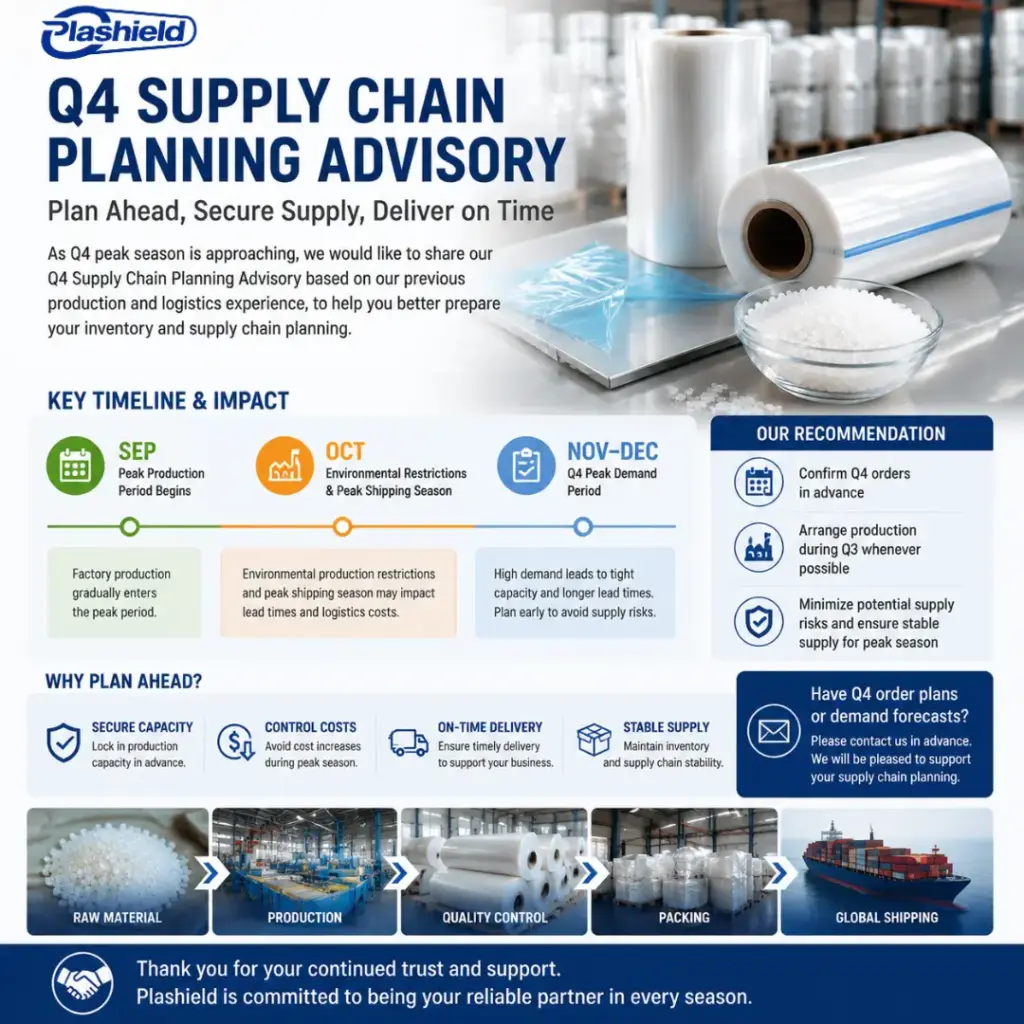
Q4 supply chain planning advisory
Based on previous production and logistics experience, Plashield recommends discussing Q4 requirements before peak-season production and shipping schedules fill.
Starting in September, the Plashield factory will gradually enter its peak production period. If you already have a Q4 order plan or demand forecast, confirm the specification and request an updated price in advance. Where possible, arranging production during Q3 can leave more time for sample approval, production scheduling and shipment preparation.
Local environmental production controls, if introduced, may affect some schedules. Shipping demand from October may also affect lead times or logistics costs on certain routes. These are planning risks rather than guaranteed events, so ask Plashield to confirm the current factory and route-specific position for your order.
Use this Q4 planning sequence:
- Share your expected Q4 quantity and required delivery date.
- Complete sample testing and freeze the specification.
- Request the current price and confirm how long the quotation remains valid.
- Discuss whether the order can be confirmed and produced during Q3.
- Recheck production and freight conditions before the shipment is booked.
If your Q4 demand is already confirmed, placing the order earlier can give the factory more scheduling flexibility. If the demand is still under review, send the forecast first and ask for a current price and planning recommendation instead of relying on an old quotation.
Contact Plashield for a current price and Q4 order consultation. Send your surface, specification, quantity, destination and required date so the discussion can focus on an applicable product and production plan.
Frequently asked questions
What is the average PE protective film price per square metre?
There is no defensible universal average until the resin basis, backing thickness, adhesive, roll dimensions, printing, quantity, packaging, destination and Incoterm are fixed. Request a dated price per usable m² against one complete specification.
Does a higher oil price always increase PE protective film prices?
No. Oil can affect naphtha-based ethylene and PE economics, but ethane and other feedstocks also matter. Resin supply, plant rates, demand, currency, adhesive, conversion and freight can offset or delay the effect.
How quickly does an oil-price change reach a protective film quotation?
There is no fixed lag. It depends on the supplier’s resin inventory, purchasing contract, feedstock route, region, replacement cost and quotation policy. Ask for the quote date, validity and adjustment basis instead of assuming immediate pass-through.
Which matters more for price, PE resin or film thickness?
They work together. Resin price is the cost per kilogram of the backing input. Thickness determines how many kilograms are used per square metre. The product of the two gives the calculated PE input per m².
How much more PE does a 60 µm backing use than a 50 µm backing?
At the same density and area, a 60 µm backing uses 20% more PE than a 50 µm backing. The finished-film price will not necessarily rise by 20% because the other cost layers do not scale in the same way.
Is thicker protective film always better?
No. A thicker backing may improve handling or puncture resistance, but it cannot correct an incompatible adhesive. Choose the thinnest construction that passes the actual production, transport, dwell and removal tests.
Why does adhesive type change the price?
The cost depends on formulation, dry coat weight, solids, drying, line speed, process loss, peel target and performance requirements. Compare an adhesive construction tested for your surface, not a generic tack label.
Why does custom printing increase protective film cost?
Printing adds artwork preparation, plates or cylinders, ink, setup, registration control, cleaning and startup material. The unit effect depends on colours, coverage, repeat length, roll width and production quantity.
Does a larger order always reduce the unit price?
Not always. A larger quantity can spread setup cost across more film when it uses one approved specification. Multiple widths, tack levels, colours or print designs may still require separate setups and MOQs.
What should a factory protective film quote include?
It should state the complete film specification, roll geometry, quantity, packaging, price basis, currency, Incoterm, quote date, validity, lead-time basis and supporting sample or batch documents. Without those fields, the final number is not ready for comparison.
When should I request a Plashield price update for a Q4 order?
Request the update after your specification and forecast are clear enough to quote, and before the previous quotation expires. Plashield expects its peak production period to begin gradually from September, so confirmed Q4 demand should be discussed during Q3 where possible.
Should I place a Q4 order early only because prices may change?
No. Confirm demand, specification and inventory needs first. Early ordering is useful when it gives you enough time for approval, production and shipment. If your demand is not final, send a forecast and consult Plashield about the current price and production position before committing inventory.
Buyer takeaway: Treat oil as one upstream signal, then compare the specification and commercial terms that belong to your film. When you are preparing a Q4 order, ask Plashield for a current price, confirm the quotation-validity period and discuss whether earlier production is appropriate for your delivery plan.