



When you sell protective film, your margin depends on more than the buying price. A roll that does not fit your customer’s application, a width that creates too much slitting waste, or a repeat order with unclear specifications can leave you handling complaints instead of making the next sale.
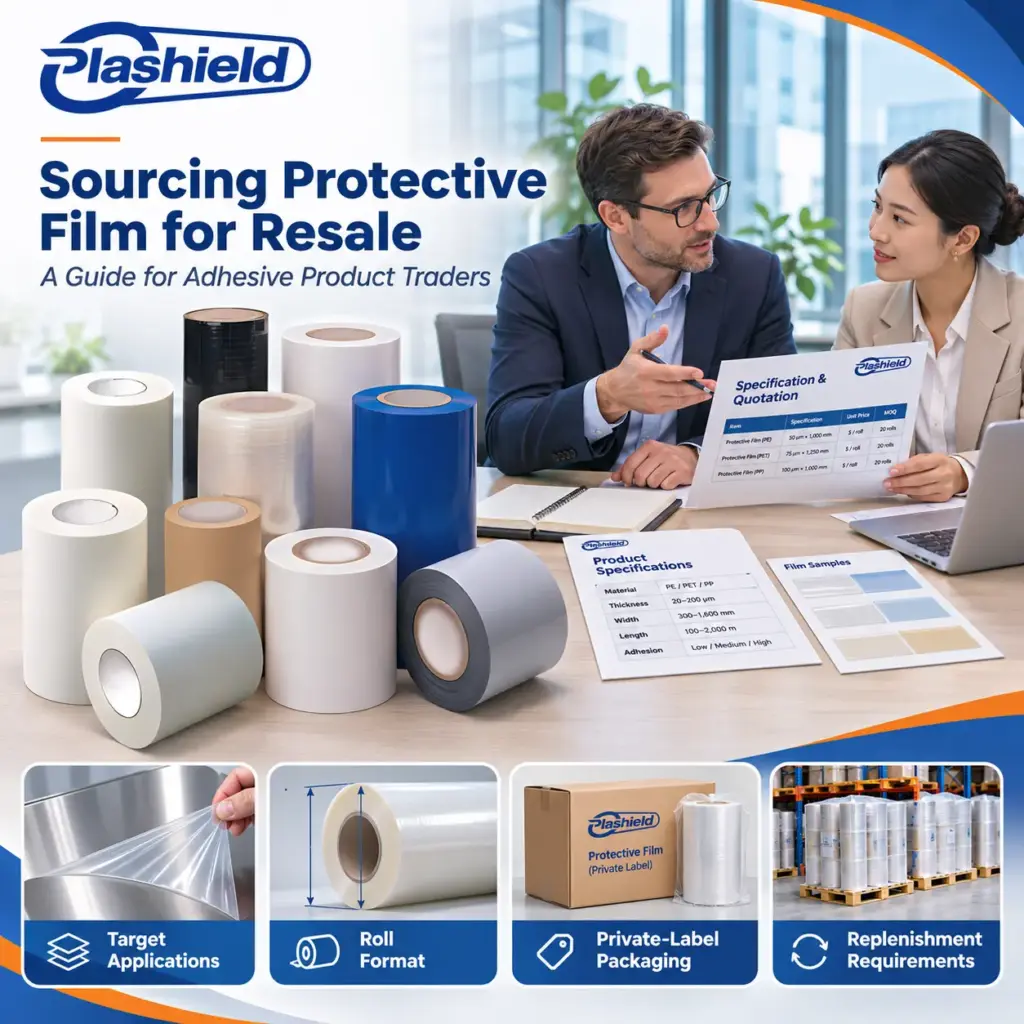
Start with two decisions: which customer applications you want to serve, and whether you will resell finished rolls or convert larger rolls yourself. Then build your quotation around the film, roll format, packaging and replenishment requirements together.
At Plashield, we can discuss your target applications and supply format, including custom slit widths and private-label packaging for suitable products. You can start with your current product list or a few customer requirements rather than a fully developed specification.
Choose a product range you can sell confidently
Build your range around the customers you already know. A trader serving stainless steel fabricators has a different starting point from one selling to flooring installers or profile manufacturers.
Record the surface, finish and next operation for each application. “Metal protection” is too broad to guide a purchase. A mirror-finished stainless sheet, a coated panel and an aluminum profile can require different film selections. The time before removal and any outdoor exposure also belong in that conversation.
Start with a manageable group of repeat applications. Add another specification when it solves a clear customer need, rather than stocking several nearly identical films without a sales plan.
Our stainless steel protective film is one option for traders supplying sheet and coil processors. For channels serving renovation and installation work, our floor protection film provides a separate product route. Treat them as application-specific products, not interchangeable stock.
Buy finished rolls or jumbo rolls?
Choose the roll format around your business model.
| Your operation | Practical purchasing priority | What to agree before ordering |
| You resell without converting | Finished rolls matched to customer demand | Saleable width and length, core, roll protection, labels and carton quantity |
| You slit and rewind in-house | Parent rolls matched to your machine and slit plan | Usable width, roll length, core internal diameter, maximum outside diameter and roll weight |
| You use an outside converter | A coordinated film supply and conversion specification | Who accepts the parent rolls, who owns conversion losses and how finished rolls are identified |
If you have no converting equipment, compare the cost of ready-to-sell rolls before assuming jumbo rolls are the cheaper choice. Outsourced slitting, extra transport and handling belong in the calculation.
If you convert in-house, ask for usable coated width as well as total roll width. Plan the slit widths before you order. A wider parent roll only helps if the extra width becomes products you can sell.
For example, a hypothetical usable width of 1,200 mm can accommodate four 300 mm lanes before any required allowances. Three 350 mm lanes use 1,050 mm and leave 150 mm before those allowances. This is a planning example, not a production yield promise: your converter must allow for edge trim and its actual setup.
Plashield offers custom slitting widths for its stainless steel film. Send your finished-width list or machine limits so we can discuss whether factory-slitted rolls or a larger roll format makes more sense for your order.
Make repeat orders repeat the specification
A customer asking for “the same blue film as last time” needs a product code that means more than its color.
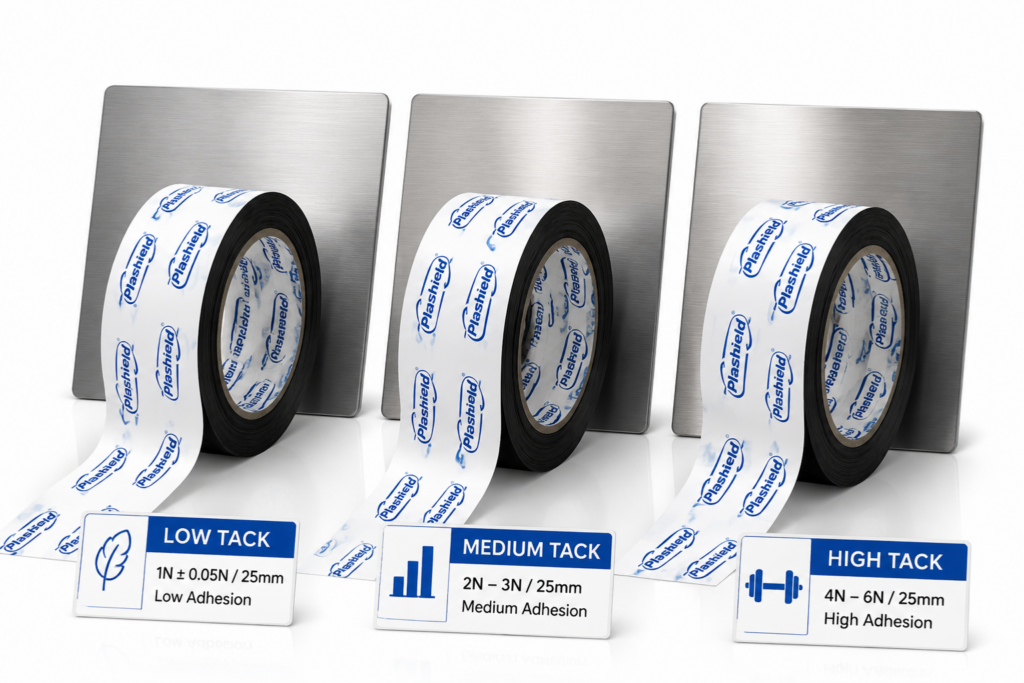
Create a purchase specification for each approved product. Include the backing and adhesive type, thickness and agreed tolerance, adhesion requirement and test method, roll dimensions, color and printing. Keep the approved surface and intended use with that record.
Adhesion results are only useful when the test conditions match. Record the test surface, dwell time, peel method and conditioning used for the comparison. Also agree how the film should behave during the customer’s process and when it is removed.
Keep a reference sample and the batch identification from each delivery. If a complaint appears, ask for the roll code, affected surface and application history before treating it as a general product failure. That gives you and the supplier a specific issue to investigate.
For your next Plashield inquiry, send an existing product code or an approved sample specification if you have one. It is a better starting point for repeat supply than a fresh description on every purchase order.
Compare cost per saleable square metre
A low price per roll can hide a shorter roll, a different thickness or packaging that you still need to finish locally.
First compare equivalent specifications. Then calculate:
Landed cost per saleable square metre = total landed and conversion cost ÷ saleable film area
Include the costs relevant to your route: freight, applicable duties, local handling, slitting or rewinding, packaging and expected conversion losses. Use saleable area after the allowances in your conversion plan, rather than the full purchased area.
Keep different purchasing terms separate. A factory-gate quote and a delivered quote are not the same offer. State the currency, named delivery location, quantity and packaging when requesting comparable prices.
Our PE protective film price guide explains the wider pricing factors. For your business, the useful next step is a current quote based on the rolls you can actually sell.
Make private-label rolls ready for your sales channel
If you sell under your own brand, define the packaging before the order reaches production.
Agree the roll label, carton marking, barcode where required, application instructions and artwork approval process. Make sure customers can identify the product and contact your business, while your team can still trace the batch.
For relevant private-label projects, Plashield supports options such as custom labels, printed cores and cartons, and roll or pallet packaging. Start by telling us where you sell: industrial customers, trade counters, online channels or retail. A carton designed for bulk industrial delivery may not be the right package for individual resale.
Ask for the quotation to separate standard packing from any artwork, printing or packaging requirements. Confirm quantities and commercial terms for each option instead of assuming that every order includes the same customization.
Plan replenishment without filling the warehouse with slow stock
Separate regular sellers from customer-specific products. Reorder your core range using actual sales and the replenishment time agreed with your supplier. Keep unusual widths, printed designs or specialized applications tied to a clear customer requirement.
Your planning window should include production, transport, receipt and any local conversion. Add a buffer based on your sales variation and the risk of interruption, rather than using one fixed stock rule for every product.
When requesting a repeat quote from Plashield, share the quantities you expect to use and your required arrival date. Ask for current production and shipping arrangements. Do not make a delivery promise to your customer from an old quotation.
Turn your product list into a Plashield supply inquiry
You do not need to finalize every technical field before starting the conversation. Send us your current roll list, a customer request or a photo of the surface you need to protect.
The most helpful starting details are:
- The surfaces and customer applications you sell into.
- Whether you resell finished rolls or slit and rewind.
- The widths and roll lengths you need most often.
- Any branding or packaging requirements.
- Your initial quantity and expected repeat demand.
Contact Plashield with those details and ask for a product recommendation and current quotation. We can discuss the film specification and supply format around your business, so your next purchase is easier to sell and easier to reorder.
Frequently asked questions
Should a protective film trader buy jumbo rolls or finished rolls?
Buy finished rolls when you need products ready for resale and have no cost-effective converting route. Consider jumbo rolls when your equipment or converting partner can turn the usable width into saleable sizes at a favorable total cost.
Can one protective film cover all my customers’ surfaces?
Do not build your range on that assumption. Group demand by surface, finish, processing conditions and removal requirements, then select products for those groups.
How do I reduce problems between repeat deliveries?
Use an agreed product specification, consistent test conditions, retained reference samples and batch identification. Keep customer application conditions with the product record.
Can Plashield support private-label protective film?
We offer private-label options for relevant products, including labels and packaging customization. Send your sales-channel and artwork requirements so we can discuss the available format and commercial terms.
What should I send to get a useful quotation?
Start with your target surface or current product list, required roll sizes, resale or converting method, quantity and destination. Add branding requirements if you plan to sell under your own label.
Final thoughts
Choose a protective film supply plan that fits the way you sell. Finished-roll traders need saleable formats and clear product information; converters also need the parent roll to work with their equipment and slit plan.
Send Plashield the products you want to sell and the customer problems you need to solve. We can discuss the appropriate film and roll format, then quote against that requirement.