



During renovations, periods of heavy foot traffic, or when moving, carpet protection film is essential for keeping your carpets clean and undamaged. Different types of carpets have different requirements for protective films. There are many choices on the market. How can you find the most suitable for your needs?
For the procurement of carpet protective film, this guide will explore the protection needs of common carpet types, the key factors to be considered when choosing carpet protective film, and provide test suggestions before bulk purchase to help you reduce the risk of use and maximize the return on your floor protection investment.
Why Do Different Carpet Types Require Different Protection Films
Carpet surfaces of different materials have different surface characteristics. Long-pile and short-pile carpets have different surface characteristics, which will affect the contact and fitting effect between the protective film and the carpet fibers. At the same time, some natural fiber carpets are more sensitive to adhesives and need to pay special attention to the problem of adhesive residue.
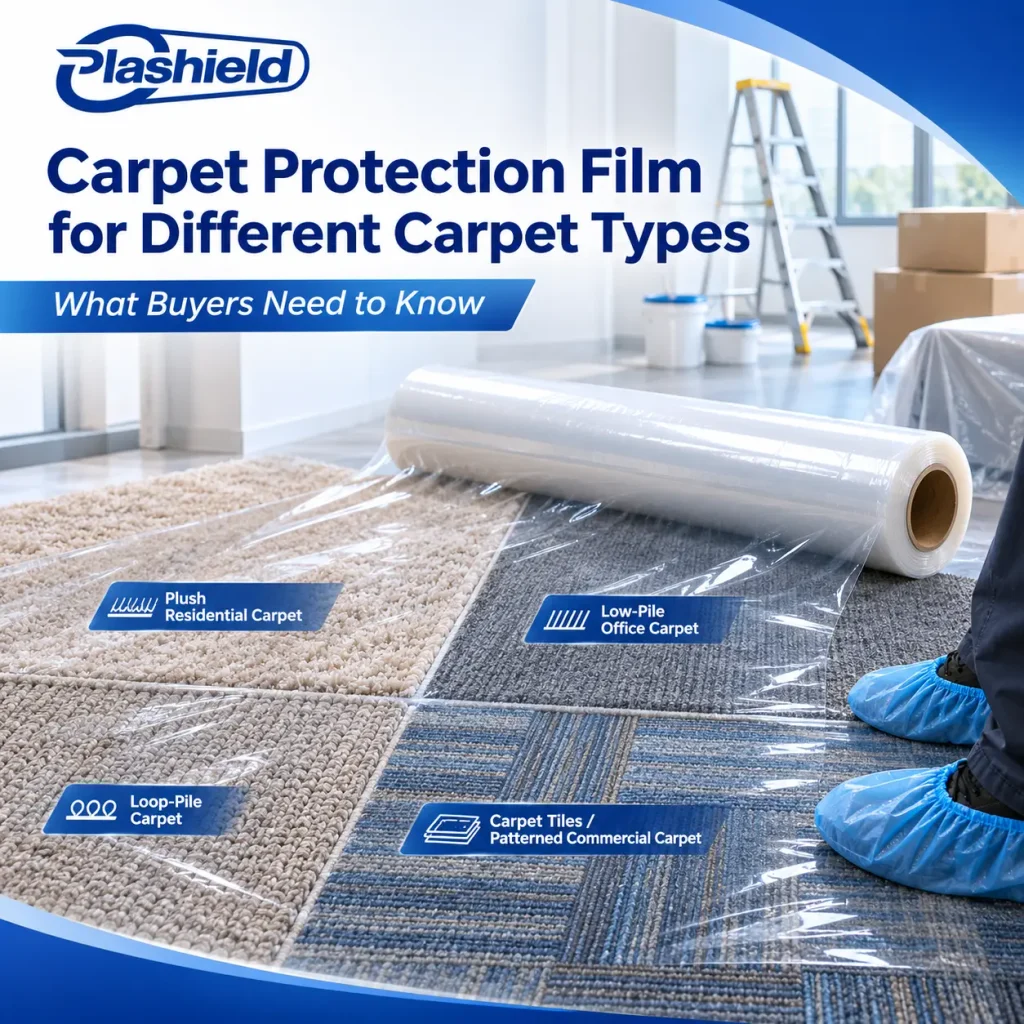
Common Carpet Types and Their Protection Film Requirements
- Nylon Carpet: Nylon carpets offer good abrasion resistance and resilience. When selecting a protective film, focus on adhesion stability.
- Polyester Carpet: Polyester carpets typically have a soft texture. The protective film must balance stain resistance with clean removal to prevent adhesive residue.
- Wool Carpet: Wool carpets are made from natural fibers and have a relatively sensitive surface, with high requirements for the adhesive compatibility of the protective film. Thorough testing should be conducted before use, focusing on checking whether there is adhesive residue or fiber damage after removing the film.
- Berber and Loop Pile Carpet: The surface of this kind of carpet has a distinct looped pile structure, and it is necessary to avoid snagging or pulling the carpet fibers during the removal of the protective film.
- Cut Pile and Plush Carpet: Cut pile and plush carpets have a distinct pile structure. it is necessary to pay attention to the fit of the protective film and to verify that removing the film does not cause the pile to be pulled or deformed.
How to Match Carpet Protection Film to Different Carpet Types
To choose a protective film for different types of carpets, you need to consider the fiber structure, pile height, installation environment, and expected duration of protection. The following summarizes the preliminary selection direction of different carpet types:
Carpet Types Suitable for Standard and Heavy-Duty Protection Films
Tufted carpets, short-pile residential carpets, office and commercial carpets, low-pile carpets, and showroom carpets are all perfectly compatible with standard and heavy-duty protection films. The adhesive of this kind of protective film can be firmly bonded to the short fiber and can be easily removed without leaving residue or damaging the carpet.
High-Pile & Luxury Carpets: Specialized Protection Required
For high-pile carpets, plush carpets, and luxury high-pile decorative carpets, it is not recommended to use standard thin protective films. You must use protective film specifically designed for high-pile carpets or adhesive-free, reusable protective pads. Standard protective film cannot adhere to the structure of high-pile carpets; it is prone to wrinkling and shifting, and is likely to tear or damage the carpet during removal.
Incompatible Surfaces & Key Precautions
It is not recommended to use on non-carpet surfaces. Wooden floors, tiles, vinyl flooring and laminate flooring are easy to adhesive residue after use. Use is not recommended on old, fragile carpets or loosely woven handmade carpets, as applying or removing the film can easily cause fiber breakage and damage. Do not use on damp carpets or those that have just been cleaned and are not completely dry, as this can lead to mold growth and adhesive residue.
Key Factors to Consider When Selecting Carpet Protection Film
Adhesion Level
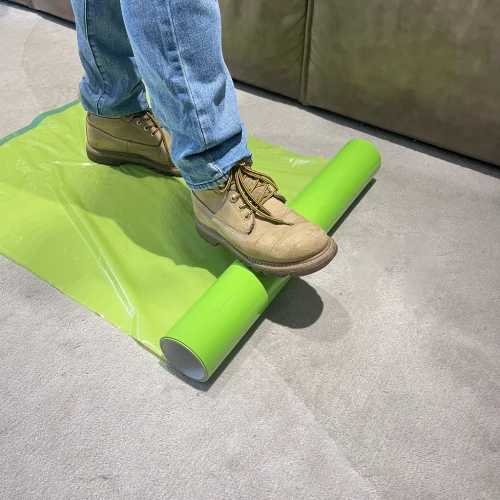
The adhesion of the protective film needs to match the surface of the carpet. When selecting a film, strike a balance between stable adhesion and easy removal.
Film Thickness and Flexibility
In areas with heavy foot traffic and frequent material handling, it is necessary to pay attention to whether the film is prone to wear or punctures. The protective film should also have sufficient flexibility to accommodate the texture of the carpet surface and the installation requirements of different areas.
Adhesive Type
When purchasing, you should pay attention to the compatibility of adhesives with carpet fibers and backing materials, especially for wool carpets, specially dyed carpets, and carpets that have undergone stain-resistant treatment.
Application Duration
The focus of short-term use is to provide sufficient surface coverage and stable adhesion. If it needs to be kept for a long time, it is necessary to consider the sustained adhesion performance and the difficulty of removing the film. The longer the protection period, the more necessary it is to verify the stability of the adhesive in the actual environment in advance.
How to Test Carpet Protection Film Before Bulk Purchasing
For overseas buyers, it is better to verify the product performance through actual carpet samples before purchasing carpet protection film in bulk. We recommend conducting tests according to the following steps:
- Check Adhesion on Different Carpet Samples
Collect carpet samples made of different materials and with varying pile structures, such as nylon, polyester, wool, loop pile, and long-pile carpets. Apply a protective film on a clean and dry surface to check whether the film can adhere securely and whether there are noticeable curling at the edges or shifting.
- Observe Performance Over Time
Observe the adhesion changes of the protective film at different time points to check for curled edges, localized peeling, or surface damage. Record the temperature, foot traffic frequency, and usage conditions in the actual environment to determine whether the protective film can meet the expected protection period.
- Evaluate Removal and Carpet Condition
After reaching the predetermined test period, slowly remove the protective film and focus on checking whether there is adhesive residue, fiber pulling, pile deformation, or color changes.
Why Choose Plashield Carpet Protection Film?
Plashield is a PE protective film manufacturer with more than 20 years of experience, focusing on the production of PE protective film. We can provide customized solutions according to different carpet types and application scenarios, including adjusting the adhesion of the film and the adhesive formula. At the same time, Plashield supports flexible customization services, which can customize the film thickness, width and roll specifications according to your needs. We are committed to providing you with a carpet protective film that takes into account the adhesion stability and cleaning and removal performance while ensuring the protective effect.
As a factory-direct supplier, Plashield can work directly with international buyers to confirm product specifications, conduct sample testing, and handle bulk order production, thereby reducing communication costs throughout the procurement process. Whether for residential renovations, commercial space construction, or carpet protection during moving and remodeling, we can match specific needs with the appropriate product solutions.
If you are looking for carpet protection film suitable for a specific type of carpet, please contact Plashield and provide details on the carpet material, surface structure, and actual application requirements. We can assist in determining the appropriate product specifications and provide samples for practical testing prior to bulk procurement.
FAQs
- Is higher tack always better for carpet protection film? How can I avoid adhesive residue or fiber damage?
No, higher tack is not always better. Adhesive strength must be precisely matched to the carpet type and exposure duration. Excessively high tack can pull carpet fibers or leave sticky adhesive residue during removal. To prevent residue and damage:
- Never apply film to damp or recently steam-cleaned carpets that are not 100% dry.
- Adhere strictly to the maximum recommended application period specified by the manufacturer.
- Remove the film by peeling it back smoothly at a 45-to-90-degree angle rather than ripping it off quickly.
- Can carpet protection film be used on hard surfaces like hardwood, tile, or marble?
No, it is not recommended. Carpet protection film uses an adhesive formulation specifically engineered to grip textured fabric fibers. Applying carpet film to smooth, non-porous surfaces like hardwood, laminate, or tile can cause severe adhesive transfer, leaving difficult-to-clean residue on the floor.
- What are the best practices for applying protection film to carpeted stairs?
Stairs experience high foot traffic and shifting forces. Begin installation from the bottom step working upward. Ensure the film is pressed firmly into the 90-degree angle where the tread meets the riser to prevent air pockets. Use a smooth plastic applicator or carpet roller to press the film into the fibers, and secure high-wear edges with low-residue painter’s tape if heavy traffic is expected.
- Is carpet protection film safe to use in areas with radiant underfloor heating?
Caution is required. Heat from underfloor heating systems can soften the adhesive, altering its chemical properties and increasing the risk of adhesive residue. If using protection film over heated floors, turn off the heating system beforehand or use a specialized film rated for elevated temperature stability.
- What precautions should be taken when protection film is exposed to direct sunlight near windows?
Direct exposure to solar UV radiation and heat can degrade polyethylene film and cause the pressure-sensitive adhesive to cross-link, bonding permanently to the carpet. In sunlit areas or near floor-to-ceiling windows, choose a film with built-in UV inhibitors or block incoming sunlight with window coverings during construction.