



For those who use coated steel products, choosing the appropriate protective film tack is the key to solving most surface protection problems. The tack of the stainless steel protective film directly affects the stability of its adhesion on the surface of the sheet, the protection effect during the processing process, and the degree of cleanliness when the film is finally removed. Common problems with surface protective films, such as adhesive residue, film peeling during transportation, and damage to steel coating, are all caused by improper tack selection. The stainless steel protective film with appropriate tack can effectively protect the steel sheet from scraping and pollution during processing, transportation and storage, and avoid costly secondary surface damage when removing the film.
This article will introduce the difference between low-tack, medium-tack and high-tack protective films, and how to choose the appropriate adhesion according to the actual application requirements.
What Does Adhesion Level Mean in Stainless Steel Protective Film
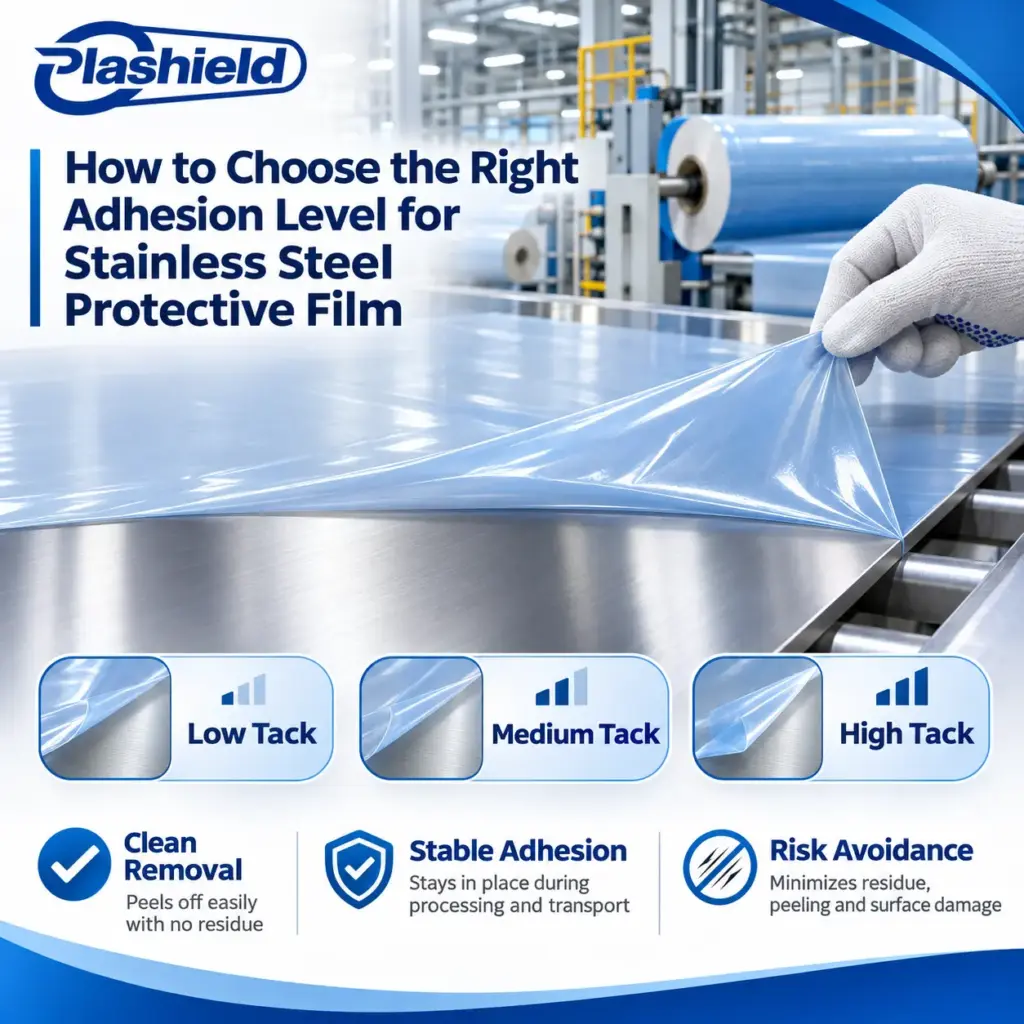
The adhesion of stainless steel protective film refers to the ability of the adhesive to bond with the surface of stainless steel, which directly affects the adhesion stability and difficulty of removing the protective film. The adhesion is not the higher the better. The key is whether the protective film can be stable during processing, storage and transportation, and can be removed cleanly after use.
Low Tack vs. Medium Tack vs. High Tack: What’s the Difference?
| Adhesion Level | Main Characteristics | Typical Applications |
| Low Tack | Lower adhesion, easy peeling, suitable for surfaces sensitive to adhesive residue. | 8K mirror stainless steel, highly polished surfaces, and other smooth finishes. |
| Medium Tack | Balanced adhesion and removability, suitable for general surface protection. | Brushed stainless steel sheets, standard stainless steel panels, and routine handling. |
| High Tack | Stronger adhesion, better resistance to lifting and slipping under demanding conditions. | Rough or textured surfaces, demanding processing applications, and situations requiring stronger bonding. |
It should be noted that low tack, medium tack and high tack are general descriptive classifications in the industry, not a unified grade standard. The adhesive formulas and test methods of different suppliers may be different, and the actual peel strength values will be different. When purchasing, it should be combined with specific product specifications and sample tests should be carried out to confirm whether the protective film meets the requirements of use.
What Factors Affect the Adhesion Requirements of Stainless Steel Protective Film
Stainless Steel Surface Finish
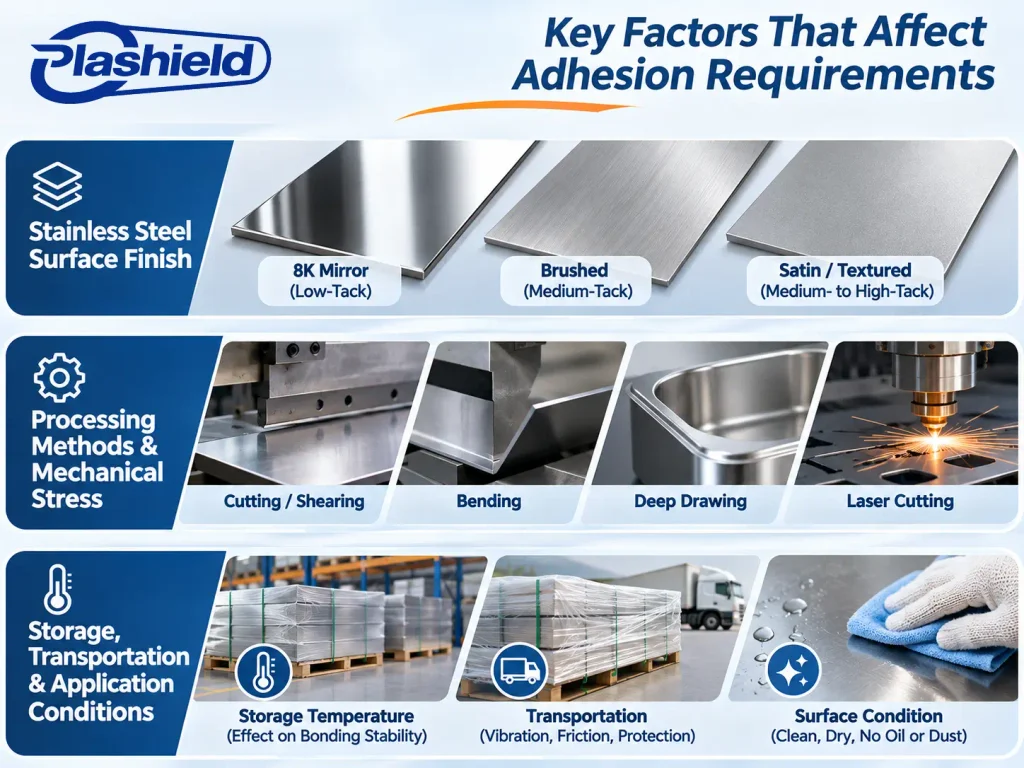
When choosing a protective film, it is necessary to consider the specific surface treatment of stainless steel. The surface of 8K mirror is highly smooth, sensitive to adhesive residue and peeling marks, and is more suitable for low-tack and easy-to-remove adhesives. Brushed stainless steel has obvious directional texture, while satin and other textured surfaces may have more obvious roughness and surface irregularity. These differences will affect the actual adhesion performance of the protective film.
Processing Methods and Mechanical Stress
Different manufacturing processes have different requirements for the adhesion stability of the protective film. During the cutting and shearing process, the protective film needs to maintain sufficient adhesion to avoid displacement. Bending and deep drawing will cause the protective film to stretch and deform with the stainless steel sheet. At this time, attention must not be limited to adhesive strength alone, but must also consider the flexibility and ductility of the base film. For laser cutting, the heat resistance of the base film and adhesive, as well as their compatibility with the laser processing method must also be considered. However, for different processing processes, it is recommended to choose a matching stainless steel protective film, rather than simply increasing the adhesive strength.
Storage, Transportation, and Application Conditions
The environment and operating conditions will also affect the actual performance of the protective film after application. If there is dust, oil or other contaminants on the surface of the sheet before applying the film, it may affect the contact between the adhesive and the stainless steel surface. Temperature fluctuations during storage may also have a certain impact on bonding stability. In addition, it is also necessary to consider the anticipated duration of the protective film’s application. The adhesion performance of the adhesive may change with the adhesion time.
How to Choose the Right Adhesion Level for Different Stainless Steel Applications
Generally speaking, it is recommended to choose a low-tack protective film for 8K mirror and BA surfaces, focusing on avoiding adhesive residue and haze after removing the film; Standard brushed and matte surfaces are usually suitable for medium-tack protective films, which balance adhesion and ease of removal; rough or deeply textured surfaces with medium-high-tack or high-tack protective film can be considered to prevent poor adhesion and edge curling. If the product requires bending, stamping, or deep drawing, the ductility, tear resistance and peeling performance of the film after processing should also be considered.
Due to the different classification of Low, Medium and High Tack in different factories, suppliers should be required to provide specific peeling strength data, test standards and actual samples when purchasing. Conduct tests on the target stainless steel surface to confirm that the protective film will neither peel off easily nor leave adhesive residue throughout its entire service life. At the same time, the choice of suppliers is also very important. Priority should be given to factories that can provide different tack formulas, sample tests and consistent batch quality control.
Common Problems Caused by Incorrect Adhesion Levels
| Common Problem | Possible Causes |
| Protective Film Lifting | Insufficient adhesion, surface contamination, or excessive mechanical stress during processing. |
| Film Slipping During Processing | Inadequate initial tack or insufficient pressure during lamination. |
| Adhesive Residue After Peeling | Excessive adhesion, poor adhesive cohesion, or prolonged application. |
| Difficult Film Removal | Adhesion that is too strong for the removal requirements or adhesive aging over time. |
| Uneven Adhesion | Inconsistent substrate surface conditions or unstable lamination processes. |
These problems are not necessarily caused entirely by tack. When troubleshooting, the adhesive formula, the quality of the base film, the cleanliness of the surface of the sheet and the actual film application conditions should also be considered.
How to Test and Confirm the Right Adhesion Level Before Bulk Purchasing
Before purchasing in bulk, it is recommended to conduct an actual test on the protective film sample to confirm whether the tack meets the requirements of use. Through the following steps, potential problems can be found in advance and the quality risk after bulk procurement can be reduced.
- Compare Peel Strength
If you have a peeling strength tester, you can compare the peeling strength of different samples under the same test conditions, including a consistent peel angle, speed and test substrate, and obtain accurate adhesion performance data.
- Test on Actual Stainless Steel Sheets
Apply the sample on the actual stainless steel sheet for testing, and leave them for 30 minutes, 24 hours, 72 hours and 7 days respectively, to observe the changes in adhesion over these time periods.
- Simulate Actual Processing and Storage Conditions
If the protective film needs to be combined with shearing, bending, stamping or laser cutting, the corresponding processing simulation test should be added to observe whether there is edge curling, film damage or adhesive residue.
- Inspect the Surface Condition After Removal
After finishing, remove the protective film and check whether the protective film is easy to remove, whether any tears occurred, and whether there is any adhesive residue, haze, or changes in surface gloss after removal.
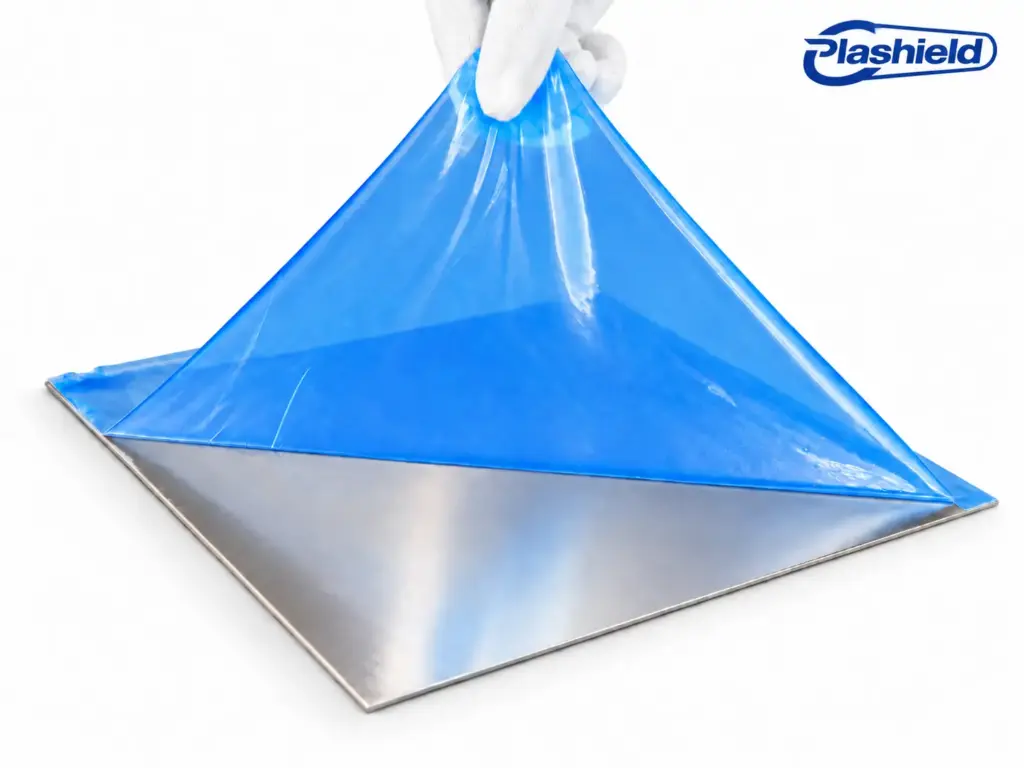
Why Choose Plashield Stainless Steel Protective Film
Choosing a suitable stainless steel protective film not only needs to match the surface tack, but also needs to comprehensively consider the adhesive formula, processing requirements and peeling performance. Plashield offers corresponding protective film solutions according to different stainless steel surface types and application needs. We can customize the tack level and provide matching solutions according to the actual situation and needs you provide. For different applications such as surface protection, cutting, bending and deep drawing, we can also provide suitable stainless steel protective films. At the same time, Plashield prioritizes consistency in adhesion performance across production batches to help customers achieve more stable results. Through tailored product solutions and flexible customization services, Plashield is committed to helping you find a protective film that balances surface protection with easy peel-off performance.
Are you looking for a protective film with the right tack for your stainless steel application? Please contact Plashield, let us know your surface type and processing requirements, and we’ll provide a customized solution and samples for testing.
FAQs
- If residual glue is found after peeling off the protective film, how can it be safely removed without damaging the stainless steel surface?
For minor adhesive residue, you can use IPA or a specialized industrial adhesive remover with a lint-free soft cloth. Never use steel wool, hard scrapers, or strong acid/alkali solvents, as they can scratch the stainless steel surface layer or cause discoloration.
- Why is it sometimes harder to peel off a low-tack protective film than a high-tack one?
This is typically related to “adhesive migration” or “adhesion build-up.” If the protective film remains in a high-temperature, high-pressure, or chemically active environment for too long, even low-tack adhesives can undergo physical or chemical bonding with the metal surface, leading to abnormally high peel strength later on.
- Does the backing film thickness affect the choice of adhesive strength?
Yes. Thicker protective films offer higher impact resistance and rigidity, but their edges are more prone to lifting due to elastic recovery forces; therefore, they usually require a slightly higher tack to maintain bonding. Thin films have good flexibility and can bond stably on flat surfaces using lower tack.
- How can air bubbles or trapped dust be avoided during the protective film application process?
Before lamination, ensure the stainless steel surface is clean, free of oil, and dust-free. It is recommended to use a rubber roller laminating machine for continuous pressing, controlling the lamination speed and roller pressure, and operating in a dust-free or low-dust workshop environment.
- During stamping or deep-drawing processes, is a protective film tearing or detaching caused by insufficient tack or a substrate issue?
This is usually caused by insufficient substrate elongation or inadequate tensile strength rather than just adhesive tack. Stamping processes require specialized deep-drawing films featuring high elongation and good lubricating properties.