



Laser cutting allows for fast and precise processing of metal sheets, but the surface of the sheets still needs to be protected during cutting and handling. Standard protective films may not be designed for high temperature, high-speed cutting and mechanical conditions involved in laser processing. In the process of stainless steel laser cutting, the protective film not only needs to protect the surface of the sheet from scratches and contamination, but also needs to withstand the high temperature environment generated by laser cutting process. Adhesion stability, film strength, heat resistance and ease of removal will all affect the performance of the film during the cutting process and after cutting. If the protective film does not match the laser cutting process, various problems may occur after cutting, such as burrs at the edge of the film, black spots caused by carbonization of the adhesive layer, and even localized fusion between the protective film and the sheet surface, making it difficult to peel off.
Therefore, the choice of stainless steel laser cutting protective film should be based on the actual application. Factors such as laser process, metal surface, cutting conditions, adhesive system and required protection duration need to be comprehensively considered. This article will introduce common protective film problems, causes and prevention methods in the laser cutting process, and analyze how to choose a suitable laser cutting film for stainless steel sheet from the actual processing needs.
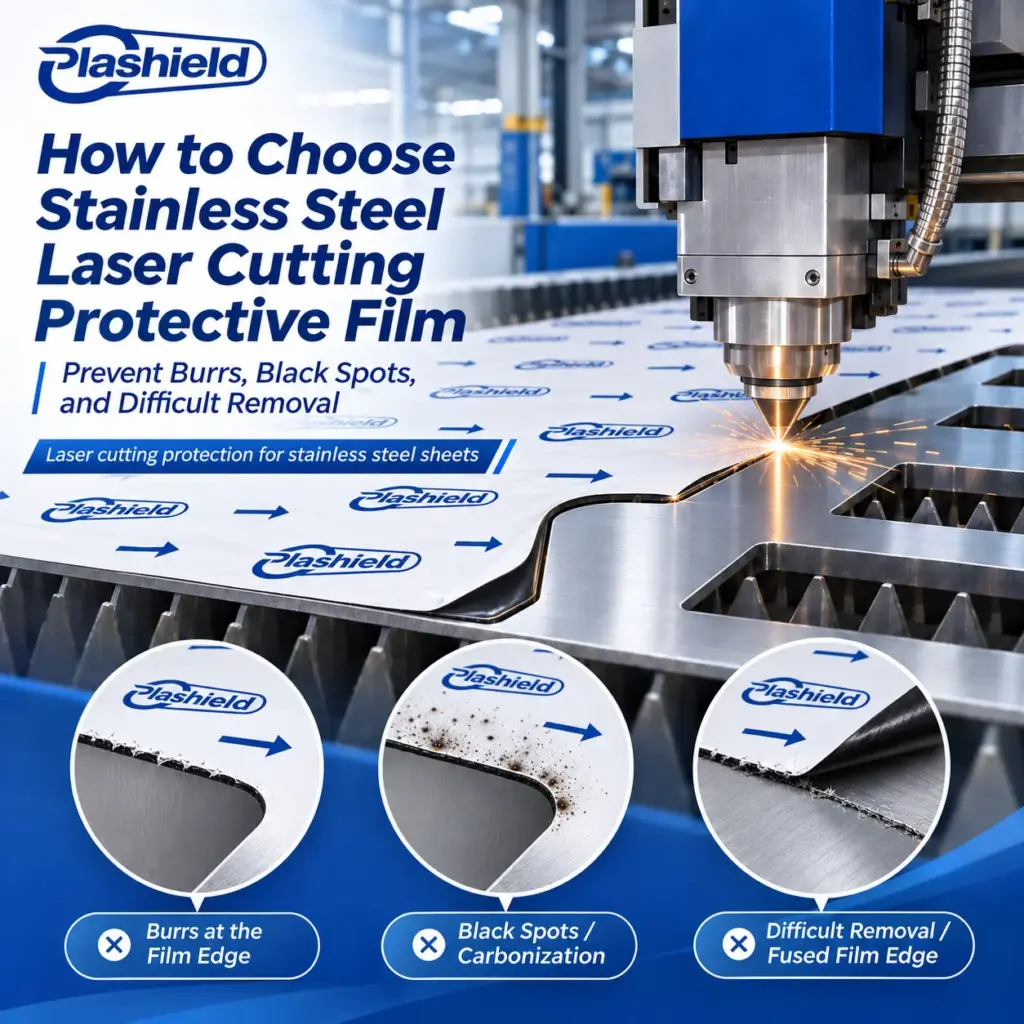
3 Common Problems with Stainless Steel Laser Cutting Protective Film
Film Edges Are Not Fully Cut or Have Rough Burrs
A common problem is that the laser has cut through the stainless steel sheet, but has not completely severed the protective film on the surface. After the processing is completed, irregular burrs or rough edges appear on the edge of the protective film. In this case, it is easy to have problems such as uneven tearing along the edges in the process of removing the film.
Black Spots and Carbonized Adhesive After Laser Cutting
The appearance of black spots around the laser cutting area is a particularly challenging issue in stainless steel processing, especially on the processing mirror surface. These black spots come from the thermal decomposition of the protective film substrate or adhesive under the action of local high temperature. When the adhesive layer is exposed to excessive heat, some of its components decompose to form carbonized residues.
Protective Film Tears or Becomes Difficult to Remove
Some protective films adhere normally before cutting, but after laser processing, they become difficult to remove, resulting in delamination or even adhesive residue. This is because the local high temperature during laser cutting may change the physical properties of the protective film and adhesive. The film may becomes brittle or damaged by heat, and the adhesive may undergo thermal degradation, resulting in changes in the original peeling properties.
Why Do These Problems Occur During Laser Cutting & Solution
The appearance of burrs, black spots or difficulty in removing the film after laser cutting does not necessarily mean that the protective film itself has quality defects. In many cases, the problem is that the material characteristics of the protective film do not match the actual processing conditions. Here are three factors to consider and their corresponding solutions.
Mismatch Between Laser Parameters and Protective Film
In actual processing, parameters such as laser power, cutting speed, focus position and nozzle assist gas collectively determine the energy input to the cutting area, and the energy input will affect the state of the protective film. When other conditions are similar, insufficient power or excessive cutting speed may prevent the protective film from being fully cut through. On the contrary, if the input energy is too high, the thermal impact on the protective film and adhesive layer will increase, making it prone to scorching or carbonized residue.
Solution: When selecting the protective film, it needs to be tested in combination with the thickness of the sheet, the type of laser and the actual cutting process. Especially when changing the protective film supplier or adjusting the film thickness, it should be re-verified whether the original cutting parameters are still applicable.
Unsuitable Film Material and Adhesive Formulation
Different PE materials vary in molecular structure, density, and thickness. If the substrate is prone to obvious shrinkage or thermal deformation under laser exposure, irregular residue may occur at the cutting edge, affecting the complete severing of the film. The adhesive formula is also one of the influencing factors. Adhesives not only need to maintain stable bonding properties at room temperature, but also need to consider the chemical changes when heated. Some common water-based acrylic adhesives may undergo thermal decomposition under high temperatures, carbonized residues or other byproducts. If the polymers and adhesive components in the formula are not suitable for the laser processing environment, even if the coating amount is not high, there may be obvious black spots and adhesive residue problems.
Solution: When choosing a laser cutting protective film, you can’t just look at whether the substrate is PE or whether the adhesive is water-based. What’s more important is to check whether the substrate and adhesive have been tested for laser cutting applications, and whether they can still maintain controllable peeling performance after cutting.
Improper Adhesive Coating Weight
The amount of adhesive coating also needs attention. If the amount of coating is too thick, the adhesive layer near the cutting path may produce more thermal decomposition byproducts when exposed to laser heat, increasing the occurrence of black spots and carbonized residues. At the same time, If the adhesive layer is too thin, which may lead to insufficient initial adhesion, and the protective film cannot firmly adhere the stainless steel surface. In the process of laser cutting, a poorly adhered film may curl or peel off in certain areas, affecting processing stability. In addition, it is also necessary to pay attention to the uniformity of the adhesive layer. Avoid local coatings that are too thick or too thin, which may cause inconsistent cutting performance in different positions.
Solution: The coating thickness of laser protective film needs to be adjusted according to the adhesive formula, substrate performance and actual processing conditions. An appropriate coating thickness ensures stable adhesion while minimizing thermal decomposition residues from the adhesive layer during laser cutting.
How to Choose the Right Laser Cutting Protective Film for Stainless Steel
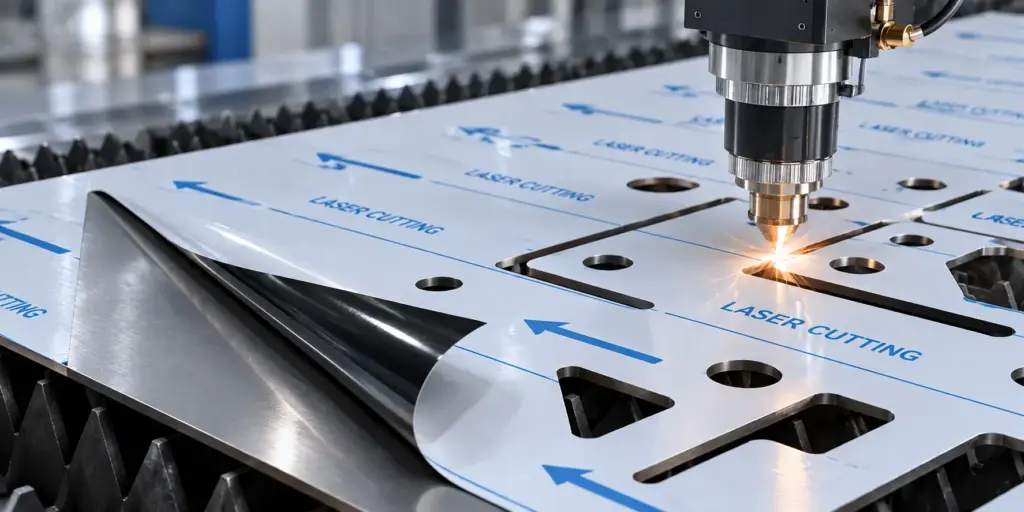
When choosing a laser cutting protective film, you can not only look at the laser power, but also make a comprehensive judgment in combination with the sheet thickness, cutting speed and actual processing conditions. PE substrates and pressure-sensitive adhesive formulas specially designed for laser cutting should be selected instead of using standard stainless steel protective film directly. The adhesive needs to take into account heat resistance and peeling properties, and the amount of adhesive application should also be reasonably controlled to avoid the adhesive layer being too thick to increase carbonized residue, or too thin to cause curl during processing. Finally, conduct on-machine testing with actual equipment to verify cutting results, adhesive residue, and peel performance before finalizing specifications for bulk procurement.
Why Choose Plashield Laser Cutting Protective Film?
For stainless steel processing plants, choosing a reliable laser cutting protective film supplier is crucial not only for cutting quality but also for production efficiency and procurement costs. Plashield offers water-based adhesive laser cutting protective films specifically developed for stainless steel processing applications, providing customers with a more cost-effective solution.
Plashield’s laser protective film for stainless steel focuses on the balance between adhesion performance and post-processing peeling performance. By optimizing the adhesive formula and coating process for the laser cutting process, we reduce the risk of issues such as excessive carbonization of the adhesive layer, adhesive residue, and difficulty in peeling the film during processing. At the same time, we can also provide corresponding product specifications according to the actual processing needs of customers.
Contact Plashield to request free samples of water-based adhesive laser cutting protective films. Test product performance on your actual production equipment to find a protective solution that meets your processing needs at a more reasonable procurement cost.
FAQs
- Does stainless steel surface finish affect the selection of laser cutting protective film?
Yes. Different surface finishes have different surface characteristics and protection requirements. Mirror-polished stainless steel is particularly sensitive to visible surface defects, while brushed stainless steel has a directional texture that may require consistent film adhesion across the surface. The film should be evaluated according to the surface finish, appearance requirements, and subsequent processing steps.
- How does sheet thickness influence laser cutting protective film selection?
Sheet thickness affects the cutting conditions required to process the material. Thicker sheets may require different combinations of laser power, cutting speed, and assist gas, which can change the thermal exposure experienced by the protective film. Therefore, film specifications should be validated against the actual thickness range processed in the factory rather than selected based on a single sheet specification.
- Is laser cutting protective film suitable for stainless steel parts that undergo additional fabrication processes?
Yes, provided the film is compatible with the subsequent manufacturing operations. Stainless steel components may undergo bending, stamping, welding, or other fabrication processes after laser cutting. Manufacturers should evaluate whether the film can remain securely attached during these operations and whether it can be removed without affecting the finished surface. A dedicated film specification may be necessary when several processing stages are involved.
- How long can laser cutting protective film remain on stainless steel after processing?
The allowable application period depends on the adhesive formulation, storage environment, temperature exposure, and surface condition. Extended storage after laser cutting may change the peeling behavior of some protective films, particularly if the material has experienced localized heating. Manufacturers should establish a recommended removal period through aging and post-processing tests under their actual production and storage conditions.
- Can laser cutting protective film be applied to stainless steel coils before the sheets are cut?
Yes. In many industrial applications, protective film is applied to stainless steel coils or sheets before they enter downstream processing lines. This allows the material surface to remain protected during storage, transportation, and subsequent fabrication. However, the film must be compatible with the entire processing sequence, including uncoiling, leveling, feeding, and laser cutting.