



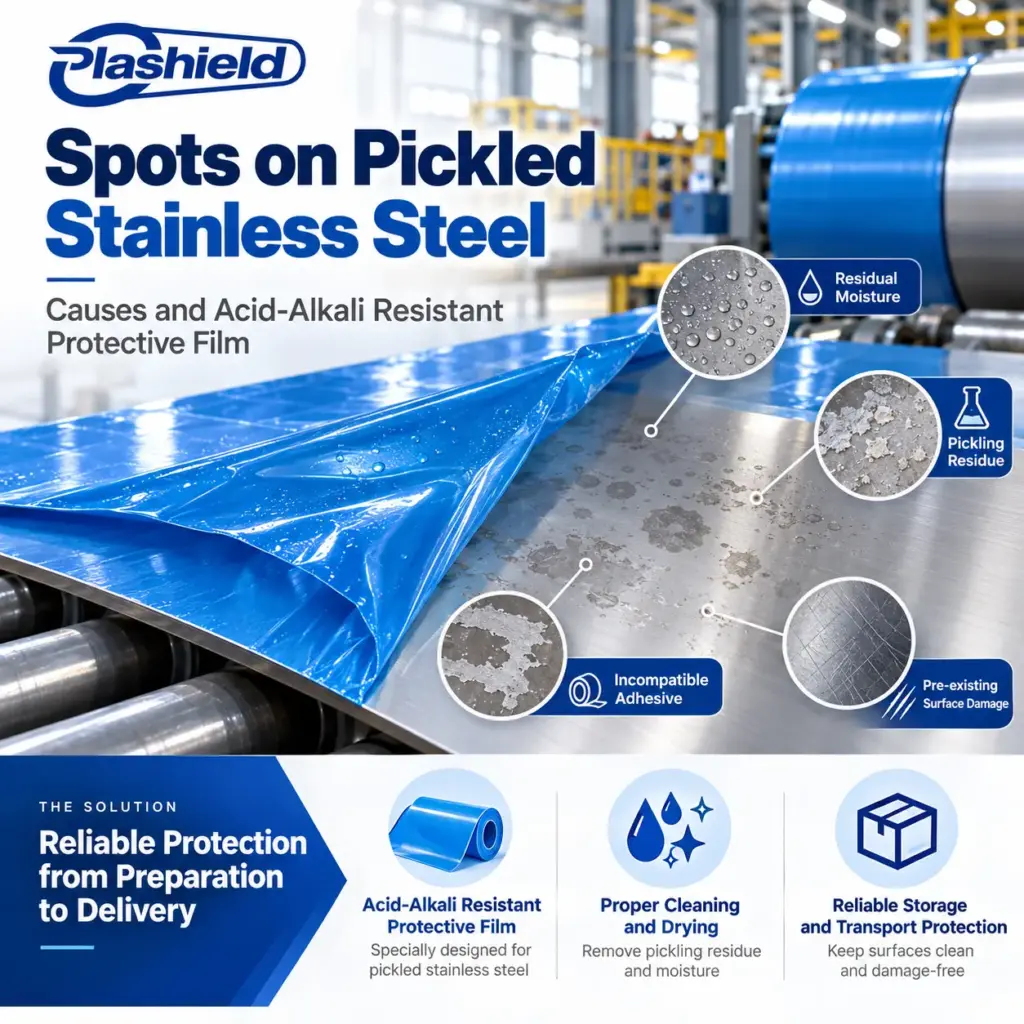
Many customers who make pickled stainless steel sheets have encountered such a scene: the stainless steel sheets after pickling appear normal when the protective film is first applied. But when the film is removed after some time, spots, watermarks, or even localized adhesive residue appear. This not only affects the appearance of the sheet, but also increases the cost of cleaning and rework. Spots under the membrane may be caused by residual moisture, pickling residue, incompatible adhesives, or surface damage that existed prior to film application.
Therefore, two types of problems need to be solved at the same time: whether the sheets have undergone proper cleaning and drying,, and whether the adhesive system of the PE protective film is suitable for subsequent processing, transportation, and storage. This article will introduce the troubleshooting method of spots, as well as more reliable procurement and usage requirements.
Why Do Stains and Water Marks Appear Under Protective Film
Residual Moisture and Acid on the Sheet
If pickled sheets are sent to the lamination process before being thoroughly rinsed and dried, moisture and chemical residues are likely to remain trapped between the metal and the adhesive layer. Laminating the sheet will seal these residual acids and moisture beneath the film, affecting the contact between the sheet surface and the adhesive layer. Residual acid may damage the adhesive layer or continue to corrode the sheet. To obtain a spotless surface with good corrosion resistance, it is necessary to thoroughly rinse off the pickling residue.
When checking, special attention should be paid to the edge of the sheet, drainage marks, and the location where water is easy to accumulate. The middle of the sheet looks dry, which does not mean that all areas have reached the conditions for lamination.
An Adhesive That Does Not Match the Surface Chemistry
Stainless steel protective films that perform well on polished surfaces may not necessarily be suitable for acid-etched surfaces. Using an unsuitable adhesive can lead to various problems, including unstable adhesion during use, adhesive residue upon removal, and even the appearance of hazy marks. When selecting a stainless steel protective film, it is necessary to comprehensively consider the surface texture, chemical state, and subsequent production processes of the stainless steel to match it with the appropriate film material. It is also important to confirm whether the adhesive layer can remain stable after a period of storage or environmental changes.
Excessive Pickling or Incomplete Rinsing
Pickling conditions need to match the steel grades and follow the relevant process requirements. Improper handling may damage the panel surface even before the film is applied. Inadequate rinsing may leave chemical residues on the panel surface. In addition, the water quality will also have a certain impact. When the water contains high levels of total dissolved solids, mineral deposits may form after drying, resulting in water rings or streaks that resemble adhesive layer defects.
Excessively high acid concentration or temperature, or prolonged contact time, may all damage the surface condition of the sheet. These variables should be checked comprehensively when troubleshooting problems.
How to Choose Protective Film for Pickled Stainless Steel
Specify Acid and Alkali Resistance for the Actual Exposure
Give priority to the stainless steel protective film suitable for pickling sheets. When selecting, inform the supplier of the pickling medium, cleaning method, surface condition, film application temperature, and expected storage duration, and request a protective film that matches the actual operating conditions and requirements. It should be noted that the acid-resistant adhesive is not the same as a neutralizing agent; you cannot rely on the protective film to remove residual acid from the sheet surface. Even if a special formula is used, qualified washing and drying should be completed first.
Treat a Clean, Dry Surface as a Release Requirement
Special adhesives also needs a suitable substrate surface. The substrate must be clean and dry when applying the protective film. Before application, inspect the sheet surface for visible contamination, dryness, and any process residues.
Optimizing Adhesive Application Quantity
The appropriate application quantity helps the adhesive layer to form stable contact with the actual pickled surface. However, it should not assume that chemical resistance is improved simply by increasing the application quantity. The decision to increase the application quantity should be based on the adhesive formulation, the condition of the board surface, and peel test results, while also evaluating adhesive residue and film peel performance. It is recommended to ask the protective film manufacturers to compare different application schemes under the same conditions, and check the adhesion, adhesive residue and board surface appearance after aging.
Application Precautions for Pickled Stainless Steel
- After pickling, rinse thoroughly with water and dry the material before proceeding to the lamination process When watermarks appear repeatedly, you should check the drainage condition and the quality of the rinse water first, and then consider adjusting the protective film. Lamination roller and handling equipment should also be kept clean.
- Keep the lamination area clean. The membrane roll should avoid direct sunlight and extreme environments. When the cold sheet material enters the warm and humid workshop, it should wait for it to reach a suitable condition for lamination, confirm that there is no condensation on the surface.
- Manage the storage cycle and schedule film removal in advance. Processing and removing the film should be scheduled within the protection period, and it should not be stored for a long time.
Common Misconceptions About Acid-Resistant Protective Film
- Applying more adhesive does not necessarily result in better protection. Adjustments to the coating process require comparative testing. The higher initial adhesion does not mean that the anti-spot performance is better, nor does it guarantee cleaner film removal.
- Marks that appear after removing the film are not necessarily caused by the film itself. Water-related deposits, adhesive residue, and panel damage each require different corrective measures. The cause should be determined by first comparing the results to a reference sample.
- Just because a sample passes inspection once does not mean it can be used for all future orders. Changes in panel source, surface condition, cleaning chemicals, or storage conditions can all alter the results.
Why Choose Plashield Protective Film for Pickled Stainless Steel?
Plashield offers PE protective films formulated with a specialized acid- and alkali-resistant adhesive, developed specifically for acid-pickled stainless steel surfaces. We pay attention to the actual condition of the sheet surface, as well as the specific requirements for the protective film related to production and delivery schedules. We can work with you to optimize the adhesive system, coating weight, and film structure, with the goal of ensuring stable adhesion during the temporary protection period and clean removal when the film is peeled off. Combined with proper surface preparation, this helps minimize issues such as spots and watermarks associated with protective film application.
Please provide Plashield with details regarding the steel grade, surface condition, cleaning process, film application conditions, and expected protection period. Based on this information, we can recommend a suitable PE protective film solution and arrange sample verification prior to bulk purchase.
FAQs
- Why do spots or stains still appear after applying protective film to stainless steel sheets that have undergone passivation?
Although passivation enhances corrosion resistance, if post-passivation rinsing is incomplete or sealing agents are not fully dried, trace acid salts or passivation residues become trapped beneath the airtight protective film. Trapped under changing temperature and humidity conditions, these residues undergo galvanic or electrochemical reactions, leading to localized micro-pitting or osmotic spotting.
- Why does protective film occasionally tear or shred during removal from pickled sheets?
Acid-etched surfaces feature microscopic surface roughness that offers significantly higher mechanical interlock than smooth, polished surfaces. If the film’s PE backing lacks sufficient tensile/tear strength, or if the peel adhesion exceeds the yield strength of the film, tearing occurs. Specialized heavy-duty films with high tensile resistance are recommended for etched substrates.
- How can you distinguish whether post-removal marks are “adhesive residues” or “acid burn / water-spot etching”?
Apply a solvent test using anhydrous ethanol or a dedicated adhesive remover:
- If the mark wipes away easily or rolls off under manual friction, it is adhesive residue or low-molecular-weight exudate.
- If the mark persists and reveals microscopic pits or localized metal discoloration under side-lighting, it represents surface etching caused by over-pickling, trapped rinse acids, or mineral deposits from hard rinse water.
- Why do different batches of pickled stainless steel show varying peel performance with the same protective film?
Minor fluctuations in pickling line parameters—such as bath acid concentration, temperature, rinse water total dissolved solids, or residual rolling oils—alter the surface energy and chemical state of the steel. Variations in surface free iron or micro-roughness directly impact the wetting kinetics and long-term release characteristics of pressure-sensitive adhesives.
- What are the potential risks of excessive coating weight?
Indiscriminately increasing the coating weight not only fails to enhance corrosion resistance but also poses three major risks: First, after the film is applied, adhesive tends to bleed at the edges, attracting dust from the air; second, as the storage period lengthens, the cross-linking reaction between the adhesive and the metal surface intensifies, causing the peel strength to increase exponentially; third, when the film is peeled off, large areas of adhesive residue are likely to be transferred.