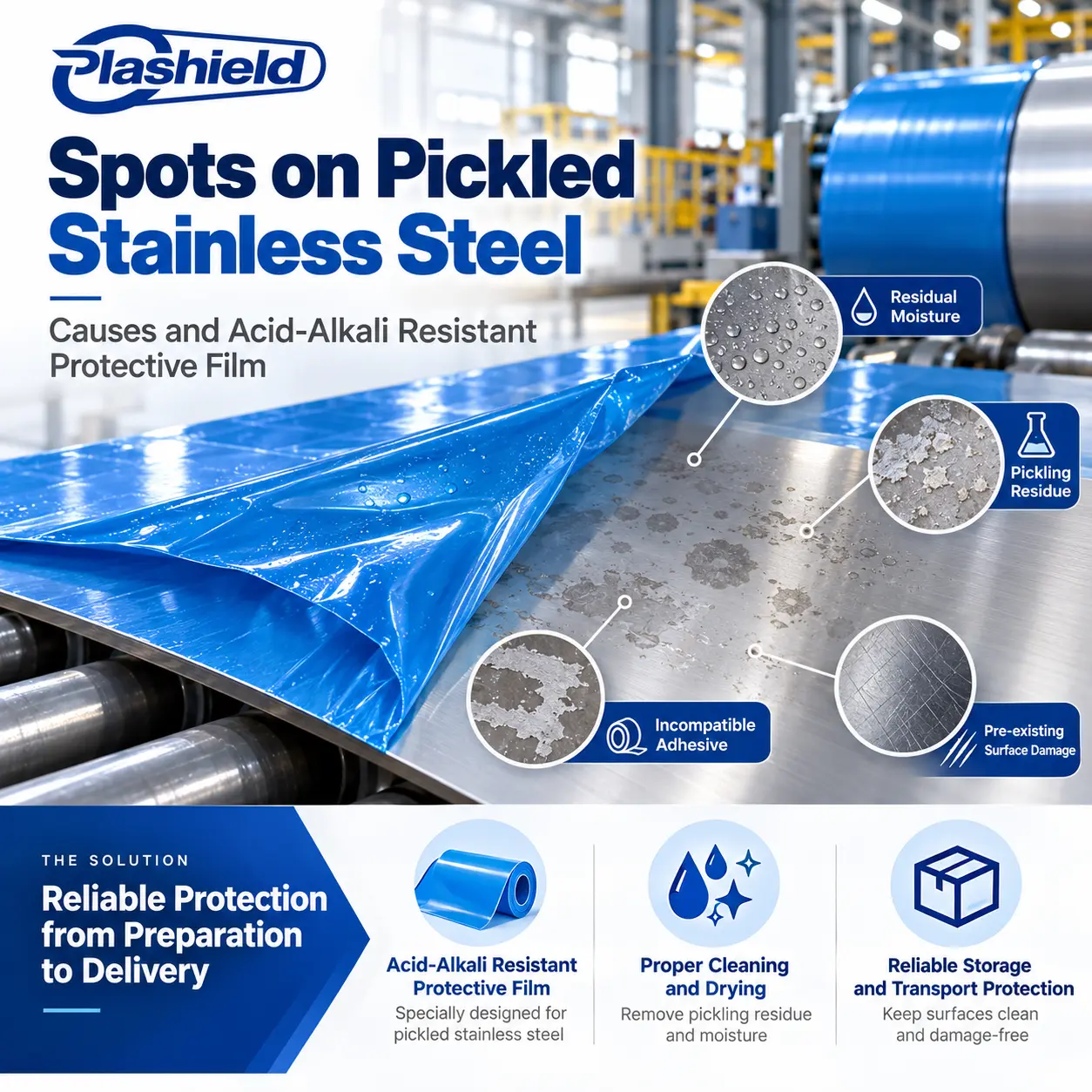




8K mirror-finish stainless steel sheet has a very high surface finish, and any slightest particles, uneven adhesive layers, or residual marks become obvious under reflective lighting. For manufacturers of high-end decorative panels, elevator panels, home appliance panels and other mirror-finish stainless steel products, damage to a stainless steel sheet means it should be repolished or scrapped entirely. Therefore, the mirror protective film is not a mere optional consumable, but a part of the product quality commitment. It is also very important to choose the right surface protective film for stainless steel. It must not only to effectively prevent scratches during transportation, processing and installation, but also to maintain stable adhesion during use, and restore the sheet’s original mirror finish as much as possible after removal.
This article will introduce three common problems and five purchase keys of 8K mirror stainless steel protective film to help you make better decisions.
3 Common Problems with Protective Film for 8K Mirror Stainless Steel
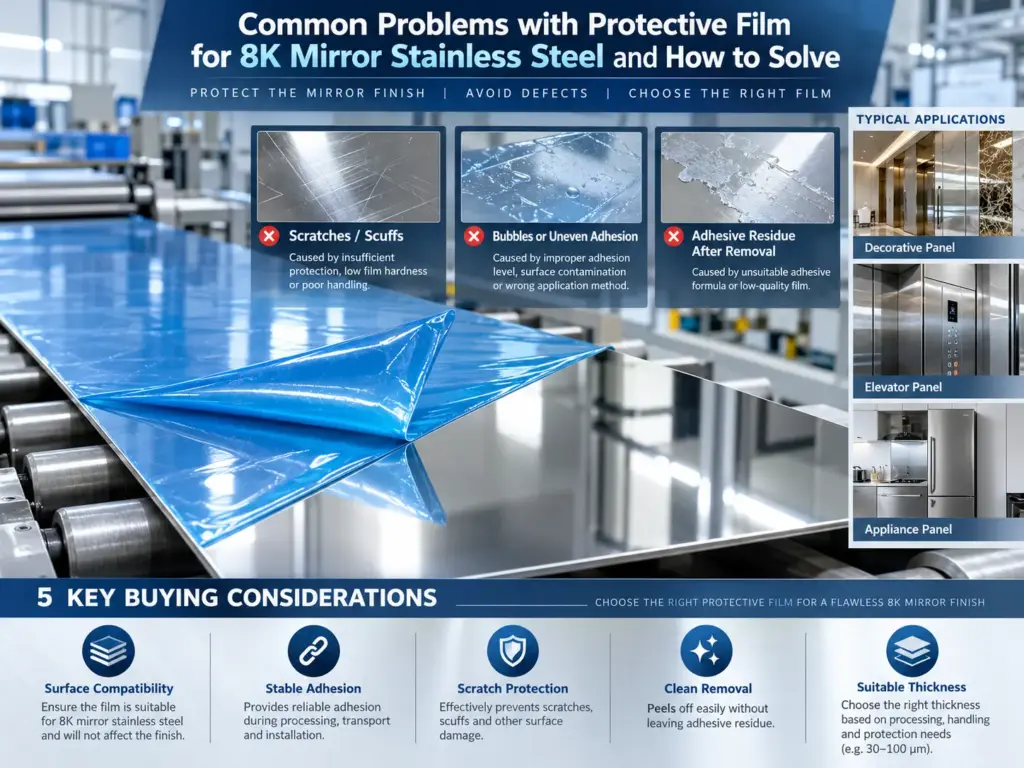
Adhesive Residue and Ghosting
Ghost is the number one complaint about the mirror panel. After tearing the film, the panel surface may appear hazy, or the traces of glue will be reflected in the whole sheet. Such traces are difficult to remove because the adhesive has been partially transferred to the panel surface or has already begun to polymerize there. The root cause of this kind of situation is typically: the adhesive system is inappropriate, excessive adhesive application, or the coating is not dried properly, and the solvent and moisture are locked in the adhesive layer. The reliable verification method is to conduct an adhesive residue test on the panels before the large-scale production, tear it off after 7-14 days according to the actual storage temperature, and then check the surface to determine if it can be removed cleanly and retain the original luster of the mirror as much as possible.
Particle Imprints and Bubbles
On the surface of 8K mirror stainless steel, small dust, bubbles or localized adhesion issues may form obvious appearance defects. These foreign particles may cause raised spots on the surface of the protective film; if the air is not discharged smoothly when applying the film, it may also form bubbles or localized indentations. Because the surface of the mirror panel is optically flat and has a strong reflective effect, these subtle problems are often more obvious under specific light. The prevention methods for such problems are simple but effective: clean application environment, proper melt filtration, and particle inspection of each roll before shipment.
Crystal Defects and Green Spots
Crystal spots, black spots or green spots may appear on the surface of the protective film or stainless steel sheet, and they come from the impurities of the substrate. High temperature and tension turn them into visible crystal spots or green spots, and directly transferred onto the optical surface. It is different from particle imprinting. Particle imprinting comes from the outside and appears under pressure, while the crystal spots comes from the inside of the film and appears under heat. The occurrence of this phenomenon is usually related to cost reduction. Using clean, virgin materials to optimize the blowing film formula can effectively avoid such problems.
How to Solve Common Protective Film Problems on 8K Mirror Stainless Steel
How to Remove Adhesive Residue Without Damaging the Mirror Finish
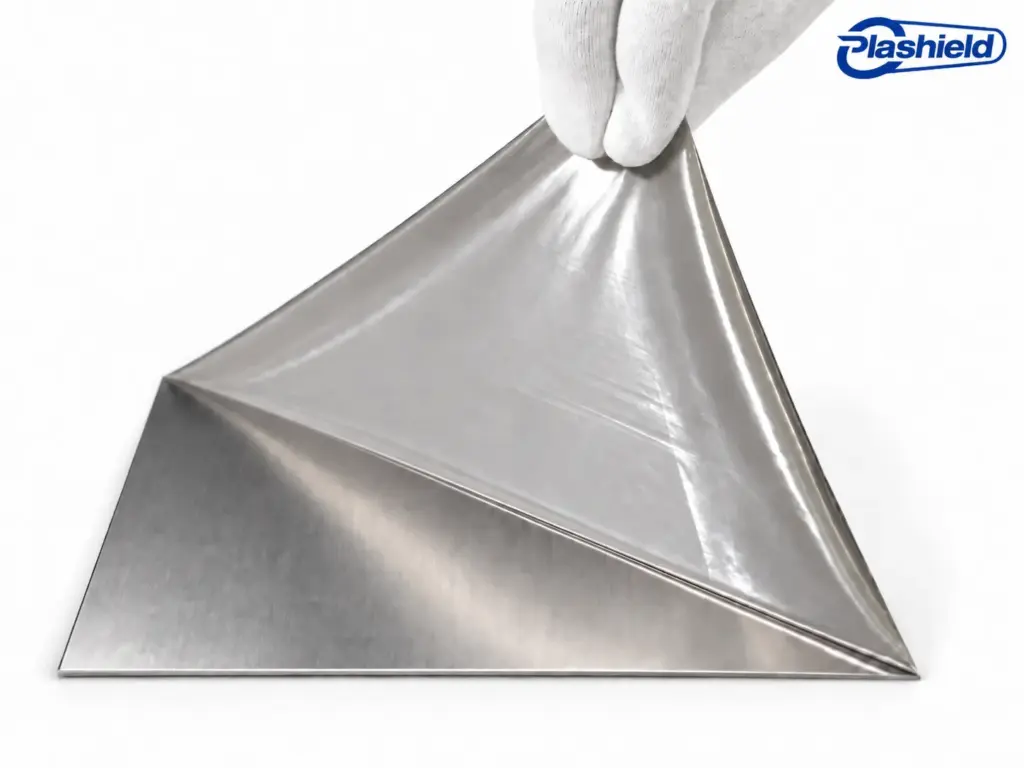
When a hazy adhesive residue or ghosts appear after removing the 8K mirror stainless steel film, it is not recommended to use strong solvents, abrasive materials or vigorous wiping to clean it immediately, which may further damage the mirror surface. A safer practice is to test the cleaner in a small area first, confirm that it will not affect the surface of the sheet or subsequent processing. If the adhesive residue is difficult to remove, it is necessary to further investigate the use time, storage temperature and removal conditions of the protective film. For future purchases, it is recommended to use the actual mirror panel for film, storage and film removal tests first, and confirm that the performance meets requirements at every stage before bulk use.
How to Prevent Particle Imprints and Air Bubbles
If there are particle imprints or bubbles on the mirror panel, it should be distinguished first whether the defect comes from the protective film itself, or the dust, pollution or air residue in the process of applying the film. You can remove the protective film first, observe whether the defect still exists, and then compare the unfilmed area and the unused film roll samples to identify the likely source of the problem. In daily production, maintain cleanliness of the panels and equipment, reduce particle pollution in the environment, and ensure that the pressure and speed of the film are appropriate, and the air can escape smoothly. If similar particle defects occur repeatedly, the supplier needs to check the cleanliness of the film, the coating surface and the quality of the roll material.
How to Identify and Eliminate Crystal Defects and Green Spots
Crystal spots, black spots, and green spots may come from the protective film, or may be related to the stainless steel substrate or surface treatment process. When troubleshooting, first determine the location of the defect. If the abnormality occurs inside the film, the cleanliness of the raw material, the pollution during the extrusion process and the filtration control should be checked. If there are still the same defects on the sheet surface after removing the film, it is necessary to further check the quality of the substrate and the surface treatment processes.
How to Choose the Right Protective Film for 8K Mirror Stainless Steel
When choosing a protective film suitable for 8K mirror stainless steel, should focus on five key aspects: The adhesive needs to be adapted to the mirror surface with high gloss and low roughness to avoid adhesive residue or ghosts after removing the film; PE substrate should maintain good cleanliness and minimize particle defects. In addition, consider the uniformity of corona treatment and adhesive coating, the impact of drying process on the stability of the adhesion layer, and whether the supplier has reliable finished product inspection and batch quality control capabilities.
Before bulk purchase, sample testing is also required to evaluate the film effect, the adhesion changes after storage, and the adhesive residue and appearance performance after removing the film.
Why So Many Factories Get Mirror Film Wrong
Mirror-finish stainless steel protective film may appear to be nothing more than ordinary PE film with an adhesive layer, but to meet the high requirements of the 8K mirror panel for cleanliness, adhesion stability and film release effect, there are strict requirements for raw material control and production technology.
- In order to reduce costs, some suppliers may neglect the cleanliness of raw materials and impurity control during the extrusion process, or use recycled materials, resulting in crystal spots, black spots, or particle defects on the film.
- Lack of specialized adhesive formulation designed for high-gloss surfaces, the direct use of general-purpose protective film adhesives can easily lead to issues such as uneven adhesion, adhesive residue after long-term application, or hazy marks left behind after removal.
- The line speed is too fast. While a faster line speed means higher output, it can prevent moisture from evaporating completely, resulting in a hazy finish.
Why Choose Plashield Protective Film for 8K Mirror Stainless Steel
For 8K mirror stainless steel, the protective film should not only prevent scratches during transportation and processing, but also preserve the sheet’s original luster and mirror finish as much as possible. Plashield focuses on 5 key points, focusing on the quality control of the whole process from PE substrate, adhesive formulation to coating process, helping to reduce common problems such as particles, uneven adhesive layers and adhesive residue. For different surfaces or sizes, Plashield also provides custom stainless steel sheet protective film customized according to your thickness, width and peeling strength requirements to help you select the most suitable surface protective film for stainless steel. At the same time, Plashield also provides sample test support. You can conduct application, storage and peel tests on actual stainless steel sheets, evaluate the protective effect, adhesion stability and the risk of residue in advance before finalizing product specifications for mass production.
Choosing Plashield’s surface protective film for stainless steel not only adds a protection to the mirror panel, but also provides a more reliable guarantee for the surface quality and the consistency of the finished product in the production process. Please feel free to contact us for a personalized quote and sample service.
FAQs
- What is the “ghosting” phenomenon upon film removal, and how does it differ from standard adhesive residue?
Standard adhesive residue typically leaves tangible, localized chunks of glue on the metal. In contrast, “ghosting” appears as a hazy, clouded, or iridescent outline corresponding to the coating tracks. This is usually caused by inappropriate adhesive formulations, excessive coating thickness, or trapped moisture/solvents that trigger micro-chemical reactions with the mirror finish, altering localized reflectivity and making it extremely difficult to clean.
- Why are the requirements for protective film on 8K mirror stainless steel much higher than those for regular brushed or 2B finish sheets?
8K mirror-finish stainless steel features an extremely high surface finish and optical flatness, presenting a reflective mirror state. Under such high reflectivity, even the slightest imperfections are magnified by light refraction. Therefore, mirror protective films not only need to prevent scratches, but also demand exceptionally high standards for substrate cleanliness, crystal point control, and the prevention of adhesive residue or ghosting.
- Can a standard mirror protective film be used directly if the stainless steel sheet requires subsequent laser cutting?
Standard mirror protective films are generally not recommended for direct fiber laser cutting. Laser cutting requires specialized fiber laser protective films, which feature optimized wavelength absorption properties, enhanced heat resistance, and tailored release profiles to prevent film melting, edge scorching, detaching, or vaporized contamination of the mirror surface.
- What Information Should Buyers Provide When Requesting Custom Stainless Steel Sheet Protective Film?
To obtain a suitable custom solution, buyers should provide the stainless steel surface finish, required film thickness, roll width, target adhesion level, expected application period, and primary processing methods. If the sheets will undergo stamping, bending, or other specialized operations, the relevant processing conditions and quality requirements should also be specified. Providing actual sheet samples or clearly defined surface acceptance criteria can further help the supplier assess compatibility. More detailed requirements make it easier to select specifications that balance surface protection, process compatibility, and removal performance.