



Choosing the right commercial roofing system impacts your building’s performance, durability and long-term asset value. Two of the most common membranes are TPO and PVC. For roofing contractors, project estimators, and building owners, the goal is not simply to choose the best single-ply roofing membrane, but the one that is best suited to the specific needs of the project. This guide provides a detailed comparison of TPO and PVC roofing membranes, covering their definitions, advantages and disadvantages, cost differences, service life, and ideal applications. It is designed to provide you with comprehensive insights to help you decide on the best roofing solution for your commercial property.
Understanding TPO and PVC Roofing
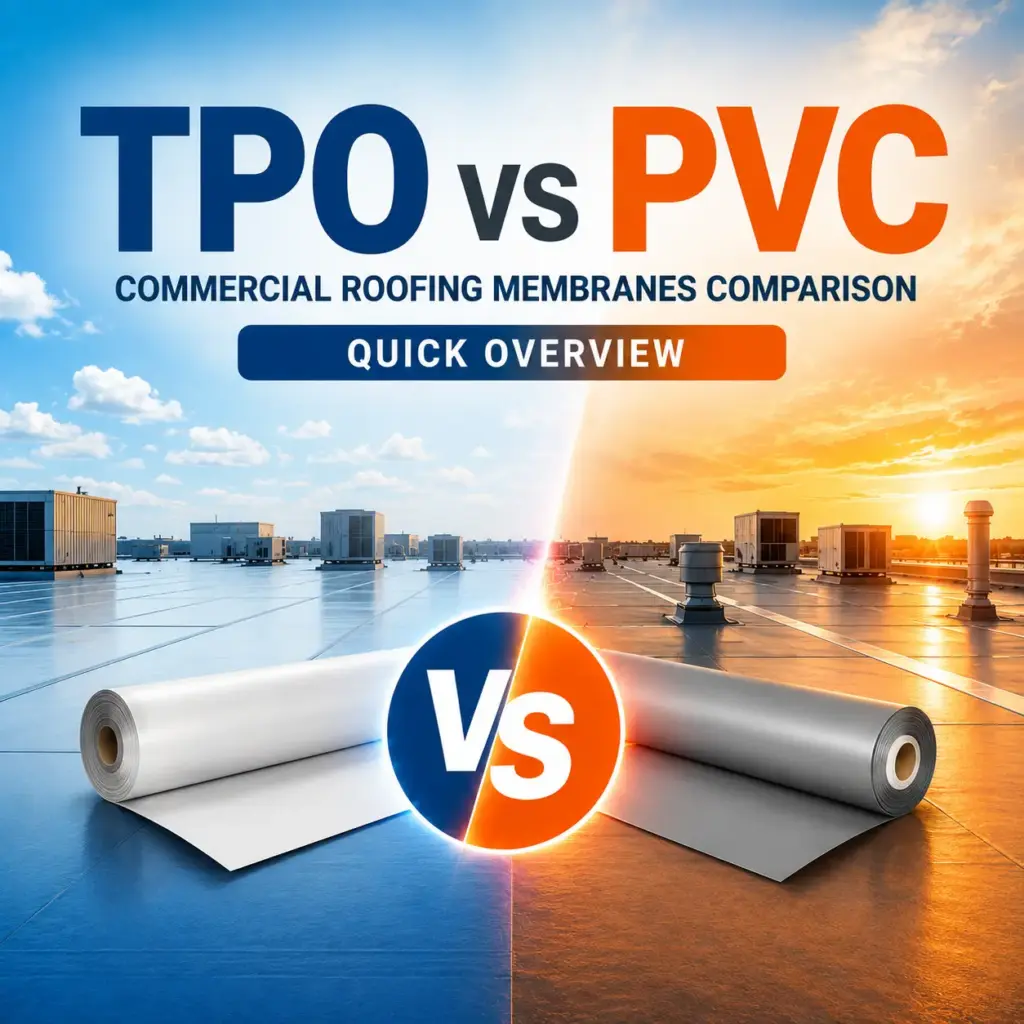
TPO and PVC are both thermoplastic single-ply roofing membranes commonly used in commercial low-slope and flat roof systems. Although both offer excellent water resistance, each has its own unique advantages. Selecting the most appropriate solution requires a comprehensive consideration of factors such as project conditions, budget, building use, and long-term performance requirements.
TPO is a cost-effective roofing solution designed to reflect UV radiation, significantly improving energy efficiency by reducing heat absorption. Because PVC offers excellent resistance to chemical and grease corrosion, it has been the material of choice for commercial roofing for decades. This material maintains its integrity in a variety of environments, including industrial settings that demand extremely high chemical resistance.
TPO vs PVC: Quick Overview
| Factor | TPO Roofing | PVC Roofing |
| Material Composition | Made from a polymerized rubber blend | Made from Polyvinyl chloride membrane with plasticizers |
| Service Life | Typically last 15-20 years | Typically last 20-30 years |
| Cost | Lower upfront | Higher upfront |
| Energy Efficiency | Reflective surface reduces heat gain | Reflective + chemical/fire benefits |
| Chemical Resistance | Moderate | Excellent; resists chemicals, grease and oils |
| Flexibility | Good, especially in newer formulations | Good, but can depend on plasticizer performance |
| Maintenance | Moderate | Moderate to low |
| Best Use Cases | Cost-sensitive projects like warehouses, retail, offices, general commercial roofs | Demanding commercial and industrial roofs like restaurants, factories, chemical exposure areas, high-performance roofs |
What Is TPO Roofing?
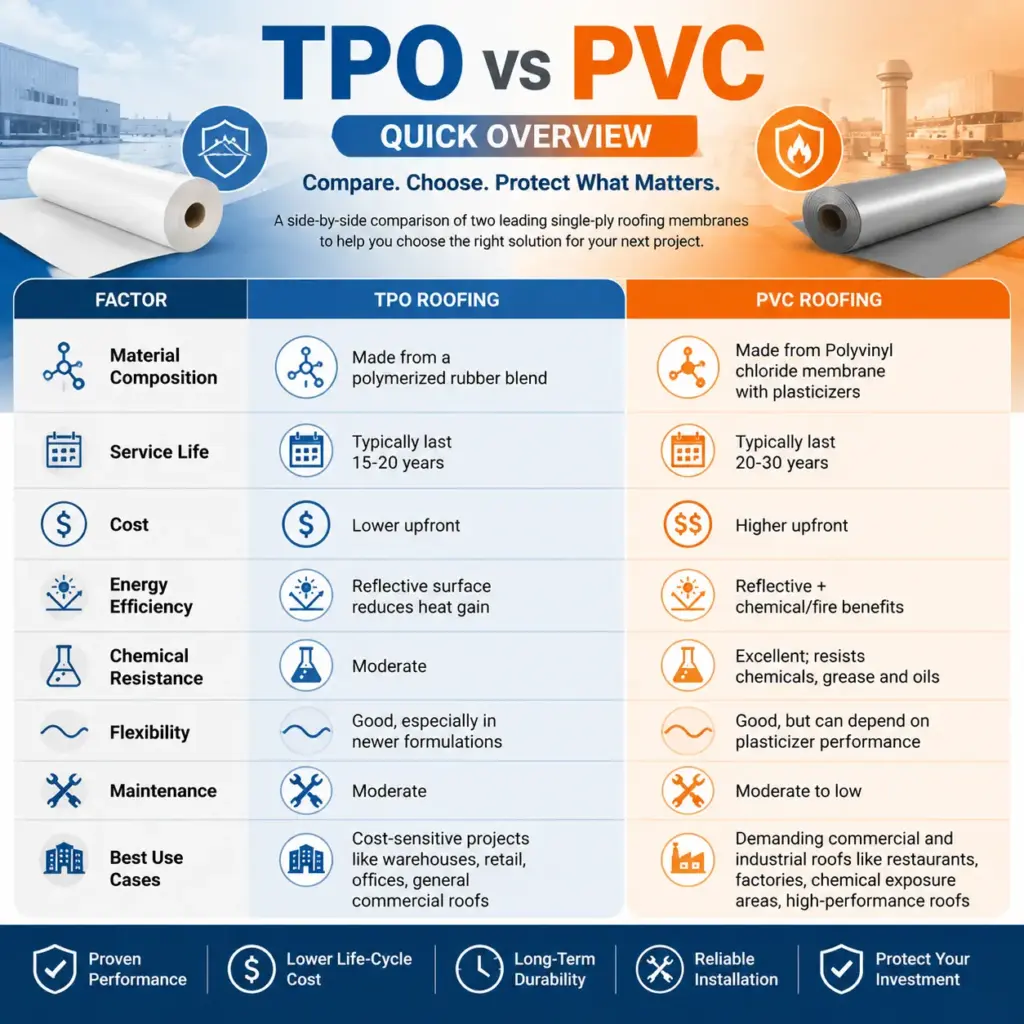
TPO is a single-ply roofing membrane made from a blend of polypropylene and ethylene-propylene rubber. It is typically white, reflective, lightweight, and heat-sealable. This material is widely used in commercial low-slope and flat roof projects, including warehouses, office buildings, retail centers, schools, and various other commercial building roofing projects.
Pros of TPO Roofing
- TPO roofing materials are known for their affordability and are a cost-effective roofing option, with installation costs lower than those of many other materials.
- TPO is an energy-efficient roofing system. White TPO membranes can reflect up to 87% of UV rays, thereby lowering indoor temperatures and reducing energy consumption. It is precisely because of this reflective property that the U.S. Department of Energy has designated TPO as a “cool roof” material.
- TPO membrane is lightweight and comes in wide sheets, which makes the installation process faster and less labor-intensive. This convenient installation method can reduce labor costs and speed up project progress.
Cons of TPO Roofing
- Compared to PVC, durability issues are more pronounced. Although TPO roofing systems are long-lasting, their service life is typically shorter than that of PVC roofing systems. This depends on the quality of installation and environmental conditions.
- TPO has a relatively short history of on-site application and has been in commercial use for a shorter period than PVC, so long-term data on it is more limited.
What Is PVC Roofing?
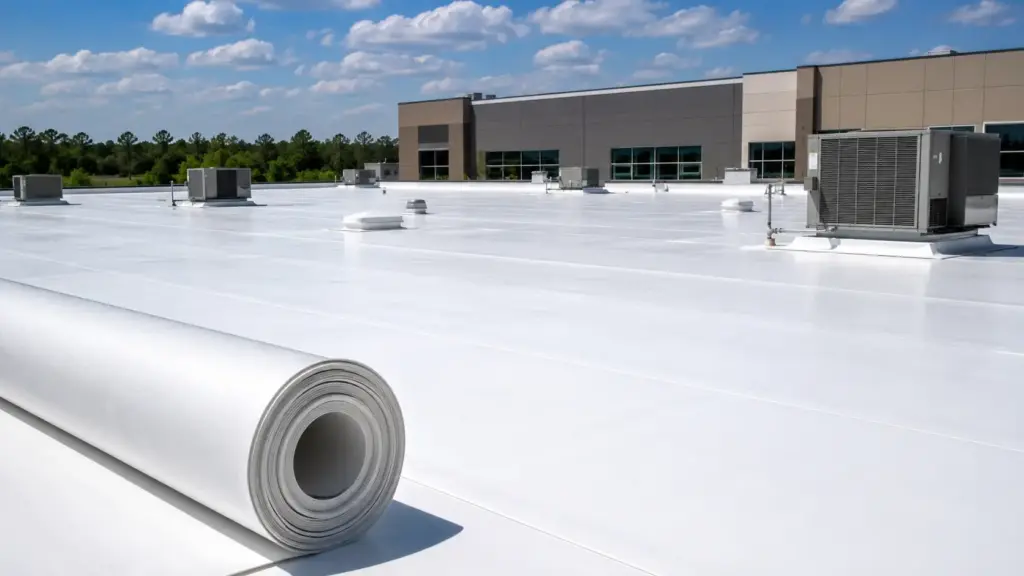
PVC is also a type of thermoplastic single-ply roofing membrane, typically formulated from PVC resin, plasticizers, stabilizers, reinforcing materials, and performance-enhancing additives. This material is widely recognized for its exceptional resistance to chemical corrosion, grease, and oil, as well as its fire-retardant properties. Polyvinyl chloride is widely used in commercial roofing applications, such as in food service establishments, food processing facilities, and buildings where the roof is exposed to grease, acids, or other highly corrosive chemicals.
Pros of PVC Roofing
- PVC roofs offer exceptional durability. Typically, a properly installed PVC roof can last 20 years or more, and with proper maintenance, some installations can even last 30 years.
- PVC roofing offers excellent resistance to chemical corrosion. It is an ideal choice for buildings in industrial areas or facilities that discharge oils and certain chemicals.
- PVC membrane materials are inherently flame-retardant. They are designed to self-extinguish upon contact with flames, offering exceptional fire resistance and thereby enhancing the overall safety of the building.
Cons of PVC Roofing
- PVC roofing has a higher upfront cost, which may exceed that of other roofing materials, including TPO. This investment reflects the material’s durability, lifespan, and performance, but it may not fit everyone’s budget.
- Although PVC roofing is durable, chemicals are used in its production, and if not properly managed, they may pose a risk to the environment.
TPO vs PVC Roofing Cost Comparison
Upfront Material Cost
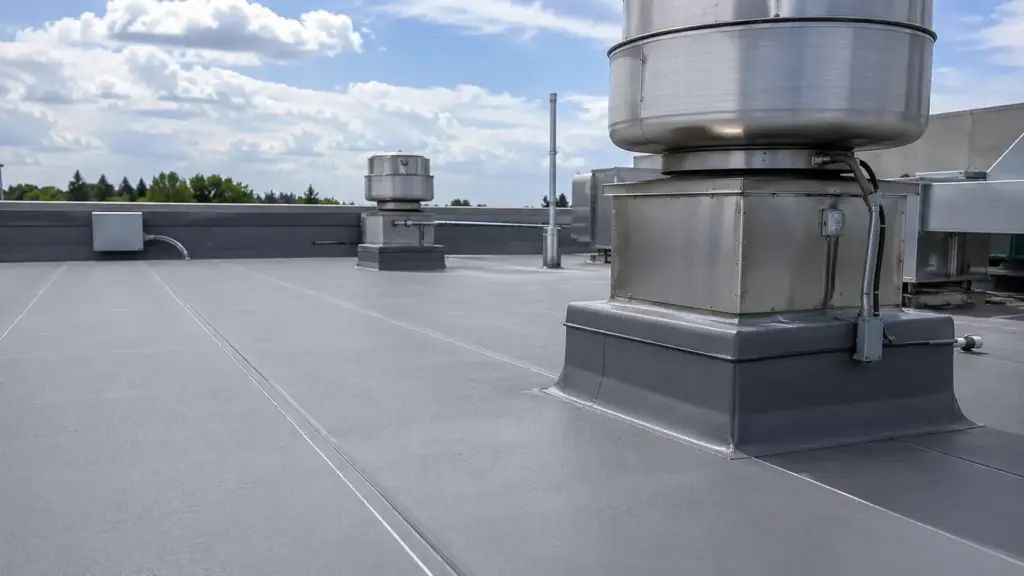
Overall, TPO is generally less expensive than PVC. PVC is more expensive due to its superior chemical resistance and long-term performance stability. In addition, the cost of the membrane depends on factors such as thickness, reinforcement method, manufacturer, warranty terms, region, and order quantity.
Installation Cost
Installing this type of membrane material also involves a series of costs, including labor, hardware, and adhesive expenses. Installation costs depend on factors such as roof area, fastening method, thermal insulation performance, and construction details.
TPO roofing systems remain among the most cost-effective commercial roofing systems available today; their lower material costs and simplified installation process can significantly reduce upfront expenses. Due to the addition of plasticizers and special formulations, polyvinyl chloride (PVC) is more expensive. On average, the installation cost of PVC is 15% to 25% higher than that of comparable TPO systems.
Maintenance and Lifecycle Cost
The maintenance costs for both systems are relatively low. Regular inspections, cleaning, and seam checks are sufficient to ensure they function properly. Because TPO material is easy to weld using hot air, repairs are typically faster and less expensive. PVC repairs, on the other hand, may require stricter temperature control to avoid damaging the membrane.
Basic maintenance is essential for extending the service life of a roof. Keep the roof surface clean and free of debris, maintain a well-functioning drainage system, and inspect the roofing system regularly. If properly maintained, PVC and TPO roofing systems can last 20 to 30 years, depending on the installation method, membrane thickness, manufacturer specifications, and the quality of the membrane’s chemical composition. On average, PVC’s superior durability typically results in a longer service life.
Performance Comparison: Durability & Weathering
Durability
Both materials are known for their strength and resistance to various environmental factors. TPO roofing is designed for high durability, offering excellent tear, puncture, and impact resistance. It can withstand hail and other severe weather conditions, which helps extend its service life and enhance its reliability.
Similarly, PVC roofing offers exceptional durability and strength. It is highly resistant to chemicals, oils, and fuels, making it an ideal choice for commercial and industrial settings where exposure to chemicals is possible. In addition, PVC roofing provides excellent fire resistance, offering an extra layer of safety for buildings and their occupants.
Weather Resistance
How to Decide for Your Building
For buildings—such as restaurants, food processing plants, factories, or laboratories—that are chronically exposed to grease, oil, chemicals, or industrial pollutants, require excellent fire resistance and chemical resistance, and prioritize life-cycle value over initial cost, PVC roofing membranes are recommended.
Plashield TPO roofing membrane Features
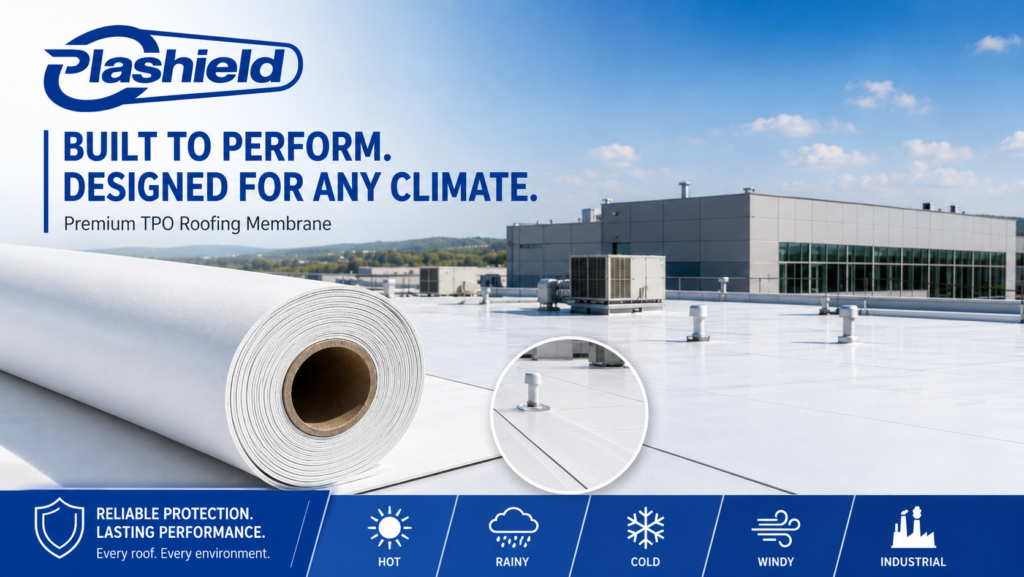
Plashield’s TPO roofing membrane is designed to withstand a wide range of climatic conditions and installation environments, offering stable and reliable performance. In accelerated aging tests, the membrane maintained stable physical properties even after 10,000 hours of exposure; it did not crack when folded at temperatures as low as -50°C, and remained stable for up to 672 hours in a continuous high-temperature environment of 135°C. This excellent temperature resistance makes it particularly suitable for regions with significant seasonal temperature fluctuations, effectively preventing the roofing membrane from cracking over time.
The membrane’s formulation is free of chlorine and plasticizers, and no harmful substances are released during production or use, ensuring excellent environmental performance. Since the material contains no plasticizers that could gradually leach out, Plashield’s TPO membrane retains its flexibility over the long term. Its surface also effectively inhibits the growth of algae and mold and performs exceptionally well in highly acidic or alkaline environments, making it an ideal choice for a wide range of industrial applications.
In terms of installation, this waterproofing membrane is manufactured in 2.0-meter-wide rolls, effectively reducing the number of on-site seams required for large-area roofs and lowering the risk of leaks at the seams. Seams are formed using a hot-air welding process; this flameless installation method not only enhances on-site safety but also ensures a strong and uniform bond between membrane sections. Plashield offers a variety of waterproofing membrane products in multiple specifications, including reinforced, backed, and self-adhesive types, to meet the needs of different substrate types and project requirements.
FAQs About TPO & PVC Roofing
1. What are the fundamental material differences between TPO and PVC roofing membranes, and how do those affect performance?
TPO is composed of a polymerized blend of polypropylene and ethylene-propylene rubber. It contains no plasticizers or chlorine, which means it won’t leach chemicals over time and remains dimensionally stable. PVC, on the other hand, is formulated with PVC resin, plasticizers, stabilizers, and reinforcing additives. The plasticizers give PVC its flexibility but can gradually migrate or evaporate over decades, potentially leading to embrittlement. This compositional difference directly impacts long-term flexibility, chemical resistance, and environmental footprint—TPO being more eco-friendly and PVC excelling in harsh chemical environments.
2. How significant is the cost difference between TPO and PVC, including both upfront and lifecycle costs?
The upfront material cost for TPO is notably lower than PVC. More concretely, PVC installation costs average 15% to 25% higher than comparable TPO systems. This premium reflects PVC’s specialized formulation, plasticizers, and performance-enhancing additives. However, lifecycle cost analysis must consider that PVC’s extended service life (up to 30 years vs. TPO’s 20 years) can offset the initial premium over multiple decades. Maintenance costs for both are relatively low, requiring only regular inspections, cleaning, and seam checks. TPO repairs tend to be faster and less expensive due to easier hot-air welding, while PVC repairs demand stricter temperature control to avoid membrane damage.
3. How do the two materials perform under extreme temperature conditions, and what installation restrictions exist?
This is a critical differentiator. TPO remains flexible even in extremely low temperatures—Plashield’s TPO membrane showed no cracking when folded at -50°C and remained stable for 672 hours at 135°C in accelerated aging tests. In contrast, PVC performs poorly in cold weather; most experts recommend against installing PVC in areas where temperatures frequently drop below 45°F (about 7°C), as it can become brittle and even shatter like glass at extreme lows. For regions with significant seasonal temperature fluctuations, TPO’s superior temperature tolerance makes it the more reliable choice.
4. What environmental and health considerations should be factored into the material choice?
PVC production involves plasticizers and chemical additives that, if not properly managed, may pose environmental risks. Over time, plasticizers can leach out, potentially releasing substances into the environment. TPO, particularly Plashield’s formulation, is chlorine-free and plasticizer-free, releasing no harmful substances during production or use. This makes TPO a more environmentally friendly option. Additionally, TPO’s surface inhibits algae and mold growth without chemical treatments. For projects with strict green building certifications or environmental policies, TPO’s cleaner composition offers a distinct advantage.
5. What is the final decision-making framework for choosing between TPO and PVC for a specific building project?
The article provides a clear decision matrix:
Choose TPO if your project is budget-sensitive, prioritizes reflectivity and energy efficiency, involves a standard low-slope roof, and has limited exposure to chemicals, grease, or oils. Ideal applications: warehouses, retail centers, office buildings, schools, and general commercial roofs.
Choose PVC if your building is chronically exposed to grease, oil, chemicals, or industrial pollutants (e.g., restaurants, food processing plants, factories, labs), requires excellent fire resistance, and you prioritize lifecycle value and long-term durability over initial cost. PVC is the premium choice for demanding environments where membrane integrity under chemical attack is non-negotiable.